
Stock Account Backdate
| Lines of Code | 346 |
| Technical name | viin_stock_account_backdate |
| License | OPL-1 |
| Website | https://viindoo.com/apps/modules/18.0/viin_stock_account_backdate |
| Read description for | v 16.0 v 17.0 v 19.0 |
| Required Apps | Invoicing (account) Discuss (mail) Inventory (stock) |
| Included Dependencies | Inventory Backdate Backdate Operations Access Rights |
Past stock operations valued and posted on their real dates
For administrators, consultants and accountants bringing a company's stock history into Odoo during the initial deployment
Sync the accounting date with past Inventory operations.
Odoo Community · Odoo Enterprise · OPL-1 · English, Vietnamese
Extends Inventory Backdate, which supplies the date dialog of stock operations and the group that grants it.
Extends Backdate Operations Access Rights, which holds the access rule and the uninstall of the whole back-date cluster.
Purpose and life cycle
Back-dating is a discouraged operation. A stock operation recorded on a past date is not recorded when the work happened, so routine use weakens the reliability of the stock valuation and of the books.
This module serves one situation: the initial deployment, when a company enters its past stock data and wants the valuation and the journal entries to carry the real dates. When that work is done, the administrator uninstalls the back-date modules from Apps. They can be installed again later if the need returns.
Keep it for the data entry, not for day-to-day work, and grant the back-date group only to the people who do that entry.
What changes for your team
An opening count posted in the period it belongs to
Without it, the valuation of a past count lands on the day somebody typed it in.
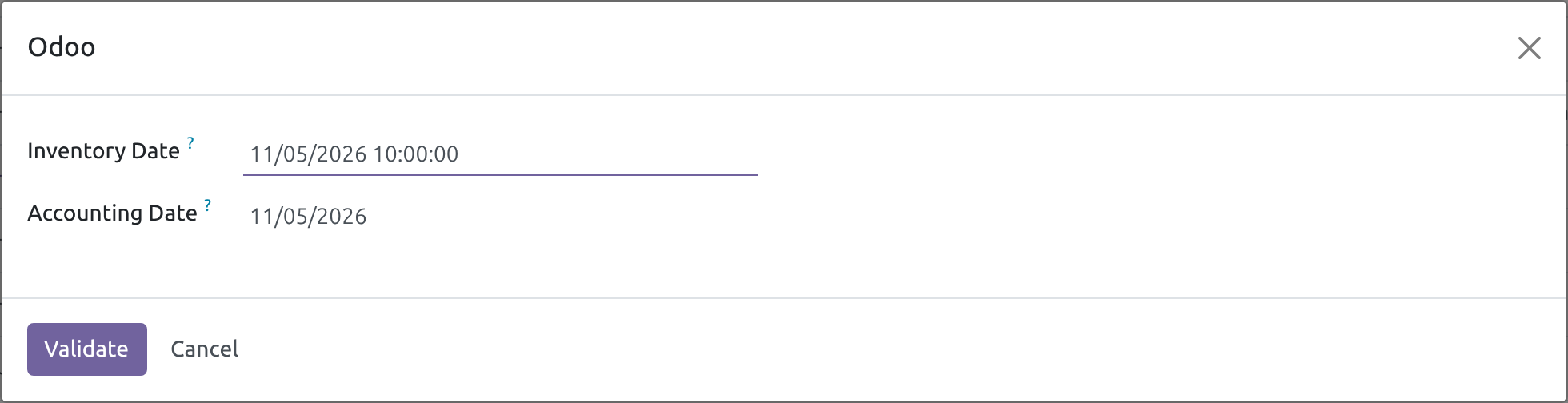
→ The back-date dialog of an inventory adjustment gets an Accounting Date. It starts on the day of the inventory date, and a future date is refused.
Valuation and journal entries follow the date entered
A receipt, delivery or scrap entered with a past date still gets a valuation line dated today, so last month's stock shows in this month.
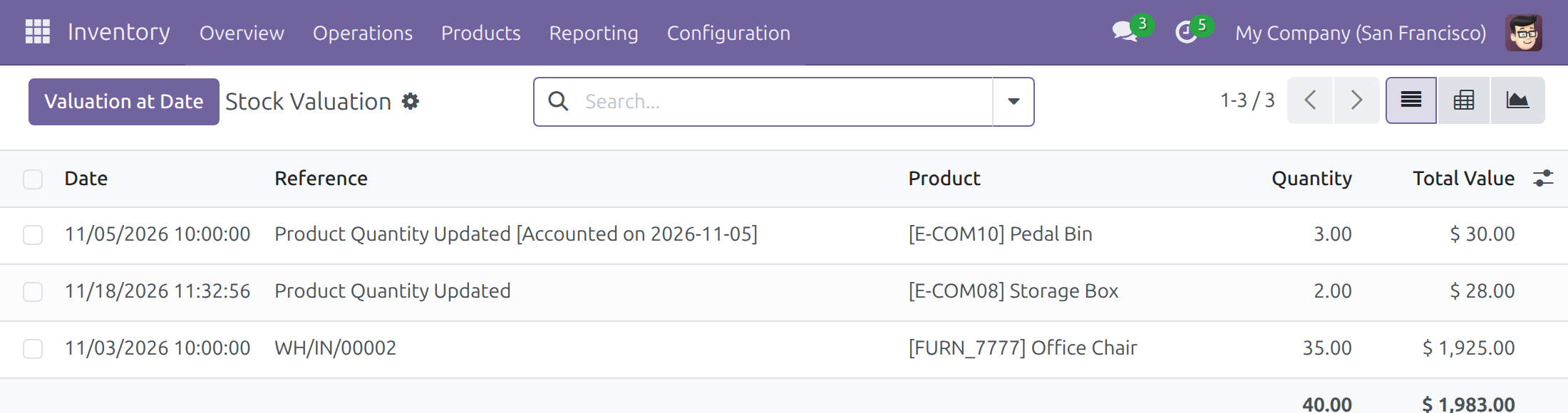
→ The valuation line carries the date that was entered. For products with automatic stock valuation, the journal entry is dated in the same period. Nothing to configure: the module installs itself when Inventory Backdate and stock accounting are both present.
The real recording moment stays on record
Once a line is back-dated, its creation time shows the past date, not the moment it was entered.
→ Each valuation line also stores the date and time it was really created. Lines that exist when the module is installed get it too.
Features
Dating the valuation
- ✓ Valuation lines of back-dated transfers, adjustments and scraps dated in the past
- ✓ Journal entries dated in the past with automatic stock valuation
- ✓ The real creation time of each valuation line kept
Inventory adjustments
- ✓ A separate accounting date in the back-date dialog
- ✓ Left empty, the day of the inventory date applies
- ✓ An accounting date in the future is refused
- ✓ The valuation reference shows the date it was accounted on
Control and exit
- ✓ Only members of the stock back-date group can back-date
- ✓ Installs itself with Inventory Backdate and stock accounting
- ✓ Uninstalling keeps every valuation figure and journal entry
Before you decide
Should we keep it installed after go-live?
No. It is meant for entering past stock data during the initial deployment. Uninstall the back-date modules when that is done; they can be installed again if the need returns.
What do we lose when we uninstall?
No valuation figure and no journal entry: every valuation line keeps its date and its value. The accounting date of the dialog goes, and so does the technical column that stored the real creation time of each valuation line.
Who can post into a past period?
Only members of the stock back-date group. Trust is per person: a member can back-date in every application they work in, not only Inventory. This module adds no group of its own.
Why is a journal entry not dated in the past?
Journal entries are created for products with automatic stock valuation only. With manual valuation, the valuation line carries the past date and no entry is posted.
Can the accounting date be later than today?
No. The dialog refuses it with a message.
Try it, then ask us
The Documentation tab holds the guide for administrators, data-entry staff and accountants. The live preview of this listing opens the stock valuation list on a demo database.
Pre-sales & partnership
viindoo.com/contactusTechnical support
viindoo.com/ticketStock Account Backdate
For administrators who set up back-dating, for the warehouse people they trust to enter past stock operations, and for the accountants who check the result.
Stock Account Backdate makes the stock valuation and the accounting side of a back-dated stock operation follow the date that was entered. Without it, the valuation line and the journal entry of an operation recorded on a past date would still carry the day it was recorded.
Note
Extends Inventory Backdate - see its documentation - and Backdate Operations Access Rights - see its documentation. The second guide covers the cluster as a whole, including the steps to uninstall it.
Purpose and life cycle
Back-dating is a discouraged operation. A stock operation recorded on a past date was not recorded when the work happened, so routine use weakens the reliability of the stock valuation and of the books.
This module exists for one situation: the initial deployment, when a company enters its past stock data (for example last month's receipts and deliveries, or the opening counts of a date before go-live) and wants the valuation and the journal entries to carry the real dates. When that work is done, the administrator uninstalls the back-date modules from Apps. They can be installed again later if the need returns.
Do not keep the module installed for day-to-day warehouse work, and do not grant the back-date group as a convenience.
What is removed by the uninstall and what stays is listed in When the data entry is done. The steps are in the guide of Backdate Operations Access Rights.
What it adds
- Valuation lines dated in the past. In Inventory > Reporting > Valuation, the Date of the line of a back-dated operation is the date you entered.
- Journal entries dated in the past. For products with automatic stock valuation, the journal entries of a back-dated operation carry the same date. The three valuation methods of the application are supported: standard price, average price and FIFO.
- An accounting date for inventory adjustments. The back-date dialog of an inventory adjustment gets a second field, Accounting Date.
Who can back-date
Back-dating stock operations is a right granted to a person through the group Stock Backdate Operations, described in the guide of Inventory Backdate. This module adds no group of its own.
Important
Trust is granted per person. Being a member of a back-date group lets that person back-date in every application where they can work, not only in Inventory. Give the group only to people you would trust with a past date in any document.
Setup (for the Administrator)
- Open Apps and install Inventory Backdate. Stock Account Backdate is installed automatically as soon as Inventory Backdate and the accounting side of Inventory are both installed; there is nothing to configure.
- Add the people who enter the past data to the group Stock Backdate Operations; the steps are in the guide of Inventory Backdate.
- Remove them from the group when their data entry is done.
Apply an inventory adjustment with an accounting date
- Open Inventory > Operations > Adjustments > Physical Inventory.
- Enter the counted quantity of a line, then click Apply.
- In the dialog, enter the date of the count in Inventory Date. Accounting Date takes the day of Inventory Date; change it if the journal entry must be dated differently.
- Click Validate.
The adjustment moves carry the inventory date and the valuation lines carry the same date. With automatic stock valuation, the journal entries are dated on the accounting date.
If you clear Accounting Date, the day of Inventory Date is used. An accounting date in the future is refused with the message "You may not be able to specify an accounting date in the future!".
Receipts, deliveries and scraps
For a transfer or a scrap validated on a past date, the dialog is the one of Inventory Backdate and has no accounting date: the valuation line and the journal entry follow the date you enter. The steps are in the guide of Inventory Backdate.
Check the valuation
Open Inventory > Reporting > Valuation. The Date column shows the date entered for each back-dated operation, not the day it was recorded. The Reference of a line created by an inventory adjustment with an accounting date ends with [Accounted on <date>].
When the data entry is done
Uninstalling the back-date modules (see the guide of Backdate Operations Access Rights) keeps every valuation line with its date and its figures, and every journal entry. It removes the field Accounting Date of the back-date dialog, and one technical column of the valuation lines: the column that stored the real date and time at which each line was created, before that date was replaced by the back-date. Nothing else is removed; no valuation figure changes.
FAQ
- The dialog of an inventory adjustment shows no Accounting Date.
- The module is not installed. It is installed automatically when Inventory Backdate and the accounting side of Inventory are installed together.
- The journal entry of a back-dated operation is not dated in the past.
- Journal entries are created for products with automatic stock valuation only. Check the valuation of the product category.
- Can the accounting date be later than today?
- No. The dialog refuses it.
This software and associated files (the "Software") may only be used (executed, modified, executed after modifications) if you have purchased a valid license from the authors, typically via Odoo Apps, or if you have received a written agreement from the authors of the Software (see the COPYRIGHT file).
You may develop Odoo modules that use the Software as a library (typically by depending on it, importing it and using its resources), but without copying any source code or material from the Software. You may distribute those modules under the license of your choice, provided that this license is compatible with the terms of the Odoo Proprietary License (For example: LGPL, MIT, or proprietary licenses similar to this one).
It is forbidden to publish, distribute, sublicense, or sell copies of the Software or modified copies of the Software.
The above copyright notice and this permission notice must be included in all copies or substantial portions of the Software.
THE SOFTWARE IS PROVIDED "AS IS", WITHOUT WARRANTY OF ANY KIND, EXPRESS OR IMPLIED, INCLUDING BUT NOT LIMITED TO THE WARRANTIES OF MERCHANTABILITY, FITNESS FOR A PARTICULAR PURPOSE AND NONINFRINGEMENT. IN NO EVENT SHALL THE AUTHORS OR COPYRIGHT HOLDERS BE LIABLE FOR ANY CLAIM, DAMAGES OR OTHER LIABILITY, WHETHER IN AN ACTION OF CONTRACT, TORT OR OTHERWISE, ARISING FROM, OUT OF OR IN CONNECTION WITH THE SOFTWARE OR THE USE OR OTHER DEALINGS IN THE SOFTWARE.