
Backdate Operations Access Rights
| Lines of Code | 457 |
| Technical name | to_backdate |
| License | OPL-1 |
| Website | https://viindoo.com/apps/modules/18.0/to_backdate?force_show=1 |
| Read description for | v 11.0 v 12.0 v 13.0 v 14.0 v 15.0 v 16.0 v 17.0 v 19.0 |
| Extensions | Inventory Backdate Purchase Confirmation Backdate Sales Confirmation Backdate Equipment Working Frequency - Backdate |
Enter your past data on the dates it happened, under your control
For administrators and consultants bringing a company's history into Odoo during the initial deployment
The permission behind every back-dated document
Odoo Community · Odoo Enterprise · OPL-1 · English, Vietnamese
Purpose and life cycle
Back-dating is a discouraged operation. A document recorded on a past date is not recorded when the work happened, so routine use weakens the reliability of the books.
This module and the back-date modules built on it serve one situation: the initial deployment, when a company enters its past data, for example last month's stock transfers, sales orders and purchase orders. When that work is done, the administrator uninstalls this module, which removes exactly the modules of the cluster. The cluster can be installed again later if the need returns.
Keep it for the data entry, not for day-to-day work, and grant back-date access only to the people who do that entry.
What changes for your team
Past operations carry their real date
Without it, last month's orders and transfers entered today are dated today, and so is everything they produce.
→ A dialog asks for the date and time the operation was done. Stock moves, journal entries and date-based document numbers follow it; a future date is refused.

You choose who may enter a past date
Without a rule, anyone who can confirm a document could also choose its date.
→ Only members of a back-date group can. Trust is per person: a member can back-date in every application they work in.
A clean exit once the history is in
A temporary tool must not stay behind as a permanent back door.
→ Uninstalling this module removes the whole cluster and deletes no recorded document.

Features
Entering past data
- ✓ One date field, starting at the current date and time
- ✓ The operation is recorded at the date you choose
- ✓ Stock moves, journal entries and date-based numbering follow that date
- ✓ A date in the future is refused
Who may back-date
- ✓ One back-date group each for stock, sales, purchase and manufacturing
- ✓ A member can back-date in every application they work in
- ✓ Non-members are refused, with a message telling them whom to ask
- ✓ When one person requests and another processes, the requester's right counts
Ending the data entry
- ✓ One uninstall removes exactly the modules of the cluster
- ✓ Documents keep their dates; valuation, entries and assets stay
- ✓ Users keep their application access rights
- ✓ Back-date groups and dialogs go; reinstall and grant again if needed
Ready on day one
The back-date dialog
Each installed application of the cluster offers it on its recording action, to members of its back-date group only. This module alone adds no menu and no screen.
First step for the administrator
Add the people who enter past data to the back-date group, and remove them when their entry is done. The guide in the Documentation tab shows where.
The modules that record past dates
Inventory Backdate
Records stock operations on the date they happened. With Stock Account Backdate, valuation and journal entries follow the date; Manufacturing Backdate builds on it for manufacturing orders and work orders.
Sales Confirmation Backdate
Confirms a sales order on the date it was actually agreed.
Purchase Confirmation Backdate
Confirms a purchase order on the date it was actually agreed.
Before you decide
Does this module work on its own?
No. It holds the shared dialog and the access rule. The dialogs and the back-date groups come from the application modules above; installing any of them installs this one.
Should we keep it installed after go-live?
No. Back-dating is meant for entering past data during the initial deployment. Uninstall the cluster when that is done; it can be installed again if the need returns.
Can I allow back-dating in Sales only?
No. A back-date group applies in every application where its member can work. Give it only to people you trust with a past date on any document.
What do we lose when we uninstall?
No recorded document. The back-date groups and their membership go, with the dialogs and one technical column that stored the original creation date of a stock valuation layer; every valuation figure stays.
What about operations from an integration or a scheduled action?
The right of the person who requested the operation is checked. An operation with no requesting person is checked against the current user.
Try it, then ask us
The Documentation tab holds the guide for administrators and data-entry staff. The live preview of this listing opens the user groups on a demo database.
Pre-sales & partnership
viindoo.com/contactusTechnical support
viindoo.com/ticketBackdate Operations Access Rights
For administrators who set up back-dating, and for the people they trust to use it.
Backdate Operations Access Rights is the foundation of the back-date cluster, the set of applications that let a trusted person record an operation on a date in the past. On its own it adds no menu and no screen: it provides the shared back-date dialog and the rule that decides who may use it. The back-date groups and the dialogs of each application come from the other modules of the cluster.
Purpose and life cycle
Back-dating is a discouraged operation. A document recorded on a past date is, by definition, not recorded when the work happened, so routine use weakens the reliability of the books.
The cluster exists for one situation: the initial deployment, when a company enters its past data (for example last month's stock transfers, sales orders and purchase orders) into the system. When that work is done, the administrator uninstalls the cluster (see Uninstalling the cluster). The cluster can be installed again later if the need returns.
Do not keep the cluster installed for day-to-day work, and do not grant back-date access as a convenience.
The cluster
The cluster is made of the modules below. Each one has its own guide.
| Module | What it adds |
|---|---|
| Backdate Operations Access Rights | This base module: the shared dialog and the access rule |
| Inventory Backdate | Back-dated stock operations and the group "Stock Backdate Operations" |
| Stock Account Backdate | Valuation and journal entries that follow the back-date of a stock operation |
| Sales Confirmation Backdate | Back-dated sales order confirmation and the group "Sale Backdate Operations" |
| Purchase Confirmation Backdate | Back-dated purchase order confirmation and the group "Purchase Backdate Operations" |
| Manufacturing Backdate | Back-dated manufacturing orders and work orders and the group "Mrp Backdate Operations" |
When both the stock back-date module and the "assets from stock" module are installed, a small bridge module of the cluster is installed with them, so that an asset generated from a back-dated asset issue carries the back-date.
Who can back-date
Back-dating is a right granted to a person through one of the four back-date groups:
| Group | Lets its members |
|---|---|
| Stock Backdate Operations | Record stock operations dated in the past |
| Sale Backdate Operations | Confirm sales orders dated in the past |
| Purchase Backdate Operations | Confirm purchase orders dated in the past |
| Mrp Backdate Operations | Record manufacturing operations dated in the past |
Important
Trust is granted per person. Being a member of any back-date group lets that person back-date in every application where they can work, not only in the application the group is named after. Give a back-date group only to people you would trust with a past date in any document.
A person who is not a member of a back-date group cannot record an operation on a past date. When they try, the system refuses with the message "<user> is not allowed to record an operation at a past date. Ask an administrator to add this user to the back-date group of the application."
When an operation is requested by one person and processed by another (for example through an integration), the right of the person who requested it is the one that counts. An operation with no requesting person, such as a scheduled action, is checked against the current user.
Setup (for the Administrator)
Open Apps, search for the back-date modules you need and click Install. Installing a module of the cluster installs this base module with it.
Activate the developer mode, then open Settings > Users & Companies > Groups.
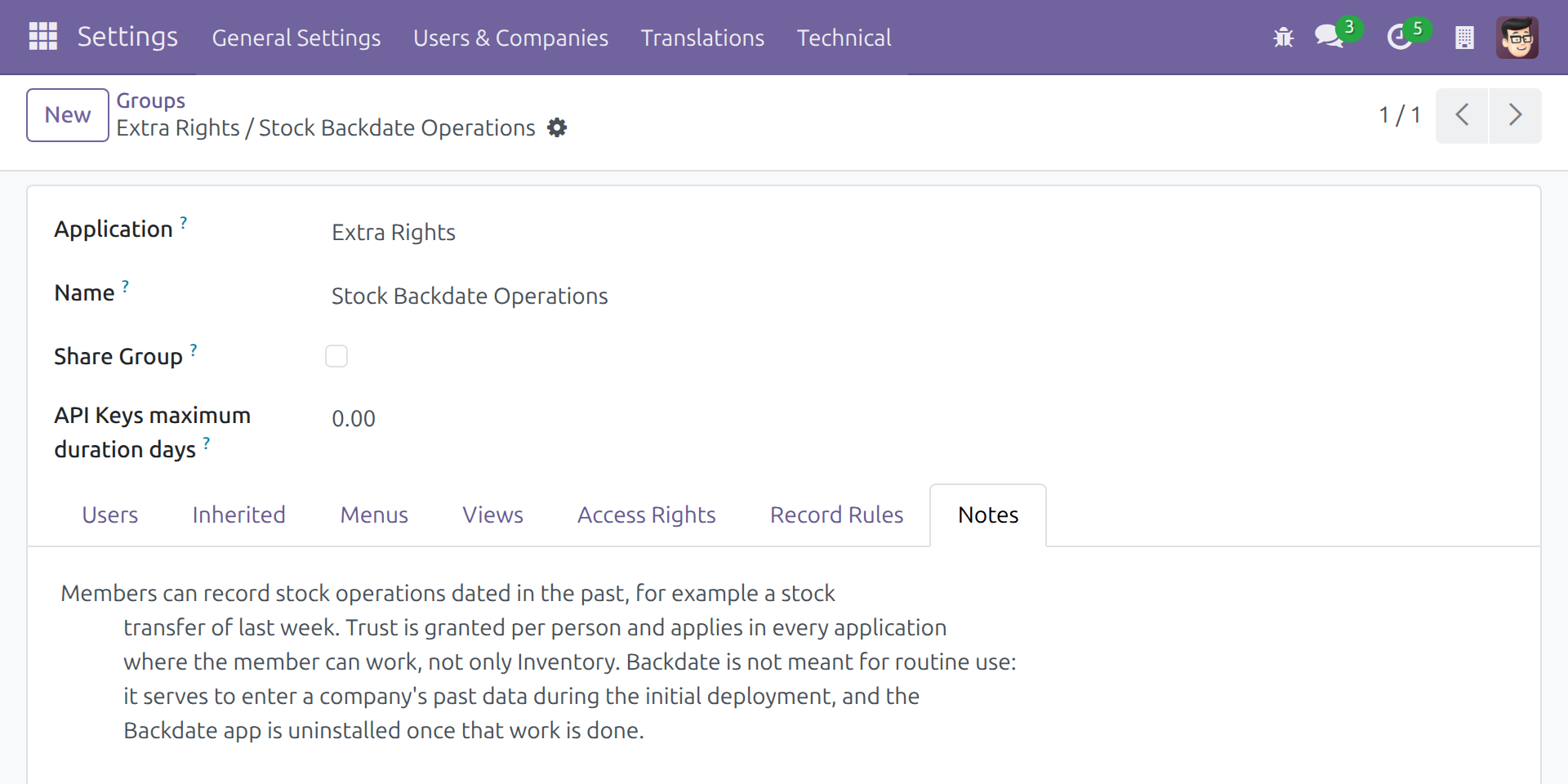
Open the back-date group you need, for example Extra Rights / Stock Backdate Operations. The Notes tab states what the members can do.
In the Users tab, add the people who enter the past data.
Remove the people from the group when their data entry is done.
Using the back-date dialog
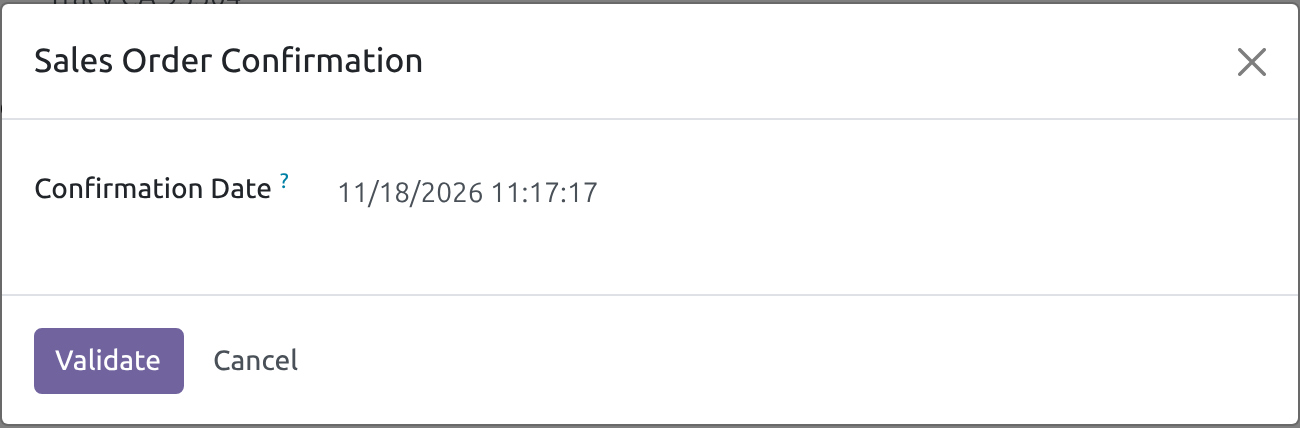
In an application of the cluster, the action that records an operation (for example confirming a sales order or a purchase order) opens a back-date dialog for members of the back-date group of that application. The dialog carries the name of the operation, for example Sales Order Confirmation, and holds one date field, for example Confirmation Date:
- The date field
- The date and time at which the operation was actually done. It starts at the current date and time and is required.
Click Validate to record the operation at that date, or Cancel to close the dialog without recording anything.
A date in the future is refused: the system answers "You may not be able to specify a date in the future!" and the operation is not recorded.
The date you choose is carried to everything the operation produces: the dates of the stock moves, the journal entries and the document numbers that depend on a date range follow it.
Uninstalling the cluster
When the initial data entry is done:
Open Apps, remove the Apps filter and search for Backdate Operations Access Rights.
On its card, open the menu and click Uninstall. The Uninstall module dialog lists, under Apps to Uninstall, the modules that will be removed. Tick Show All: the list shows this module and every module of the cluster that is installed.
Confirm with Uninstall; Discard closes the dialog and keeps everything. Uninstalling this module removes exactly the modules listed.
The list Documents to Delete of the dialog is empty: no recorded document is deleted.
What stays:
- Every document you recorded, with its dates.
- Stock valuation and journal entries.
- Assets.
- The application groups of every user (for example Inventory or Sales access): users keep their access to the applications.
What goes:
- The four back-date groups, and with them the back-date membership of every person.
- The back-date dialogs.
- One technical column of the stock valuation layers, which stored the original creation date of a layer before it was overwritten by the back-date. Every valuation figure stays.
To use back-dating again later, install the modules of the cluster again and grant the back-date groups to the people again: the membership is not kept.
FAQ
- A user cannot confirm a document on a past date although they work in that application.
- Working in an application does not give the right. Add the user to the back-date group, for example Sale Backdate Operations for a sales order, then ask them to try again.
- Can I give a user back-date access for the Sales application only?
- No. A back-date group applies in every application where its member can work.
- Can the date be later than today?
- No. The dialog accepts only the current date and time or a past one.
This software and associated files (the "Software") may only be used (executed, modified, executed after modifications) if you have purchased a valid license from the authors, typically via Odoo Apps, or if you have received a written agreement from the authors of the Software (see the COPYRIGHT file).
You may develop Odoo modules that use the Software as a library (typically by depending on it, importing it and using its resources), but without copying any source code or material from the Software. You may distribute those modules under the license of your choice, provided that this license is compatible with the terms of the Odoo Proprietary License (For example: LGPL, MIT, or proprietary licenses similar to this one).
It is forbidden to publish, distribute, sublicense, or sell copies of the Software or modified copies of the Software.
The above copyright notice and this permission notice must be included in all copies or substantial portions of the Software.
THE SOFTWARE IS PROVIDED "AS IS", WITHOUT WARRANTY OF ANY KIND, EXPRESS OR IMPLIED, INCLUDING BUT NOT LIMITED TO THE WARRANTIES OF MERCHANTABILITY, FITNESS FOR A PARTICULAR PURPOSE AND NONINFRINGEMENT. IN NO EVENT SHALL THE AUTHORS OR COPYRIGHT HOLDERS BE LIABLE FOR ANY CLAIM, DAMAGES OR OTHER LIABILITY, WHETHER IN AN ACTION OF CONTRACT, TORT OR OTHERWISE, ARISING FROM, OUT OF OR IN CONNECTION WITH THE SOFTWARE OR THE USE OR OTHER DEALINGS IN THE SOFTWARE.