
Multi-Warehouse Access Control - Manufacturing
| Lines of Code | 615 |
| Technical name | viin_multi_warehouse_access_control_mrp |
| License | OPL-1 |
| Website | https://viindoo.com/apps/modules/19.0/viin_multi_warehouse_access_control_mrp |
| Read description for | v 10.0 v 11.0 v 12.0 v 13.0 v 14.0 v 15.0 v 16.0 v 17.0 v 18.0 |
| Required Apps | Manufacturing (mrp) Invoicing (account) Discuss (mail) Inventory (stock) |
| Included Dependencies | Multi Warehouse Access Control Viindoo Base Viin Warehouse Viin Warehouse Accounting |

Each warehouse sees the production it serves, and each plant runs only its own orders
For manufacturers that run several warehouses or plants from one database
Limit manufacturing orders to the warehouses people are assigned to.

Odoo Community and Odoo Enterprise · Odoo Proprietary License v1.0 (OPL-1) · English, Vietnamese
Builds on Multi Warehouse Access Control: the access levels and the people listed on each warehouse come from there.
What changes for your team
Warehouse staff know what production needs from them
Today, an operator without the Manufacturing app sees no manufacturing order, and learns about components to prepare or space to free when someone asks.
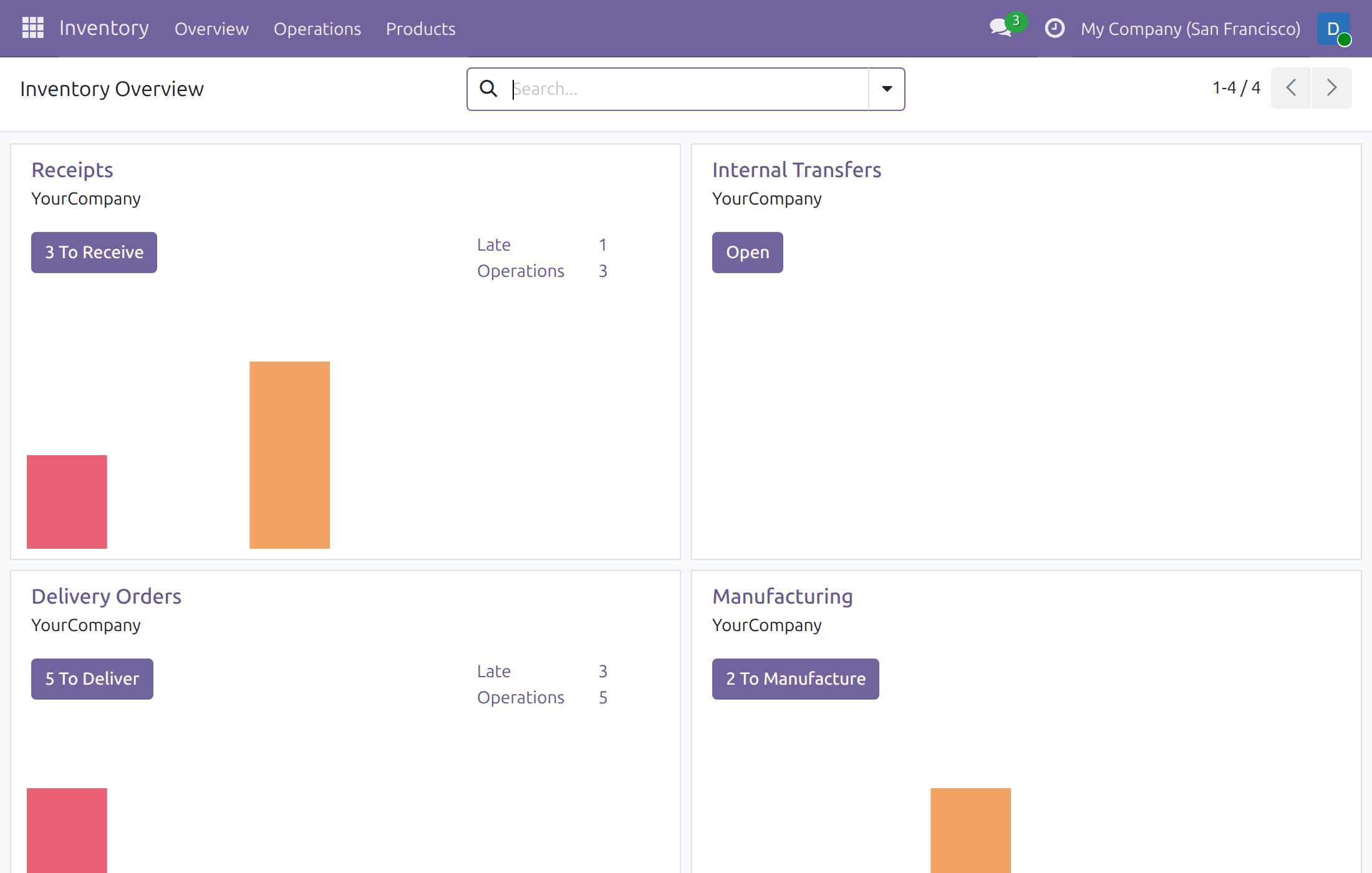
→ From the Inventory overview, they read the orders of their own warehouses, with components, availability and work orders, and no manufacturing right.
Production decisions stay with production
Today, giving warehouse staff a manufacturing role so they can see orders also lets them confirm, start, scrap or cancel them.
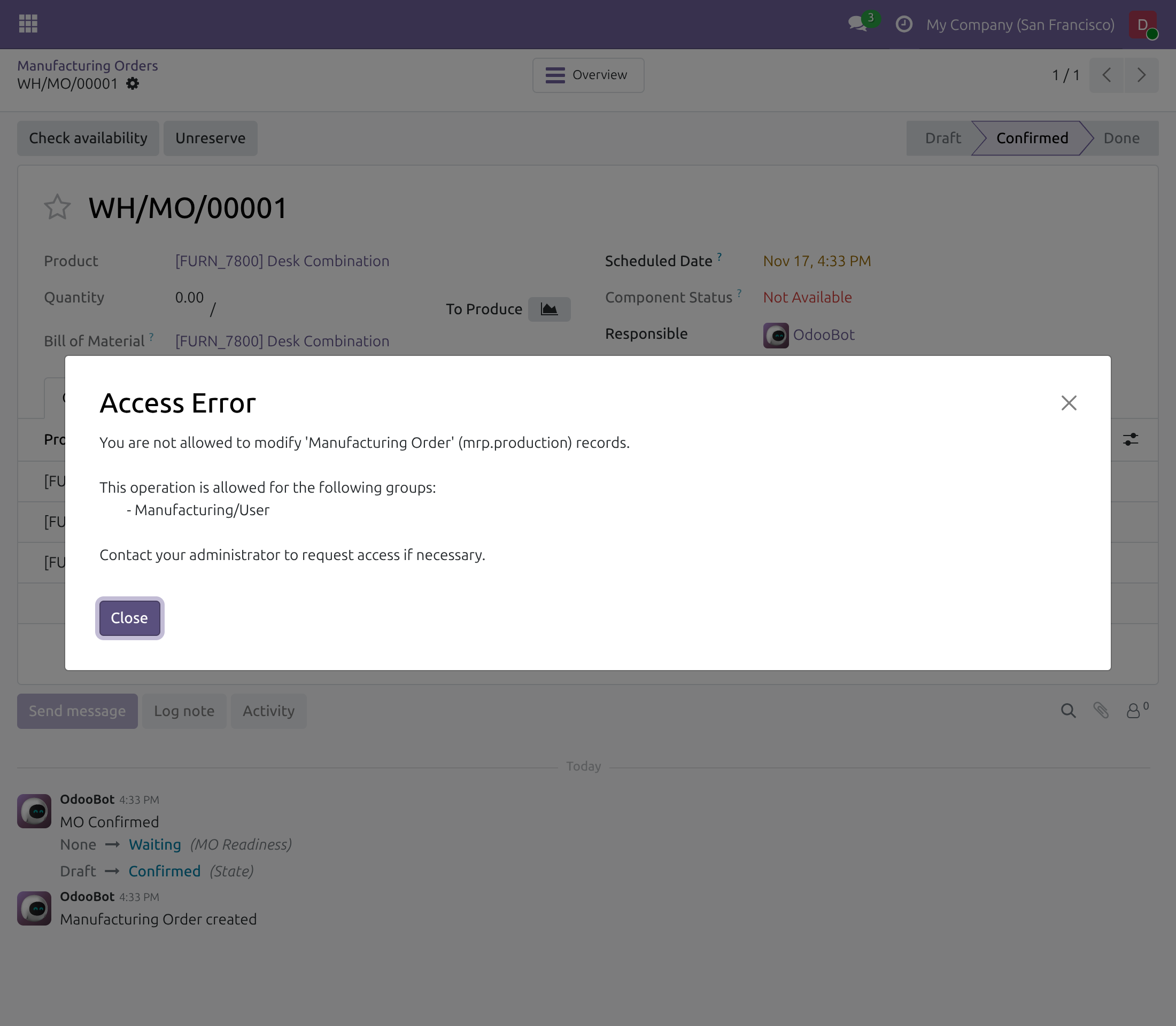
→ Warehouse roles reserve and release components; the controls that move an order along are not offered to them, and a scrap or any other change is refused.
Each plant runs its own orders
Today, a Manufacturing user reaches the orders and stock documents of every warehouse.
→ Production staff create, run and close the orders and work orders of the warehouses they are listed on, and a new order starts in one of those warehouses.

Features
Preparing for production
- ✓ Manufacturing orders of their warehouses, without the Manufacturing app
- ✓ Reached from the Manufacturing card of the Inventory overview
- ✓ Bills of materials, work orders and work centers, read-only
- ✓ Check availability and Unreserve stay with warehouse staff
- ✓ Print an order and its labels
- ✓ Serial and lot list of a move, even when partly from another warehouse
Running production by warehouse
- ✓ Production staff work only on the orders of their warehouses
- ✓ Changes to work orders follow the same warehouse limits
- ✓ A new order takes an operation type of their own warehouse
- ✓ Manufacturing users keep stock access limited to their warehouses
Keeping order data with production
- ✓ Confirm, plan, start, produce and cancel: not offered to warehouse roles
- ✓ A scrap or other change by a warehouse role is refused
- ✓ Subcontracting orders follow the rights on their receipt
- ✓ All Warehouses users read every order, whatever the warehouse
Built for daily use
- ✓ The server applies the limits to every list, form and export
- ✓ Warehouse roles cannot create or delete any manufacturing record
- ✓ Installs by itself when Manufacturing and the base module are present
- ✓ Uninstalling restores the default Manufacturing user level
Ready on day one
Rules in place at install
Read access by warehouse and the production-only controls work as soon as the module is installed.
Nothing to set in Manufacturing
Each order follows the warehouses of its components and finished-products locations.
What the administrator sets first
An Inventory and a Manufacturing level for each person, and the accessing users of each warehouse.
Before you decide
Do warehouse staff need the Manufacturing app?
No. Any Inventory level, from Users: Own Documents up, reads the orders of the person's warehouses from the Inventory app.
Which orders does a person see?
An order whose components or finished-products location belongs to a warehouse that lists the person as an accessing user, or lists nobody. All Warehouses users see every order.
Can warehouse staff change an order?
They reserve and release its components. Every other change needs Manufacturing: User, for that person's warehouses. The exception is a subcontracting order, which follows the rights on its receipt.
What is not limited by warehouse?
Reading work orders, unbuild orders and work center productivity. Subcontracting orders sit in locations of no warehouse, so every Inventory level reads them; on another warehouse's subcontracting order, Cancel is shown and then refused.
What does it take to run, or to remove?
No Python package or system program beyond Odoo, and no outside service: data stays in your database. Uninstalling returns the Manufacturing user level to the access Manufacturing gives by default.
Try it, then ask us
Open the live demo of this listing to see the manufacturing orders, and read the Documentation tab for each role.
Pre-sales & partnership
viindoo.com/contactusTechnical support
viindoo.com/ticketMulti-Warehouse Access Control - Manufacturing
Who this guide is for: Inventory administrators who give people access to manufacturing orders by warehouse, the warehouse operators and managers who read those orders, and the production staff who run them.
Note
Extends Multi Warehouse Access Control - see its documentation for the Inventory access levels and for listing the people who work in a warehouse.
Overview
Warehouse staff need to know what production will consume and deliver: which components to prepare, how much storage to free for finished products. Without the Manufacturing app they see none of it. Production staff, on the other hand, reach the orders and stock documents of every warehouse by default.
This module brings the warehouse lists of Multi Warehouse Access Control into manufacturing:
- People with an Inventory level read the manufacturing orders of their own warehouses, without any Manufacturing right.
- Production staff create, change and close only the orders of the warehouses they are listed on.
- A new order takes an operation type the person is allowed to use.
| Role | What they do | Access right to assign |
|---|---|---|
| Inventory administrator | Gives each person an Inventory level and a Manufacturing level, and lists the accessing users of each warehouse. | Inventory: Administrator |
| Warehouse operator | Reads the manufacturing orders of the assigned warehouses to prepare components and storage. | Inventory: Users: Own Documents |
| Warehouse manager | Reads the manufacturing orders of the assigned warehouses, like an operator. | Inventory: Warehouse Manager |
| Production operator | Creates, changes and closes the manufacturing orders and work orders of the assigned warehouses. | Manufacturing: User |
| Logistics coordinator | Reads every manufacturing order, whichever warehouse it belongs to; with Manufacturing: User, also changes them. | Inventory: All Warehouses User |
An order belongs to a warehouse through its two locations, Components Location and Finished Products Location. A person sees the order when at least one of them is open (its warehouse lists nobody) or lists the person. A warehouse whose Accessing Users list is empty is open to everyone who holds an Inventory level.
Setup (for the Inventory administrator)
Install the module
- Open Apps.
- Search for Multi-Warehouse Access Control - Manufacturing.
- Press Install. It is installed together with Manufacturing and Multi Warehouse Access Control when both are present.
Give each person their levels
- Open Settings > Users & Companies > Users and select the person.
- On the Access Rights tab, in the Supply Chain section, set Manufacturing to User for production staff, and Inventory to Users: Own Documents or Warehouse Manager for warehouse staff.
- Save.
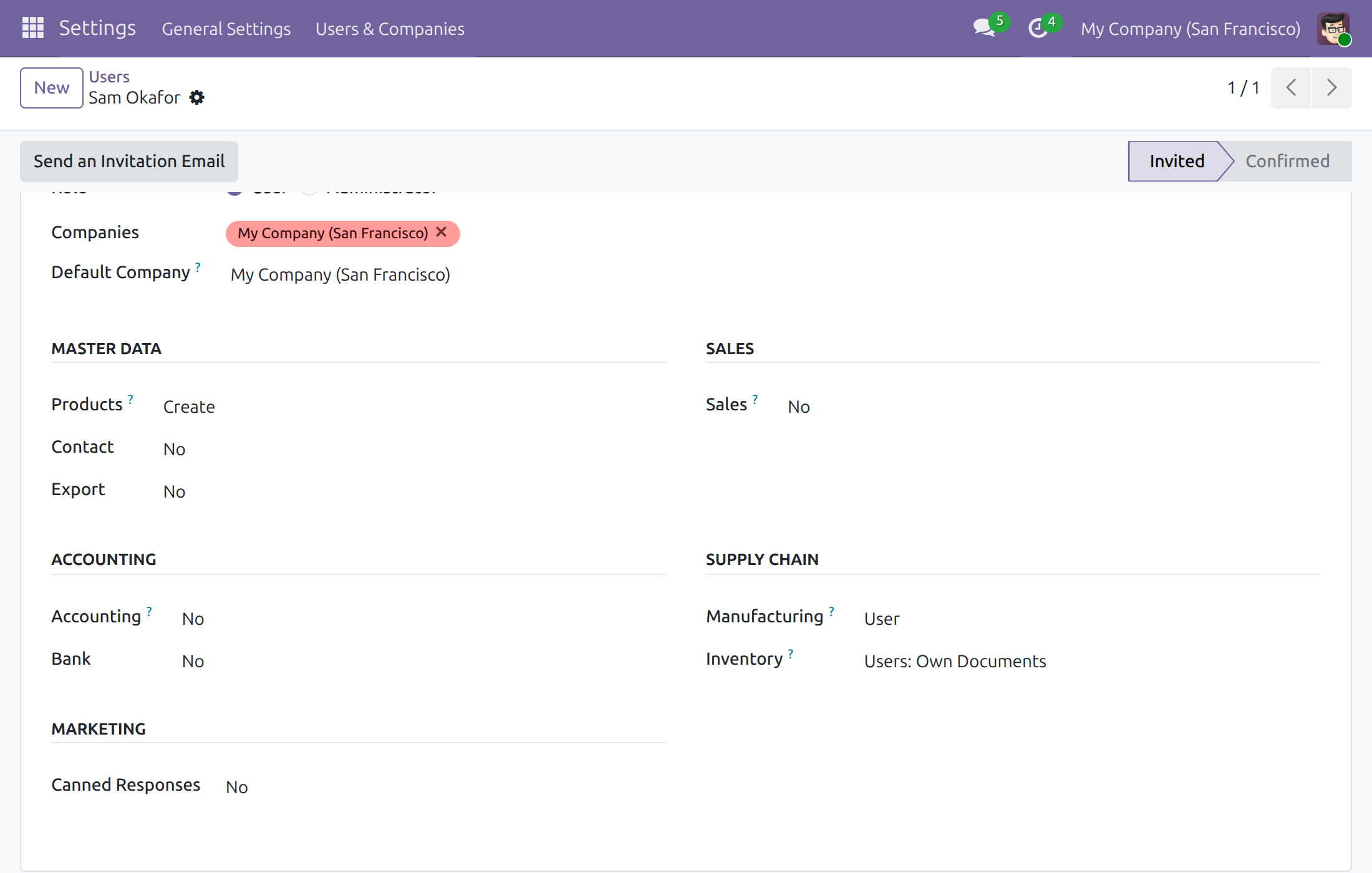
A person with Manufacturing: User also holds Users: Own Documents in Inventory. The module does not give them the all-warehouses Inventory level, so their stock documents stay limited to their warehouses too.
List the people who work in a warehouse
Open Inventory > Configuration > Warehouses, select the warehouse and add the people to Accessing Users, as described in the guide of Multi Warehouse Access Control. Nothing else is configured for manufacturing: the orders of the warehouse follow that list.
Warehouse operator and manager: read the orders of my warehouse
Operators and managers do not need the Manufacturing app. They reach the orders from the Inventory app.
Find the orders
- Open Inventory > Overview. The Manufacturing card shows only the warehouses you are listed on, or that list nobody.
- Select the button of the card, for example To Manufacture, to open the list of manufacturing orders.
- Remove the filter in the search bar to see all the orders of your warehouses.
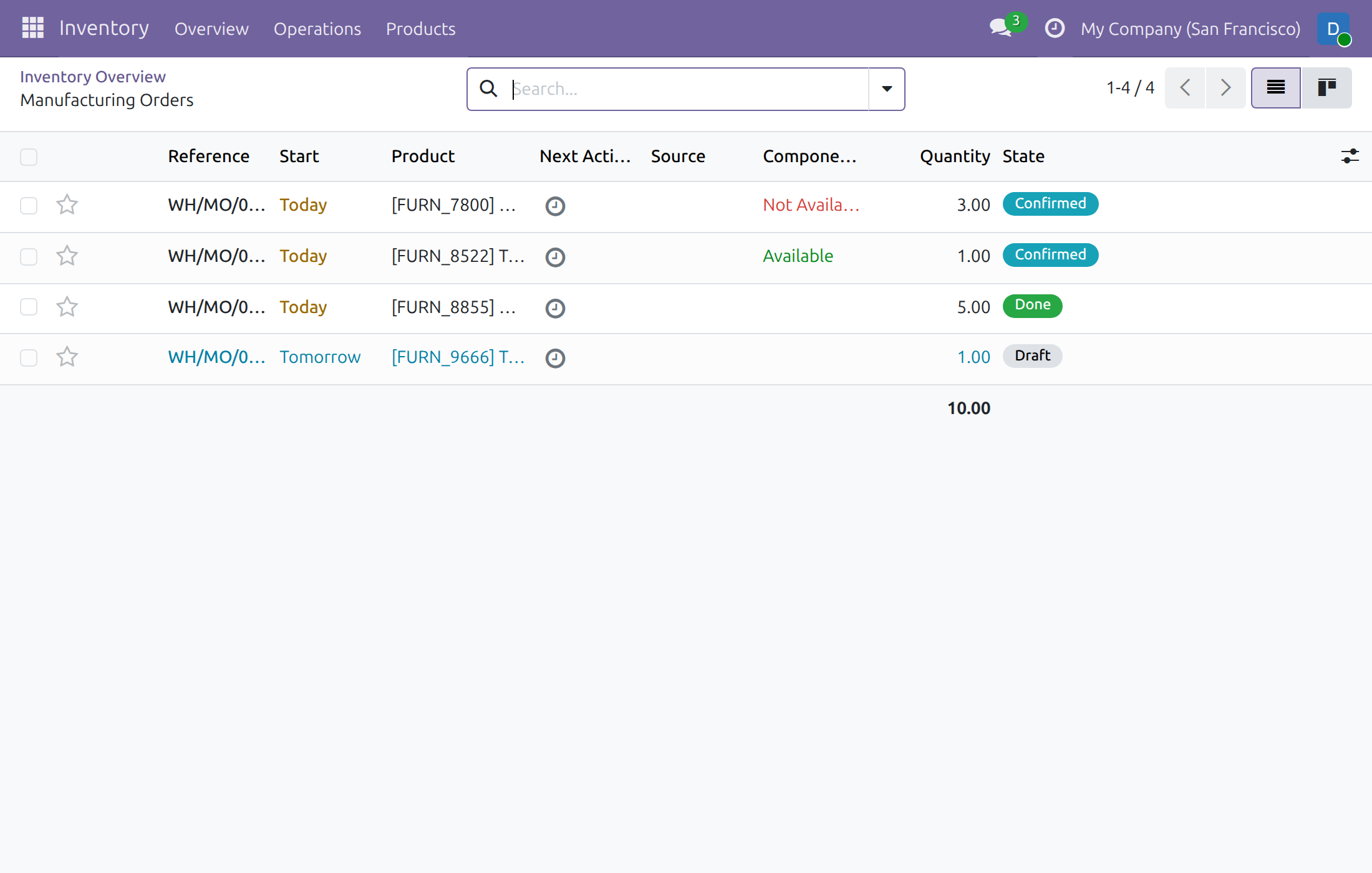
Orders of a warehouse that lists other people, and not you, are not in the list, and opening one by its link shows an access error.
Read an order
Open an order to see the product, the quantity, the Components with their availability, the Work Orders and the Miscellaneous tab with the operation type and the two locations. Use it to prepare the components and the storage for the finished products.
The access is read-only:
- The header offers only Check availability and Unreserve, which reserve and release the components: stock work that warehouse roles do. The buttons that move an order along, such as Confirm, Plan, Start, Produce All and Cancel, and the start, pause and finish controls of work orders are not offered.
- The Actions menu offers Print, with the labels of the order, and Scrap.
- Scrap is refused: it ends with an access message that names the right needed, Manufacturing/User.
- Operators and managers cannot create or delete any manufacturing record.
Besides the orders, they read the bills of materials and their lines, the work orders, the work centers, the unbuild orders and the work center productivity records.
Serial and lot numbers of a move
When you open a stock move, you read its list of serial and lot numbers, even when some of its detailed operations are taken from a warehouse you cannot access.
Subcontracting receipts
Where the Subcontracting app is installed, an operator or a manager who may change the receipt of a subcontractor also handles the subcontracting order that the receipt creates. Cancelling the receipt cancels its order, and the Cancel button of the order and Scrap in its Actions menu are offered to them. The same actions on the order of another warehouse's receipt are refused.
Production operator: run the orders of my warehouses
A person with Manufacturing: User works in the Manufacturing app, and sees the orders of the warehouses they are listed on, or that list nobody.
Work on the orders
- Open Manufacturing > Operations > Manufacturing Orders. The list holds only the orders of your warehouses.
- Create, confirm, change, produce, scrap and close an order as usual, or cancel and delete a draft one.
- Work on its work orders in the same way.

The orders of a warehouse you are not listed on cannot be opened, changed, cancelled or deleted, and you cannot create an order for it. A person with Manufacturing: Administrator is limited in the same way.
Create an order
- Press New and choose the Product.
- Open the Miscellaneous tab. The Operation Type is one of the warehouses you work in, with its Components Location and Finished Products Location.
The operation type comes first from the screen you started from, then from the saved order, else the first manufacturing operation type of the company that you may read. When the bill of materials points to an operation type of a warehouse you do not work in, it gives way to one of yours.
Logistics coordinator: every order
A person with Inventory: All Warehouses User reads every manufacturing order, whatever the Accessing Users lists say. When the person also holds Manufacturing: User, they change, create and delete orders and work orders in every warehouse. Give this level to people who coordinate several warehouses.
Known limits
- Manufacturing orders are limited by warehouse. Reading the work orders, the unbuild orders and the work center productivity records is not limited by warehouse.
- On the form of a subcontracting order, Cancel is shown to warehouse roles whichever warehouse the order belongs to; for an order of another warehouse it is refused when pressed.
- Orders of a subcontractor are made in locations that belong to no warehouse. They are open to everyone who holds an Inventory level, and their warehouse comes from the receipt: changes follow the rights on that receipt.
Troubleshooting
- An operator sees no manufacturing order
- Both locations of the order belong to warehouses that list people, and the operator is not among them. Add the operator to Accessing Users of the warehouse, or give All Warehouses User.
- An operator presses Scrap and gets an access message
- This is by design. Warehouse roles read the orders; production staff with Manufacturing: User change them.
- An operator does not see Confirm, Plan, Start, Produce All or Cancel
- This is by design: those controls are offered only to people who may use them. Give the person Manufacturing: User to work on the orders of their warehouses.
- A production operator cannot open an order
- The order belongs to a warehouse that does not list the person. Add the person to Accessing Users of that warehouse.
- The Manufacturing card is missing in the Overview
- The person is not listed on a warehouse that lists accessing users. The card appears once the person is added.
FAQ
- Does a warehouse operator need the Manufacturing app?
- No. The orders are read from Inventory.
- Can a warehouse operator change an order?
- No. Changing an order needs Manufacturing: User, and then only for the person's own warehouses.
- What happens when the module is uninstalled?
- The Manufacturing user level returns to the all-warehouses Inventory level that Manufacturing gives by default.
This software and associated files (the "Software") may only be used (executed, modified, executed after modifications) if you have purchased a valid license from the authors, typically via Odoo Apps, or if you have received a written agreement from the authors of the Software (see the COPYRIGHT file).
You may develop Odoo modules that use the Software as a library (typically by depending on it, importing it and using its resources), but without copying any source code or material from the Software. You may distribute those modules under the license of your choice, provided that this license is compatible with the terms of the Odoo Proprietary License (For example: LGPL, MIT, or proprietary licenses similar to this one).
It is forbidden to publish, distribute, sublicense, or sell copies of the Software or modified copies of the Software.
The above copyright notice and this permission notice must be included in all copies or substantial portions of the Software.
THE SOFTWARE IS PROVIDED "AS IS", WITHOUT WARRANTY OF ANY KIND, EXPRESS OR IMPLIED, INCLUDING BUT NOT LIMITED TO THE WARRANTIES OF MERCHANTABILITY, FITNESS FOR A PARTICULAR PURPOSE AND NONINFRINGEMENT. IN NO EVENT SHALL THE AUTHORS OR COPYRIGHT HOLDERS BE LIABLE FOR ANY CLAIM, DAMAGES OR OTHER LIABILITY, WHETHER IN AN ACTION OF CONTRACT, TORT OR OTHERWISE, ARISING FROM, OUT OF OR IN CONNECTION WITH THE SOFTWARE OR THE USE OR OTHER DEALINGS IN THE SOFTWARE.