
Quality
| Lines of Code | 5927 |
| Technical name | to_quality |
| License | OPL-1 |
| Website | https://viindoo.com/apps/modules/19.0/to_quality |
| Read description for | v 10.0 v 11.0 v 12.0 v 13.0 v 14.0 v 15.0 v 16.0 v 17.0 v 18.0 |
| Required Apps | Discuss (mail) |
| Extensions | Stock Quality Control Project Quality Control Helpdesk Quality Control Quality Dashboard |

Catch quality problems where they happen, and follow each one to a fix that works
For quality teams in manufacturing, distribution and services
Control points, touch-friendly quality checks with photos, and alerts followed to corrective and preventive actions.
Odoo Community Edition · Viindoo Cloud · License OPL-1 · English, Vietnamese
What changes for your team
Results recorded where the work happens
Inspectors write results on paper, photos stay on a phone, and later nobody can say who recorded what.
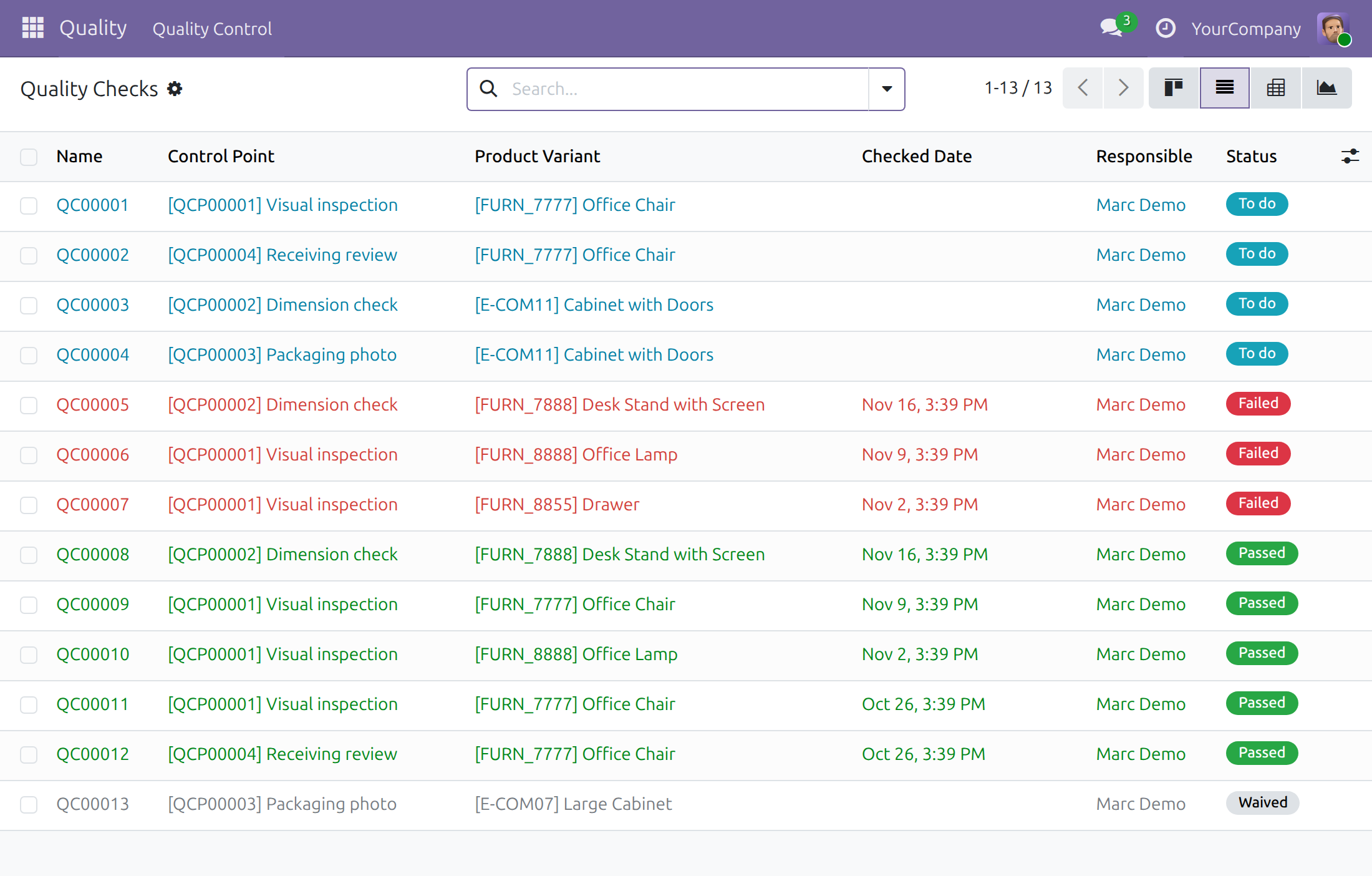
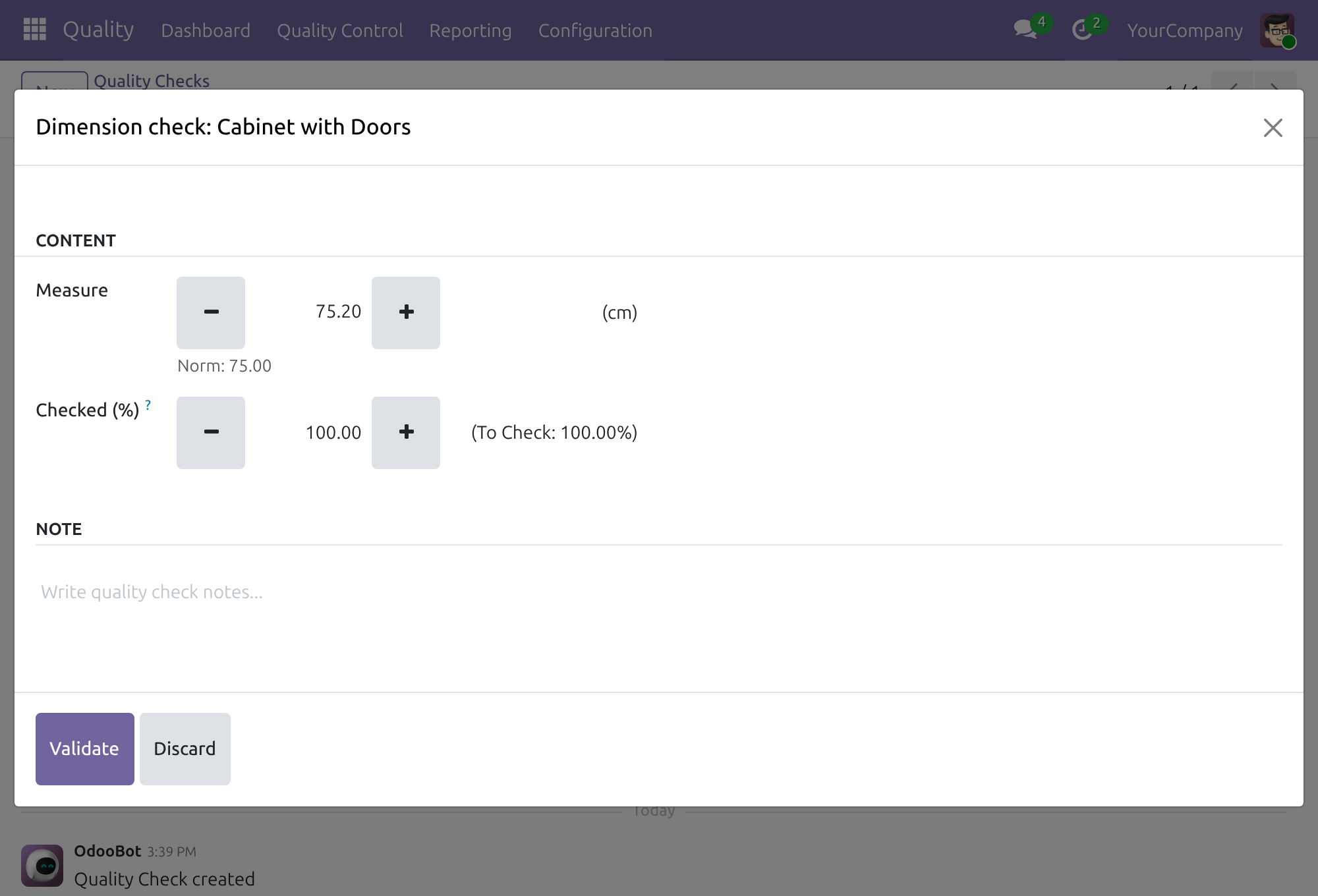
→ Each check opens in a touch dialog with only the controls its test type allows. A measure is judged against its norm and tolerance, photos stay on the check, and Checked By shows who gave the result.
A documented decision on every failed check
A failed lot waits while people agree by e-mail whether to use it, return it or rework it.
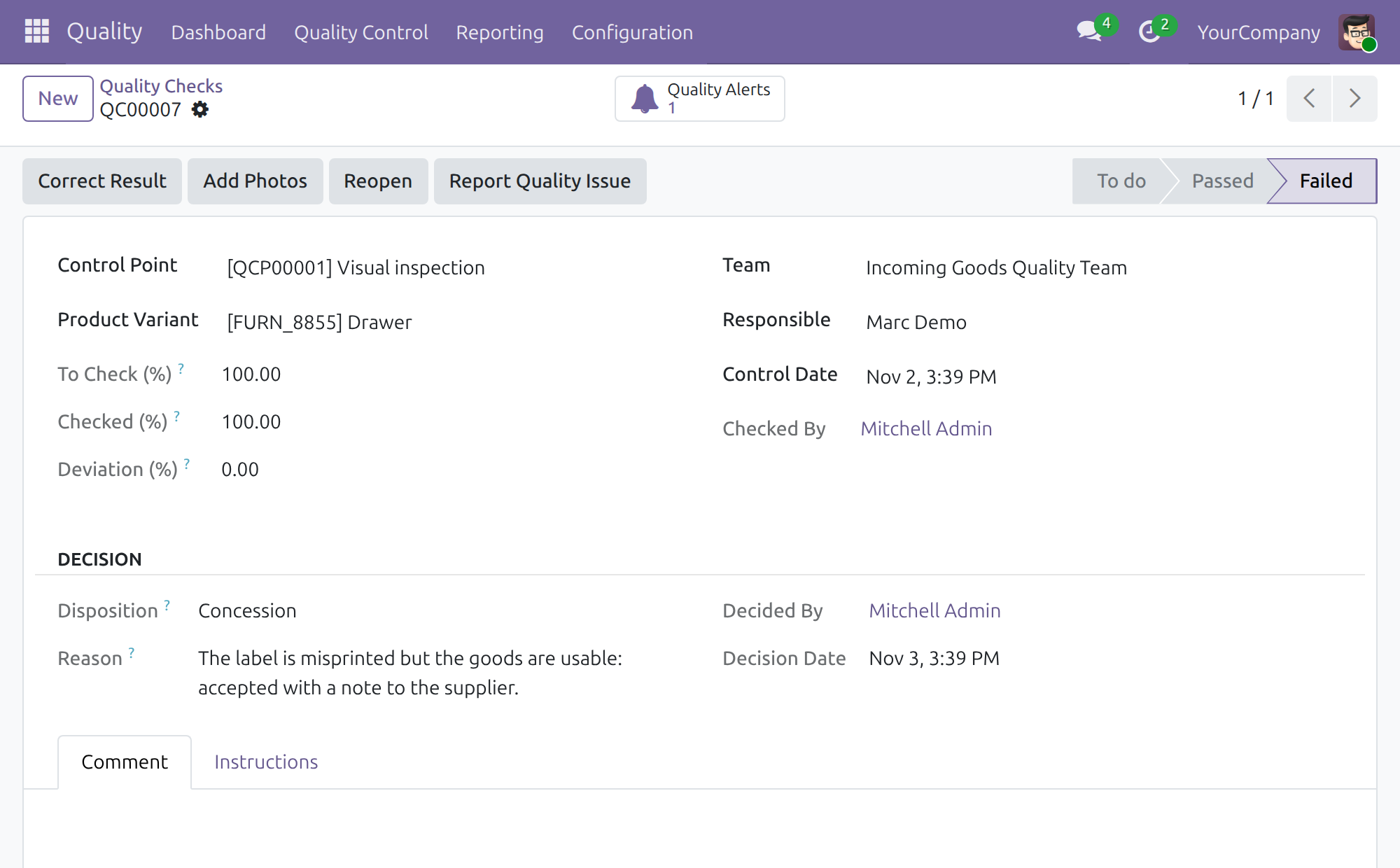
→ A Quality User accepts the failed check with conditions or rejects it, with a mandatory reason. The decision, who made it and when stay on the check.
Every problem followed to a fix that is checked
A defect is discussed, a fix is promised, and nobody checks later whether it worked.
→ Anyone raises a quality alert from a check in one step. The alert moves through its stages with a root cause and corrective and preventive actions, each with a Responsible, a deadline and an effectiveness review.
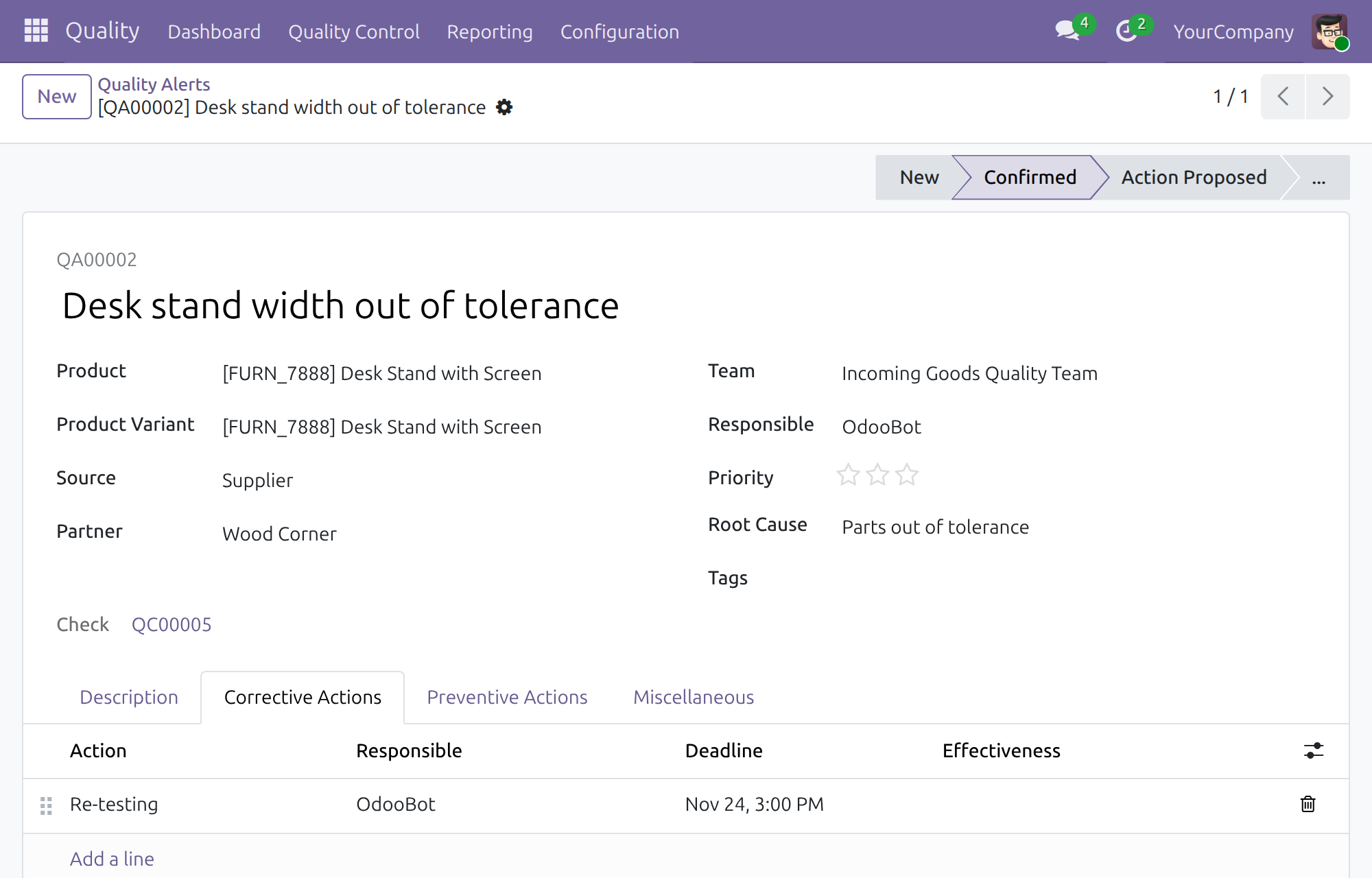
What you see as a manager
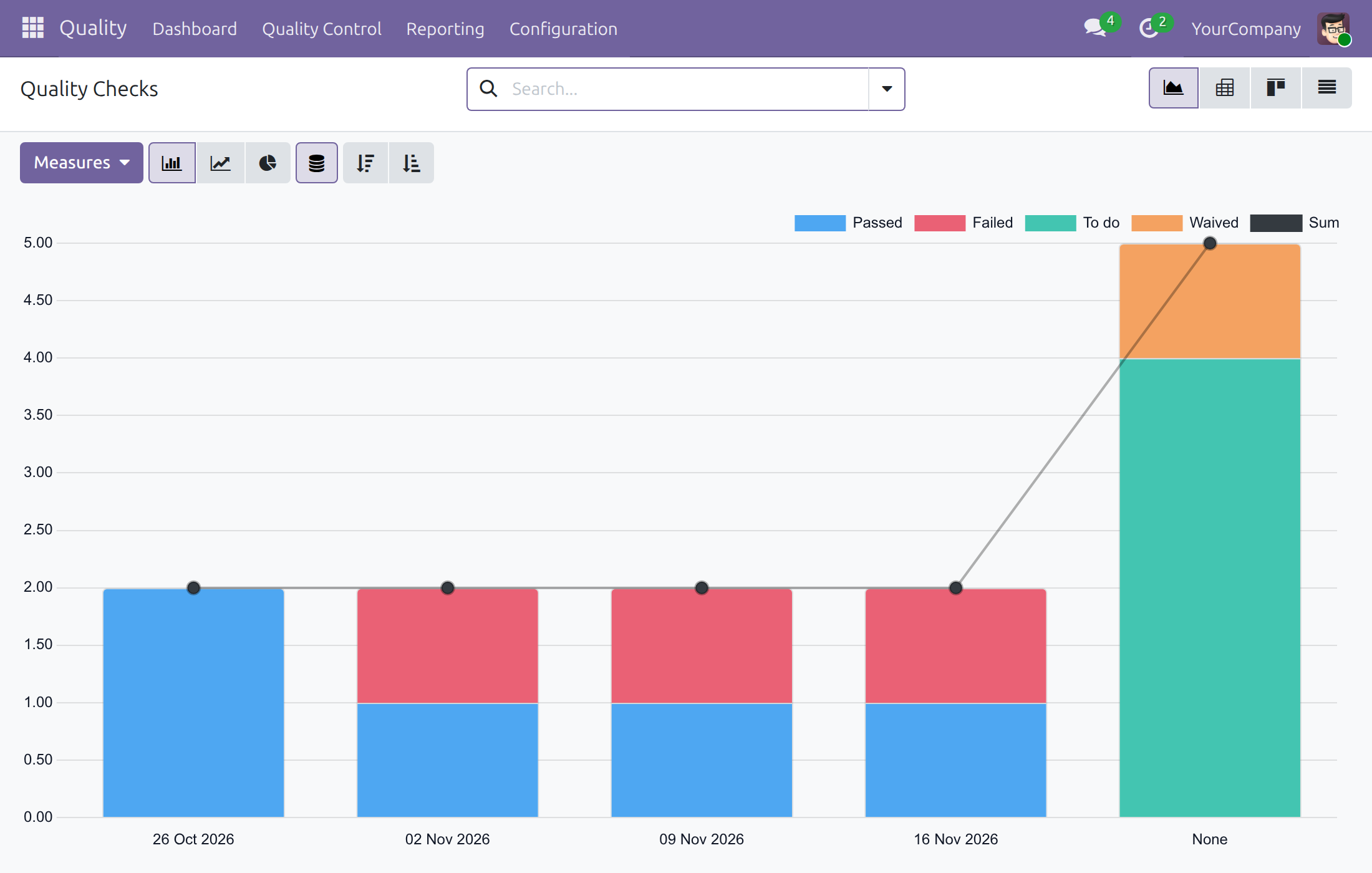
Are our checks passing, failing or still waiting?
Each check counted by status on the date its result was recorded; checks not yet recorded have no date.
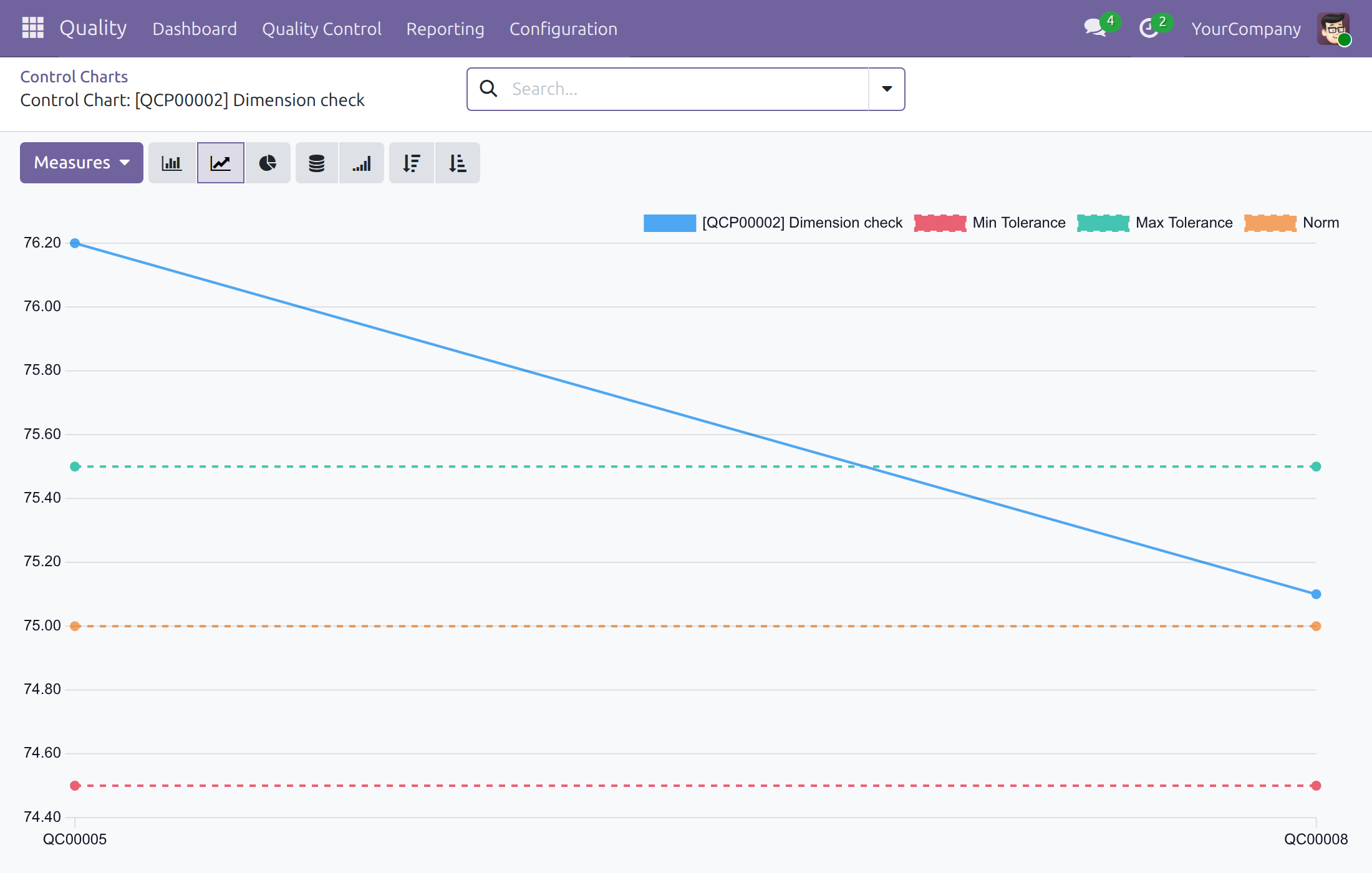
Is this measurement drifting out of tolerance?
The measures recorded on one Measure control point, against its norm and tolerance limits.
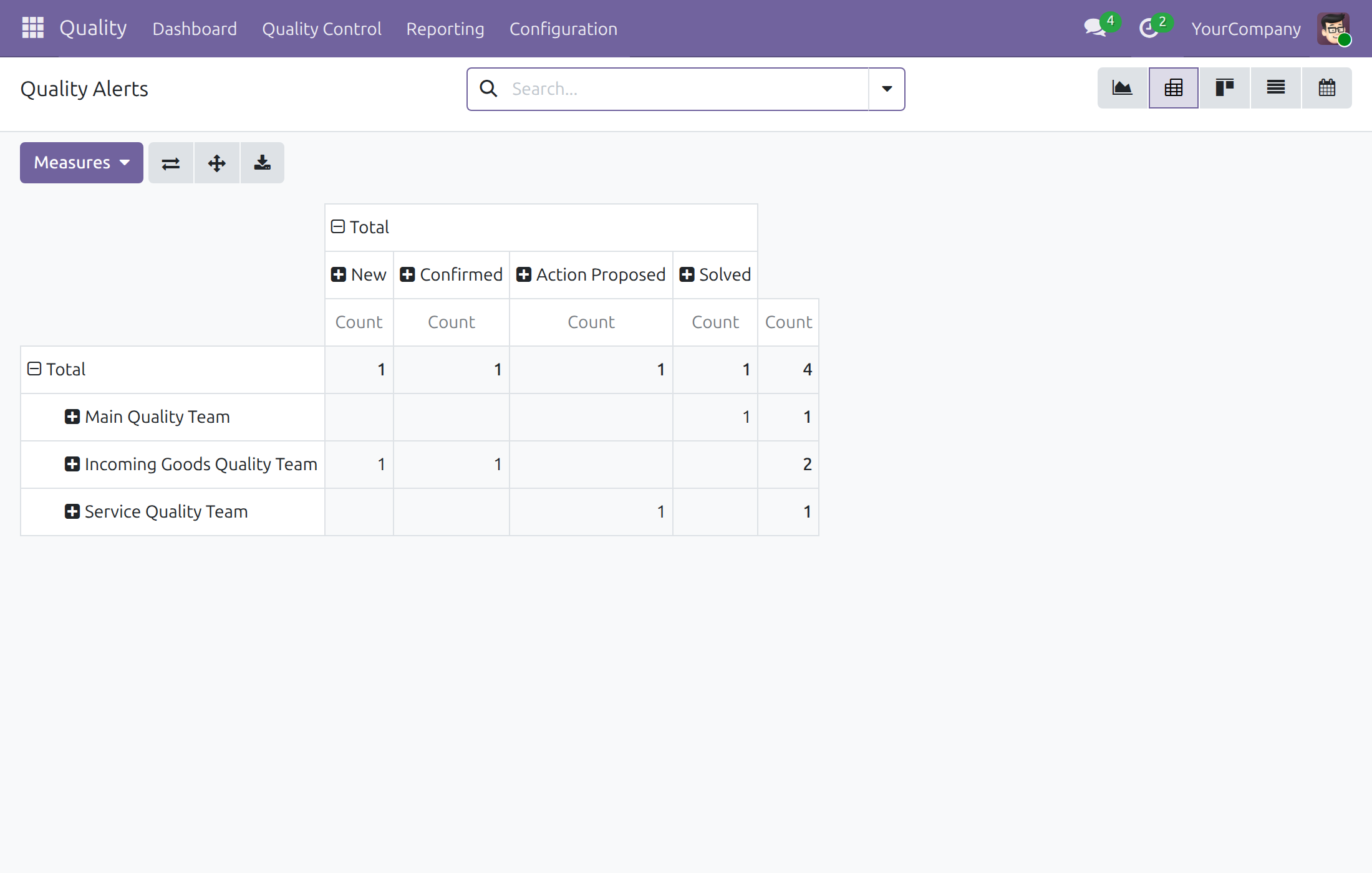
Which team holds open problems, and at what stage?
Every quality alert, counted by its quality team and its current stage.
Features
Plan the inspections
- ✓ Control points set what is checked, how, how often and on which products
- ✓ Test types Pass - Fail, Measure, Take a Picture and Scorecard
- ✓ Weighted scorecards with must-pass criteria, for goods and services
- ✓ Templates create control points for many products at once
Record the checks
- ✓ Touch dialog with plus and minus buttons and the device camera
- ✓ Measures judged against the norm and tolerance
- ✓ Many Pass - Fail checks marked Passed or Failed at once
Resolve problems
- ✓ Accept, reject or waive a check, always with a reason
- ✓ Alerts move through your own stages with root cause, tags and priority
- ✓ Corrective and preventive actions with deadlines and an effectiveness review
- ✓ Mail sent to a team's alias opens an alert in that team
Follow the results
- ✓ A dashboard card per team with checks to do and open alerts
- ✓ Control charts with the average and standard deviation
- ✓ Analyses of checks, alerts and late or ineffective actions
Built for daily use
- ✓ Three access levels: employee, Quality User, Quality Administrator
- ✓ Employees cannot remove photos from a failed or passed check
- ✓ Each decision keeps its reason, author and date
Ready on day one
Test types
Pass - Fail, Measure, Take a Picture and Scorecard are ready for your first control point.
An alert workflow
A Main Quality Team with an e-mail alias, the stages New, Confirmed, Action Proposed and Solved, and common root causes, all editable.
What you set up first
Your quality teams, each user's access right and your control points; the Documentation tab covers each step.
Extend it
Stock Quality Control
Checks created on receipts, deliveries and internal transfers, and a transfer held while a check is still to do.
Project Quality Control
A project task reaching an acceptance stage gets its check, graded by the project members.
Helpdesk Quality Control
Review the support you deliver: a ticket reaching a stage gets its check, graded on the ticket.
Quality Dashboard
One dashboard for first-pass yield, failed checks, open alerts by age and late actions.
Before you decide
Who sees and records which checks?
An employee without a Quality access right sees the checks assigned to them or that they follow, records the ones assigned to them and can report a problem. A Quality User sees every check and alert and decides on failed checks; a Quality Administrator also plans the inspections.
Does it run on Odoo Enterprise?
No. It is supported on Odoo Community Edition and Viindoo Cloud.
Can a failed check hold goods or production?
Not with this module alone: it records checks, decisions and alerts. Stock Quality Control holds a transfer while a check is to do or a blocking check has failed, and Manufacturing Quality Control does the same for work orders and manufacturing orders.
Where do the results and photos go?
Into your own database, attached to the check. The module calls no outside service.
What does it take to install and run?
It depends only on Discuss and the product catalogue, both installed with it, and needs no extra Python package or server program. Inspectors need no Quality access right of their own.
Try it, then ask us
Read the Documentation tab above, then try the live demo: v19demo-int.viindoo.com
Pre-sales & partnership
viindoo.com/contactusTechnical support
viindoo.com/ticketQuality
This guide is for the people who use the Quality app: the quality administrator who plans the inspections, the inspectors and other employees who record checks and report problems, and the quality users who decide what happens to a failed check and follow every quality alert through to its corrective and preventive actions.
Overview
The Quality app turns an inspection plan into quality checks. A check is recorded by whoever works on the goods or the service, keeps its photos as evidence that nobody can quietly remove, and, when it fails, goes to a quality user who decides what happens next. Every quality problem is followed as a quality alert, with a root cause, corrective actions, preventive actions and a review of whether the actions worked.
A quality check is always in one of four statuses: To do, Passed, Failed or Waived. The process runs in these stages:
- The Quality Administrator defines the control points: what is inspected, how, how often and by whom.
- The Inspector (the person named as the Responsible of a control point) records the result of each check: a measure, a Pass or Fail verdict, a photo or a graded scorecard.
- When a check fails, the Quality User decides: accept it with conditions, reject it, or reopen it for a new inspection. A check that does not need inspection can be waived.
- Anyone who can open a check reports a quality issue from it. The Quality User follows the quality alert through its stages, its corrective and preventive actions and their effectiveness review.
- The Quality User and the Quality Administrator follow the dashboard, the reports and the control charts.
| Role | What they do | Access right to assign |
|---|---|---|
| Quality Administrator | Defines control points, scorecards, templates, teams, alert stages and root causes; reads every report. | Quality: Administrator |
| Quality User | Sees every check and alert; decides about failed checks; waives checks; works through quality alerts; follows the dashboard. | Quality: User |
| Inspector and any other employee | Records the checks assigned to them and reports quality issues. | None: an internal user without a Quality access right |
Other Quality apps add to these screens when they are installed: for goods in transfers, for production orders, for project tasks and for helpdesk tickets. They have their own documentation. See, for example, Stock Quality Control and Manufacturing Quality Control.
Setup (for the Administrator)
Install the app
- Open Apps.
- Search for Quality.
- Click Install on the Quality app. The apps it needs are installed with it.
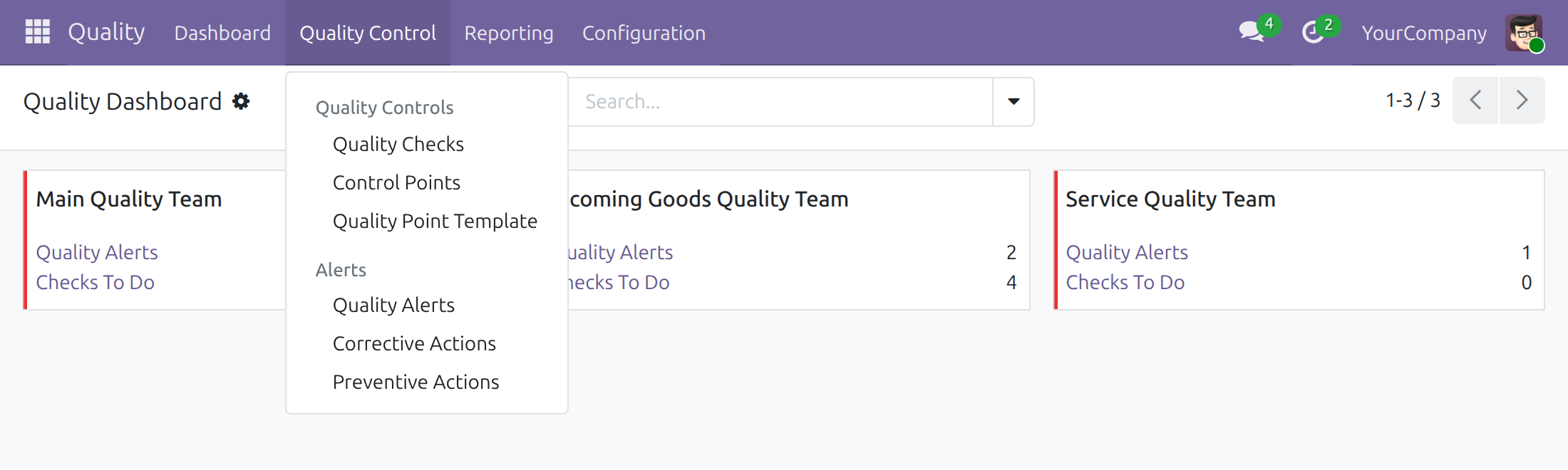
After the installation the Quality app appears in the main menu. Each person only sees the menus their access right allows.
Give people their access right
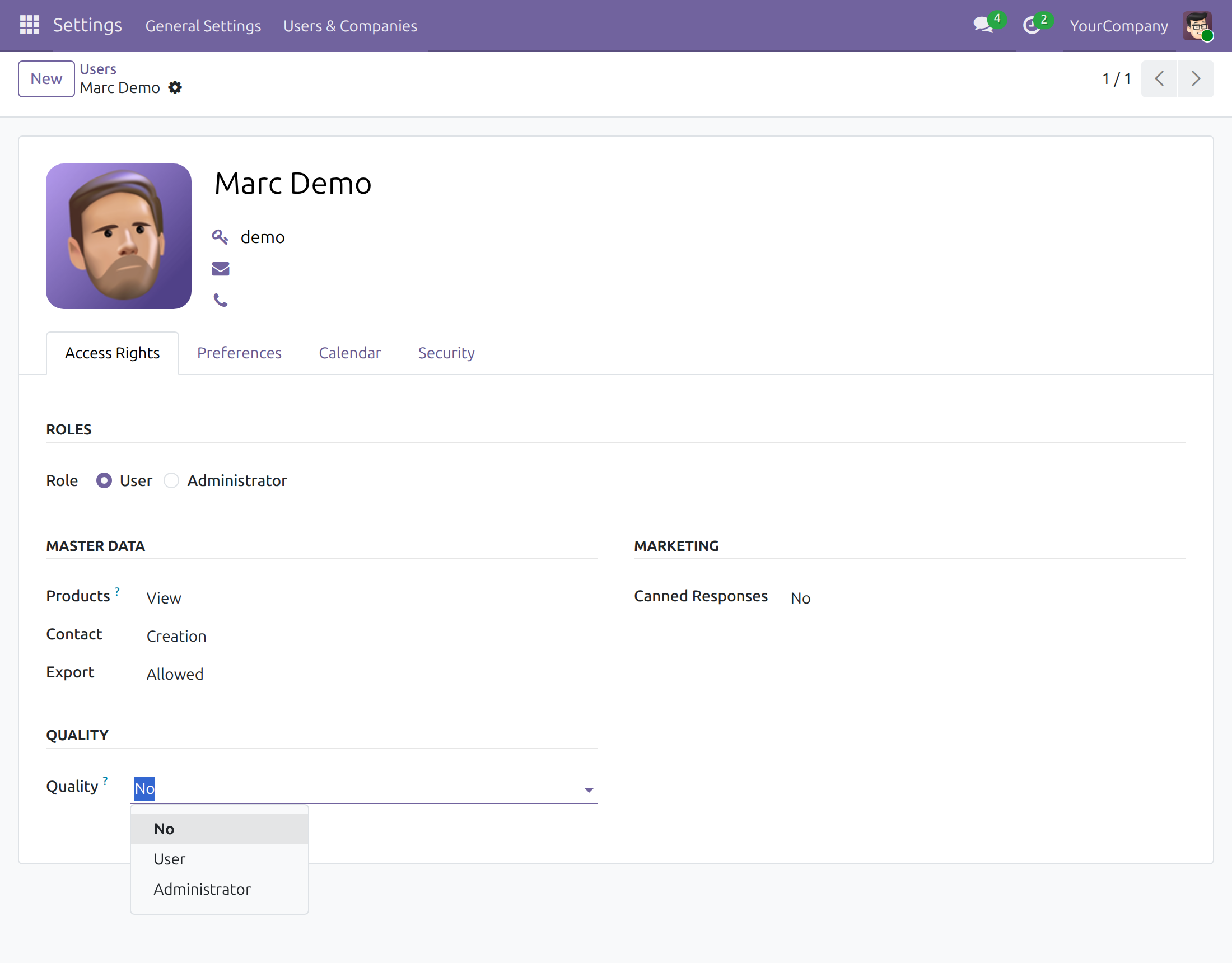
- Open Settings ‣ Users & Companies ‣ Users and open the user.
- On the Access Rights tab, in the Quality line, choose User or Administrator.
- Leave the line on No for an inspector or any other employee who only records the checks assigned to them and reports issues.
- Click Save.
Set up the quality teams
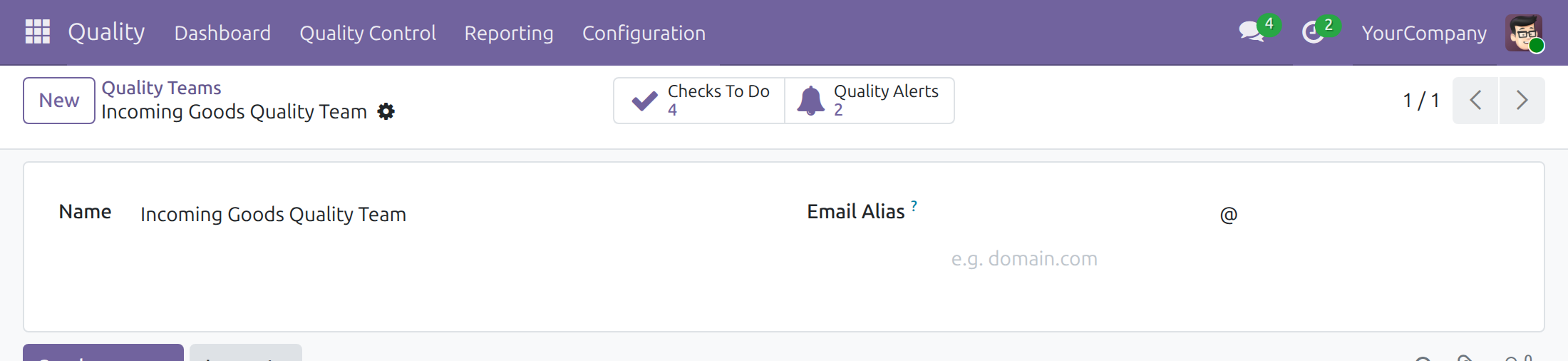
A quality team owns control points, checks and alerts, and has a card on the dashboard. Open Quality ‣ Configuration ‣ Quality Teams and open or create a team.
- Name: the name people see on the dashboard and on every check.
- Email Alias: mail sent to this address creates a quality alert in the team. The subject of the mail becomes the summary of the alert; without a subject, the first line of the mail does; without both, the address of the sender does. The body of the mail becomes the description.
- The buttons Checks To Do and Quality Alerts open the checks still to do and the open alerts of the team.
Lists you can adapt
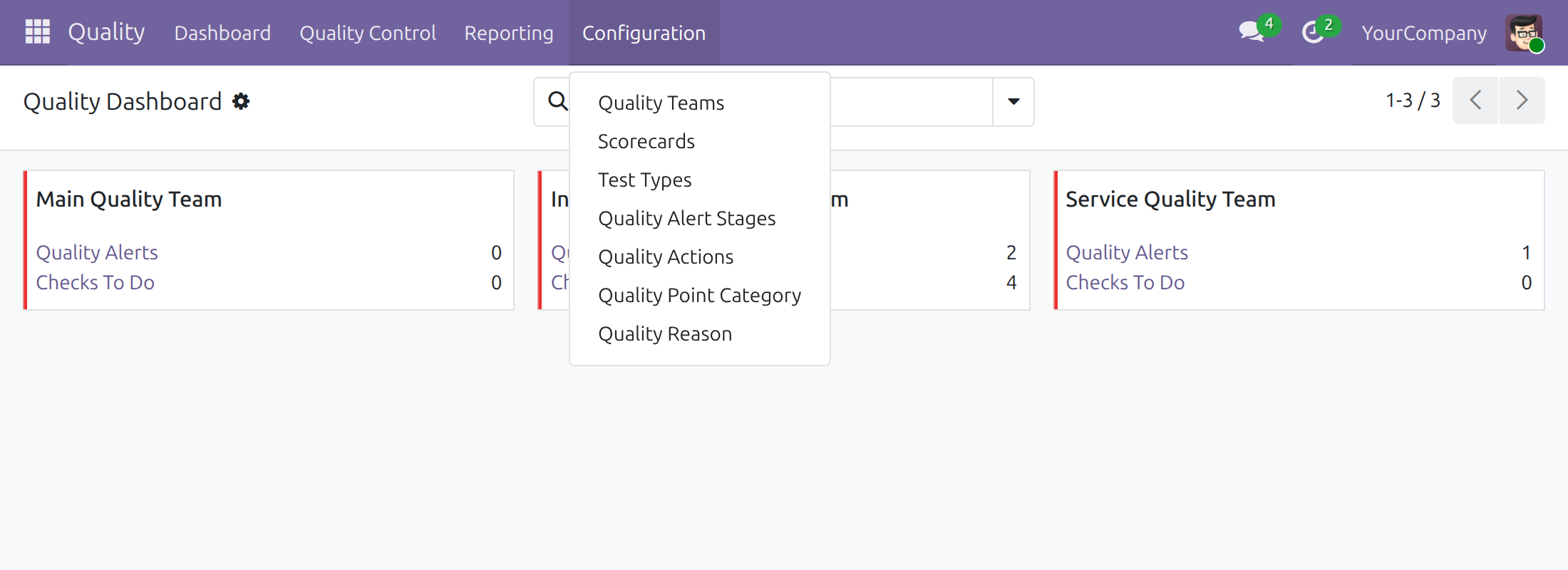
All of them are under Quality ‣ Configuration.
- Scorecards: the graded criteria of a Scorecard control point (see below).
- Test Types: the four ways a check is performed. Pass - Fail: the inspector gives a direct verdict. Measure: the inspector records a value compared with a norm and a tolerance range. Take a Picture: a photo is the evidence, and the check can only be passed with a photo. Scorecard: the inspector grades a list of weighted criteria and the score decides the result.
- Quality Alert Stages: the stages an alert moves through. The app comes with New, Confirmed, Action Proposed and Solved. Tick Folded to fold a stage in the alert board, and Alert Processed for a stage that means the alert is dealt with: such an alert is not counted as open on the dashboard.
- Quality Actions: a catalogue of reusable corrective and preventive actions, each with a default Responsible. You pick them on the alerts.
- Quality Reason: the root causes you can choose on an alert, for example Parts Quality.
- Quality Point Category: groups of control points, so you can find them by category.
- Quality Tags: labels for alerts. This menu appears in debug mode only.
Quality Administrator: plan the inspections
A control point tells the team what to inspect, how, how often and who is responsible. Open Quality ‣ Quality Control ‣ Control Points. Each control point receives a reference such as QCP00014 when you save it.
Fields every control point has:
- Title: the name inspectors see.
- Point Category: files the control point under a category.
- Product Categories, Product Templates and Products: limit the control point to some products. Leave the three empty and it applies to every product.
- Frequency: All Operations, Randomly (type the percentage of the operations to check, above 0 and up to 100) or Periodically (type a number and choose Day(s), Week(s) or Month(s)). The frequency applies to the apps that create checks for you, for transfers and production orders; with the Quality app alone you create the checks by hand.
- Test Type: Pass - Fail, Measure, Take a Picture or Scorecard.
- To Check (%): the share of the quantity to inspect, from 0 to 100.
- Passed/Failed Units: tick it when inspectors must also enter how many units passed and how many failed; the pass rate is then calculated for them.
- Team and Responsible: the team of the checks and the inspector who is expected to record them. The check takes its Responsible from the control point when it is created.
- The tabs Instructions (shown to the inspector), Notes (why the check is needed) and Message If Failure (the text shown when the result is Failed).
The form also shows a Quality Checks button with the number of checks of the control point. Once a Measure control point has measured checks, the form shows their Average and Std. Deviation and a Control Chart button.
A control point that already has checks cannot be deleted: archive it. An archived control point creates no checks, and the existing checks stay as they are.
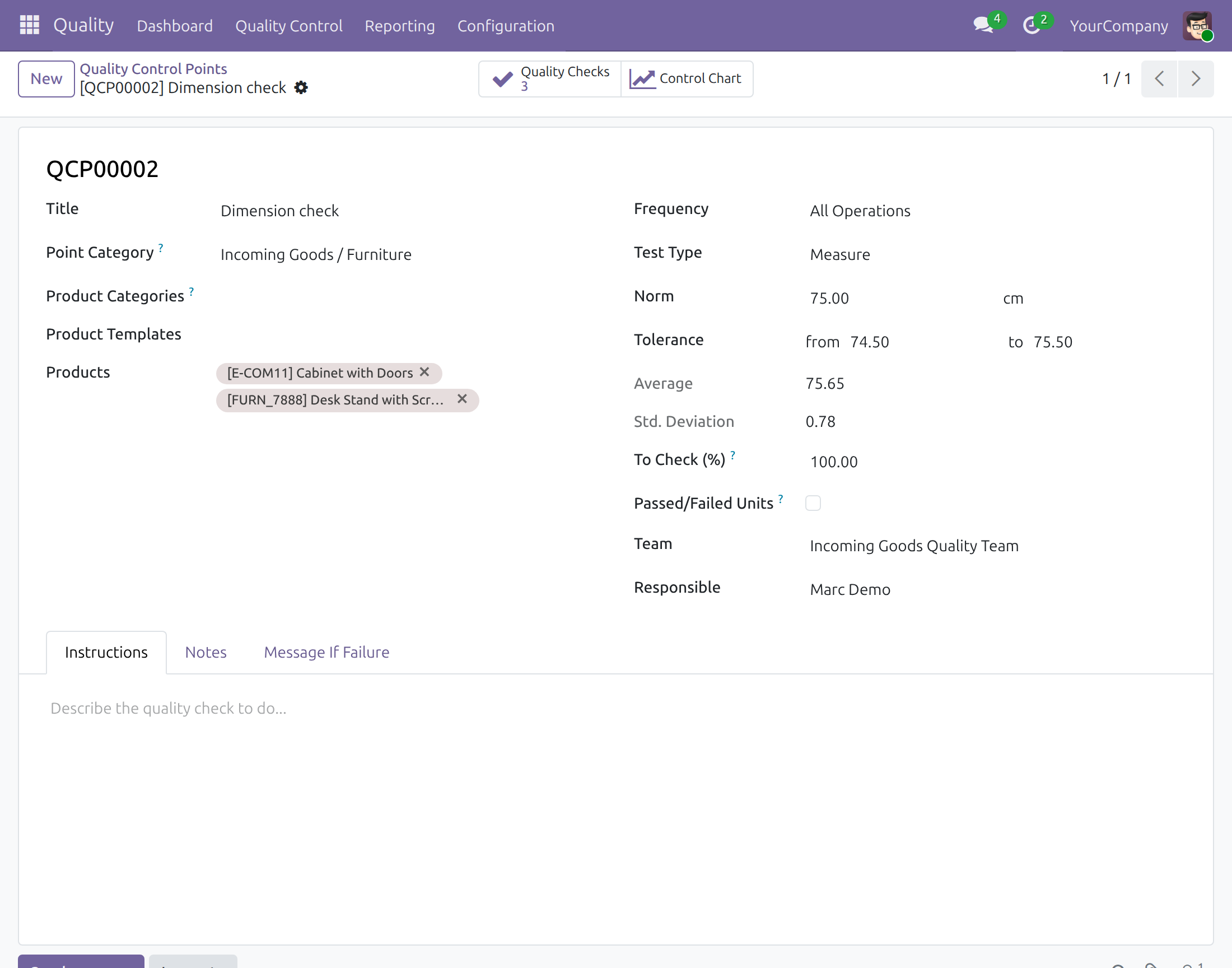
Measure a value against a norm and a tolerance
- Click New.
- In Title, type the name inspectors will see, for example Dimension check.
- In Test Type, choose Measure. The fields Norm and Tolerance appear.
- In Norm, type the ideal value (for example 75) and, next to it, the unit (for example cm).
- In Tolerance, type the lowest accepted value after from (74.5) and the highest accepted value after to (75.5). The norm must lie inside this range.
- Choose the Frequency, the Team and the Responsible.
- Click Save.
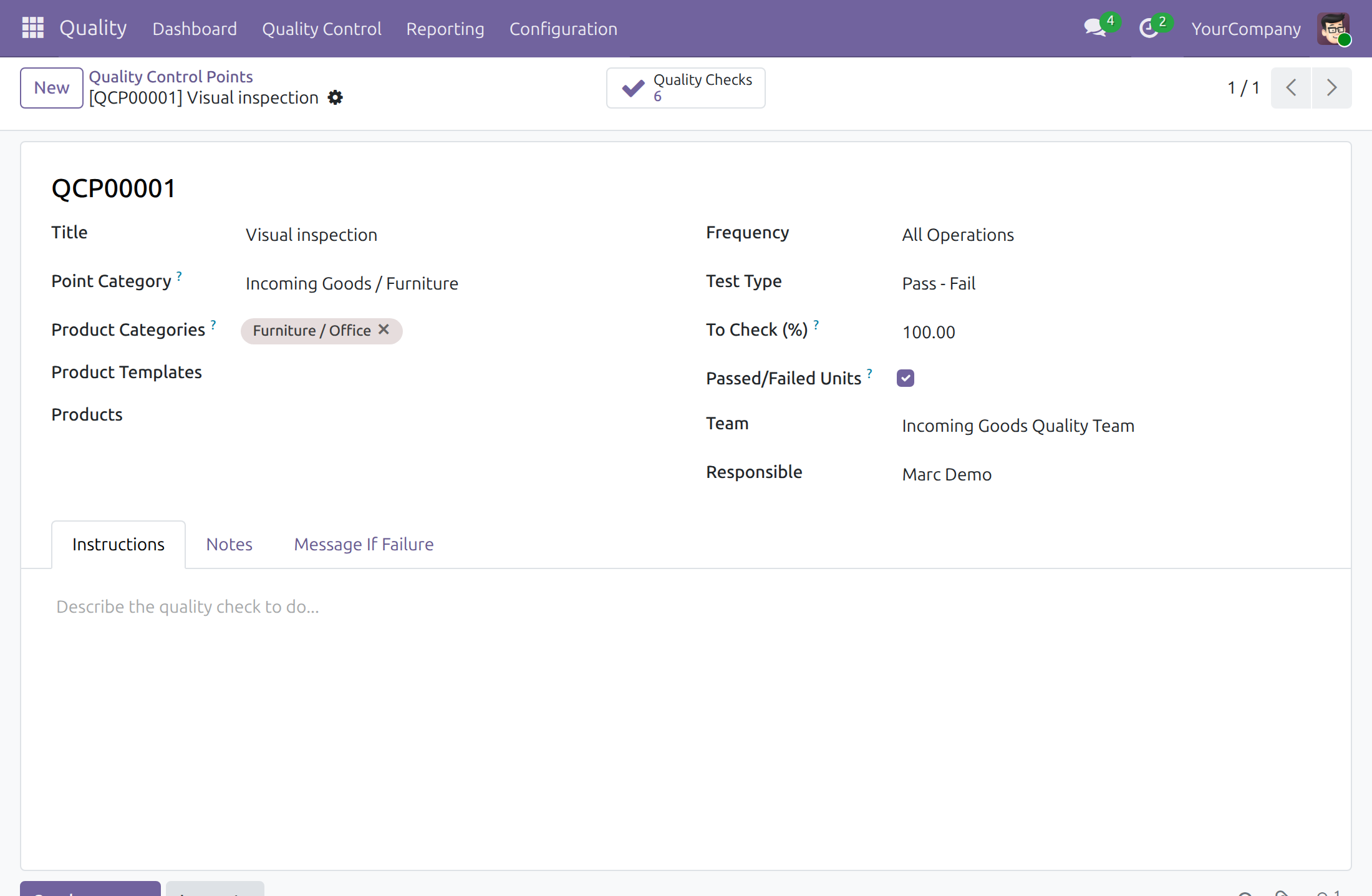
Give a Pass - Fail verdict
- Click New and type the Title, for example Visual inspection.
- Keep Test Type on Pass - Fail: the inspector gives a direct verdict, so no norm or tolerance is asked.
- Tick Passed/Failed Units if inspectors must also enter the units that passed and failed.
- Choose the Team and the Responsible.
- Open the Instructions tab and describe what to look at. Inspectors see this text while they inspect.
- Click Save.
The test type Take a Picture asks the inspector for a photo: the check can only be passed when it carries a photo.
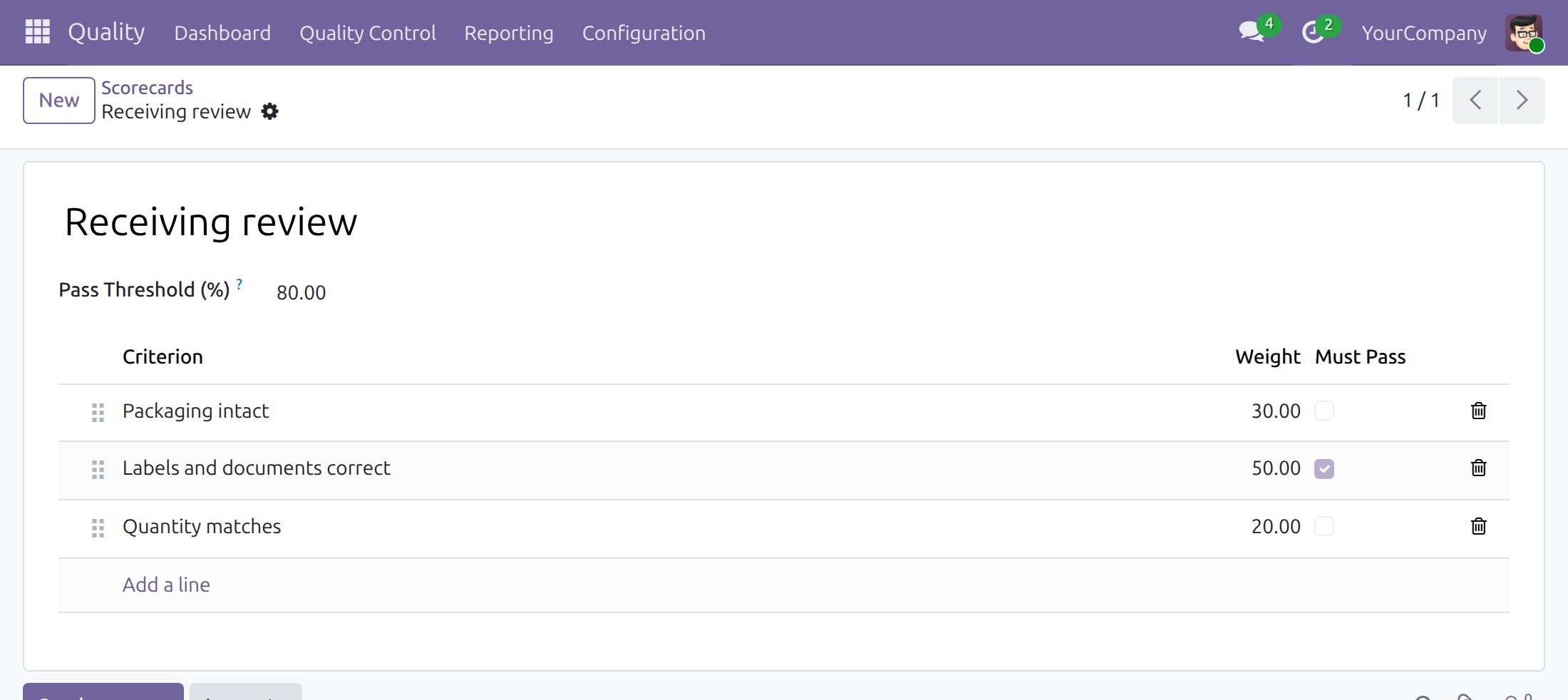
Grade goods or services with a scorecard
A scorecard grades a list of weighted criteria. It serves goods and services alike.
- Open Quality ‣ Configuration ‣ Scorecards and click New.
- Type the Scorecard Name, for example Receiving review, and the Pass Threshold (%), for example 80.
- Click Add a line for each criterion. Type the Criterion, its Weight and tick Must Pass when the check cannot pass unless this criterion passes.
- Click Save.
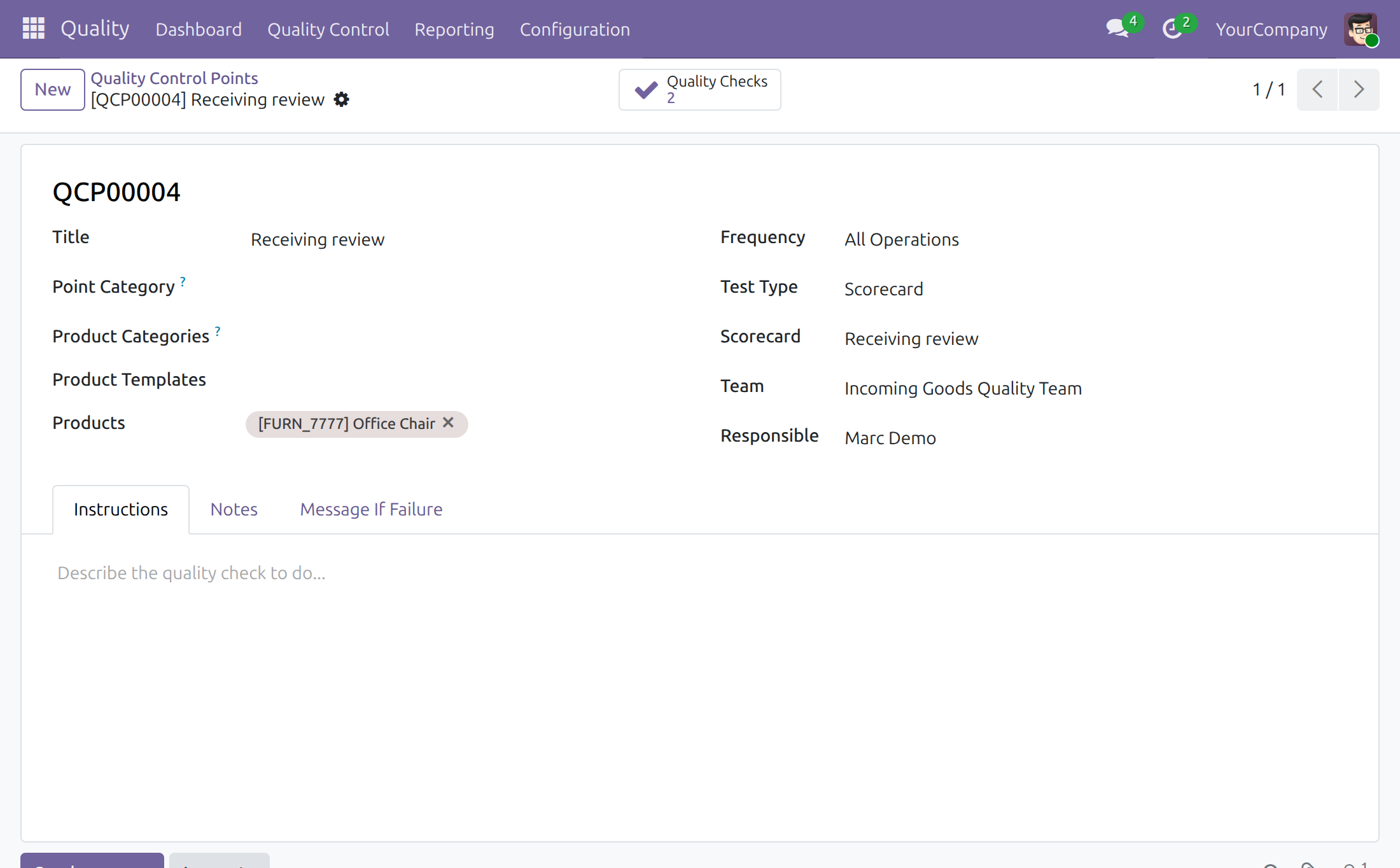
Then create a control point, choose the Test Type Scorecard and choose the Scorecard it uses. The checks of this control point show the criteria to grade.
Create many control points from a template
A template keeps a reusable set of control point lines.
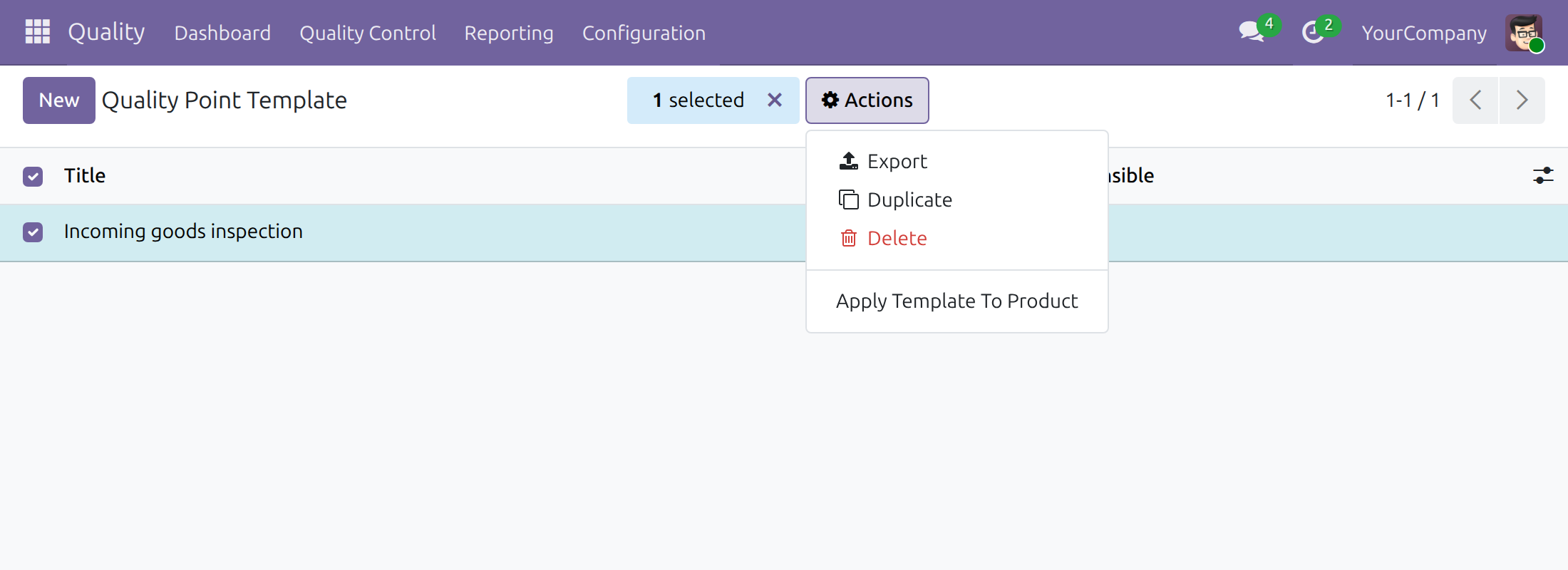
- Open Quality ‣ Quality Control ‣ Quality Point Template and create a template with its lines (title, test type, frequency, norm, tolerance, quantity to check, team and Responsible).
- Tick one or several templates in the list.
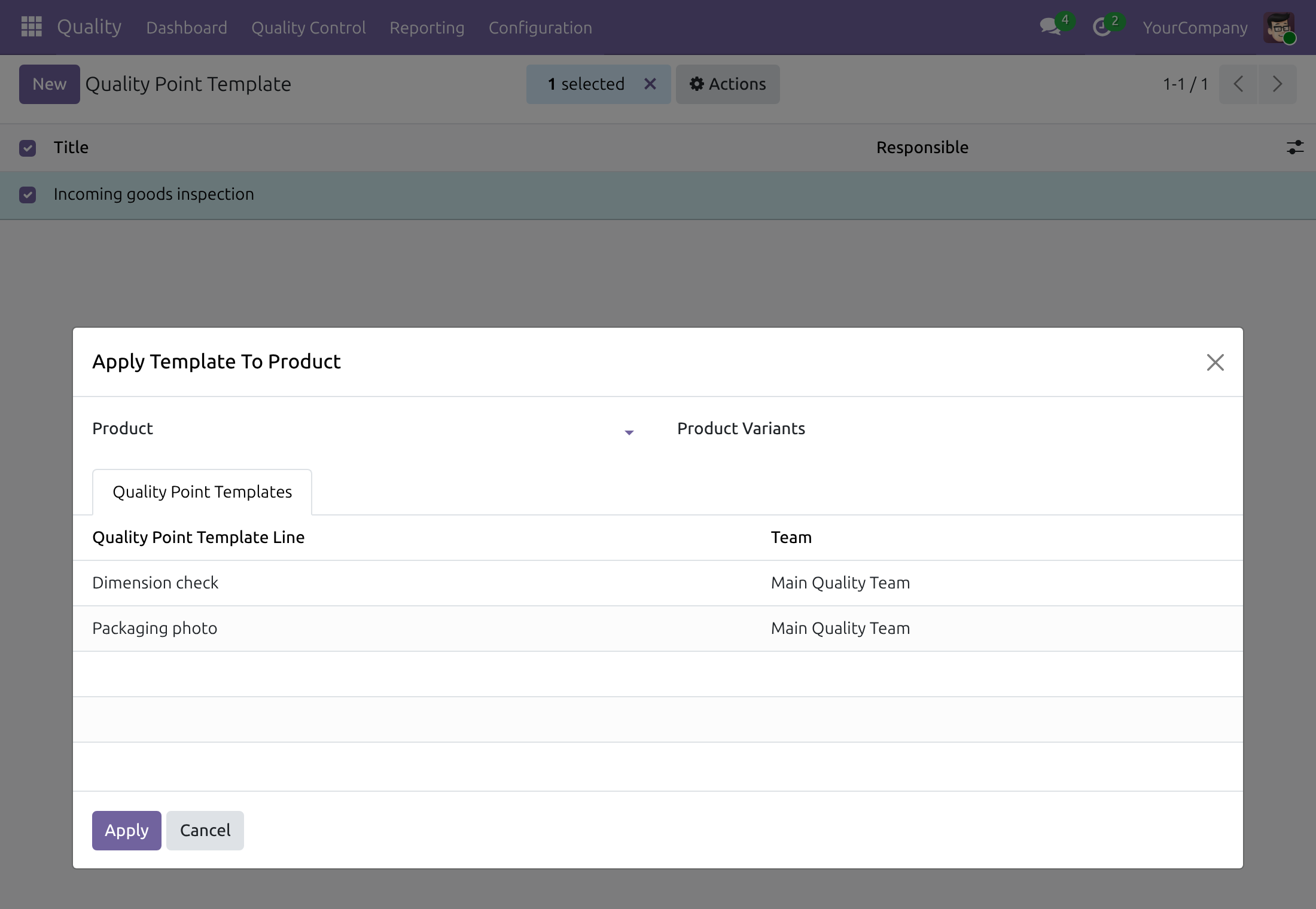
- Click Actions and choose Apply Template To Product.
- In the window that opens, choose the Product or the Product Variants, check the Team of every line and click Apply. The matching control points are created in one go.
Inspector: record the checks assigned to you
An inspector is the Responsible of a control point and has no Quality access right. The only Quality menu is Quality ‣ Quality Control ‣ Quality Checks, and it lists the checks assigned to you or followed by you.
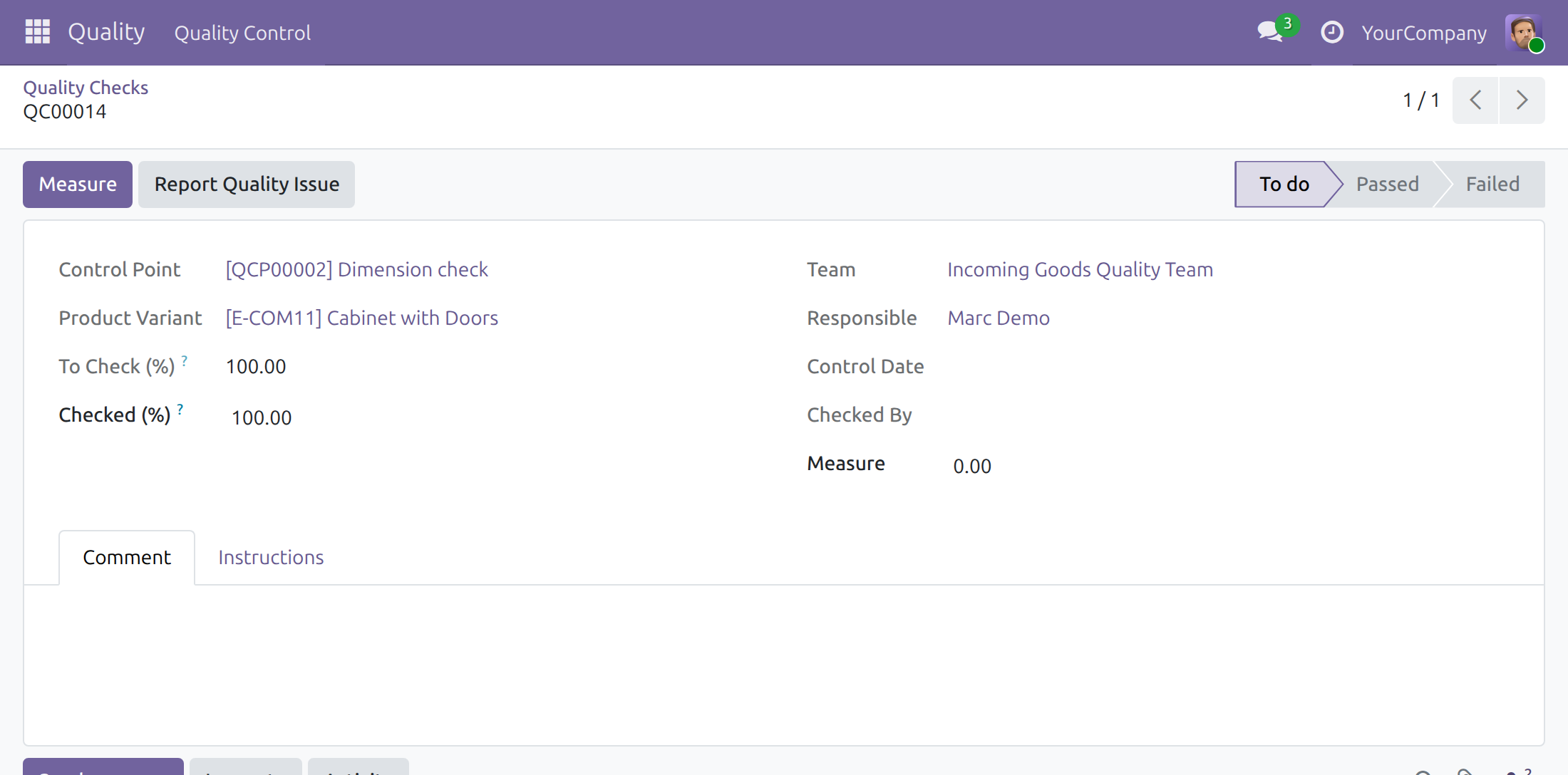
Open a check to see its Control Point, its Product Variant, the Team and the Responsible, and the Instructions tab. The header offers the buttons that fit the test type of the control point. When you record a result, Checked By shows your name and Control Date shows the moment of the result; the Responsible stays as it was.
Record a measurement
- Open a check of a Measure control point. The status bar shows To do.
- Click Measure. A large dialog opens with the control point title.
- Type the reading in Measure, or tap + and -. The first tap on + lands on the norm and each following tap moves the value by a twentieth of the tolerance range. Validate stays grey until you have entered a measure.
- Click Validate.
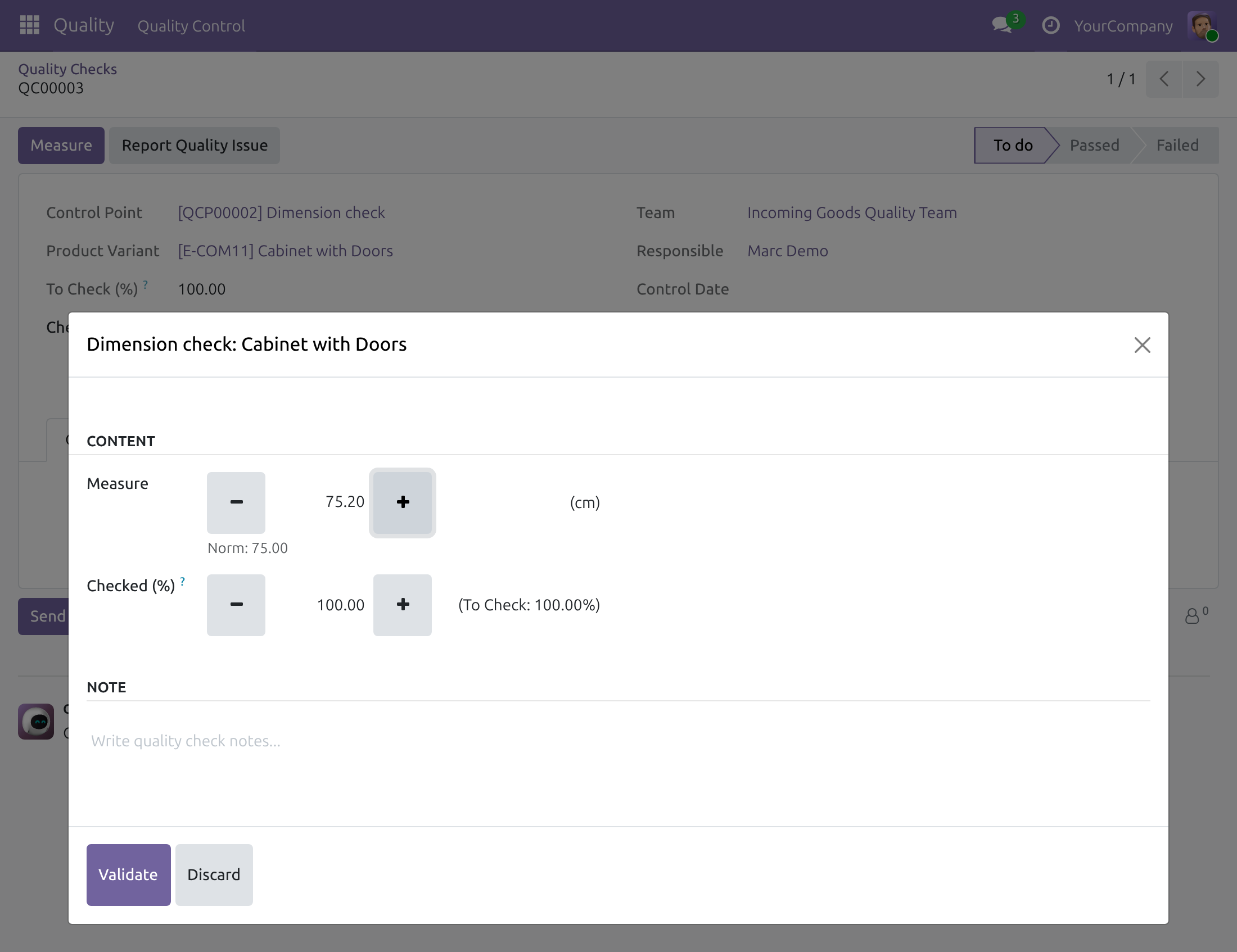
When the reading lies inside the tolerance range (74.50 to 75.50 in the example), the check becomes Passed. When it lies outside, the check becomes Failed and tells you what you measured and the range it should have been in.
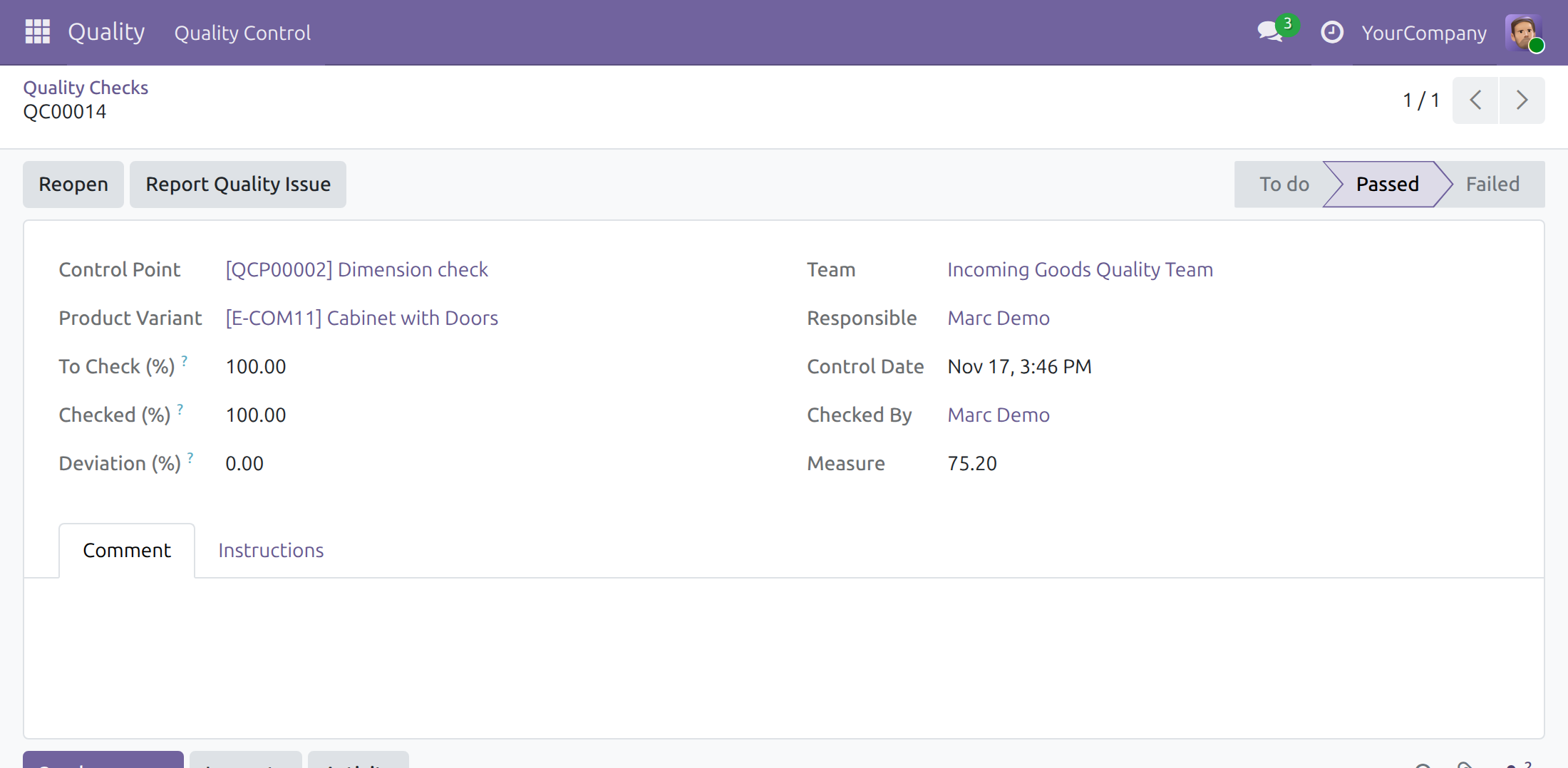
Give a Pass or Fail verdict
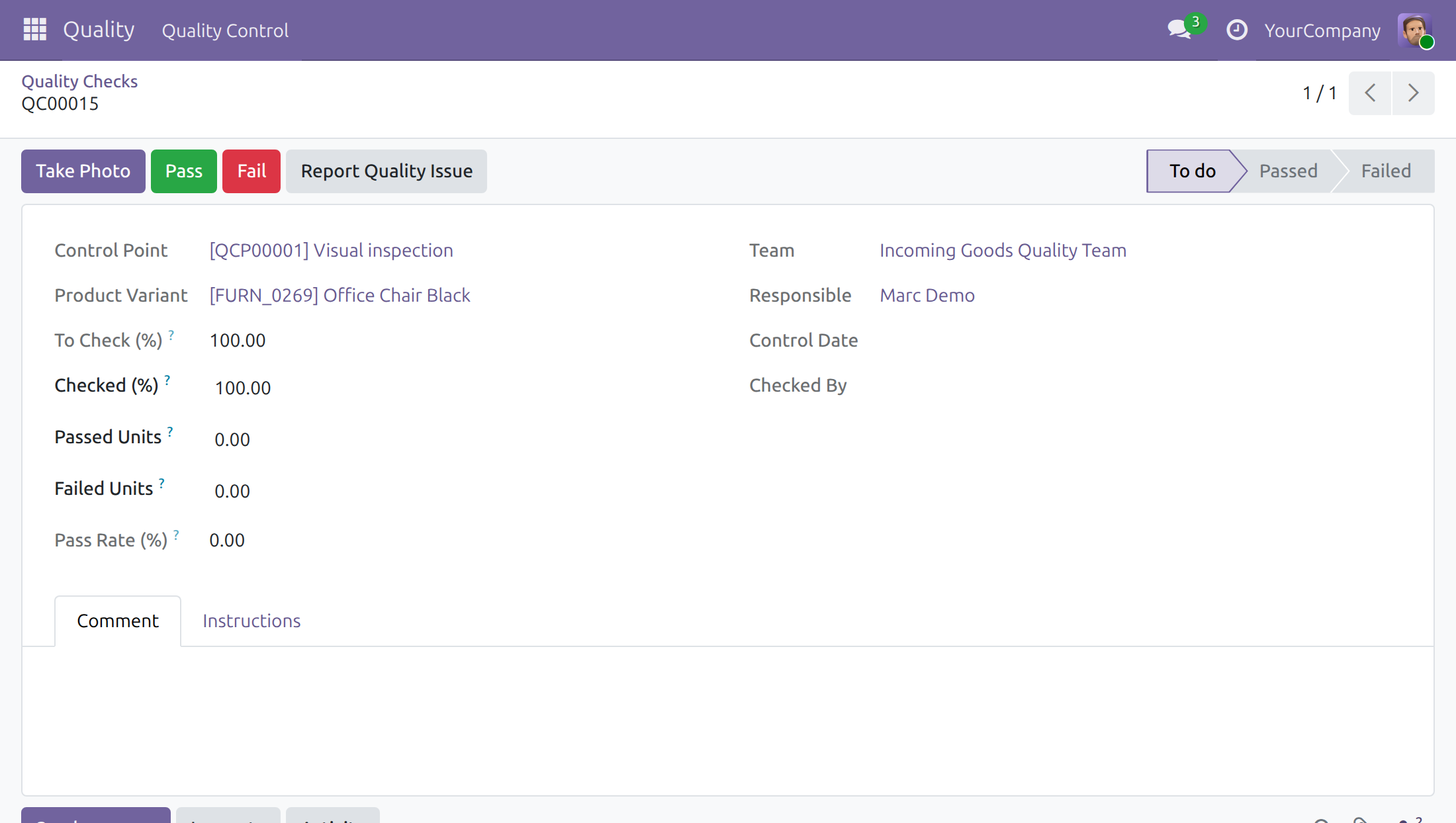
- Open the check of a Pass - Fail control point. The header offers Pass and Fail, and Take Photo to attach photos.
- Read the Instructions tab if you need to, inspect the item, then click Pass or Fail.
After Pass, the status bar shows Passed, Checked By shows your name and Control Date shows the time of your click. In the check list, a passed check is green.
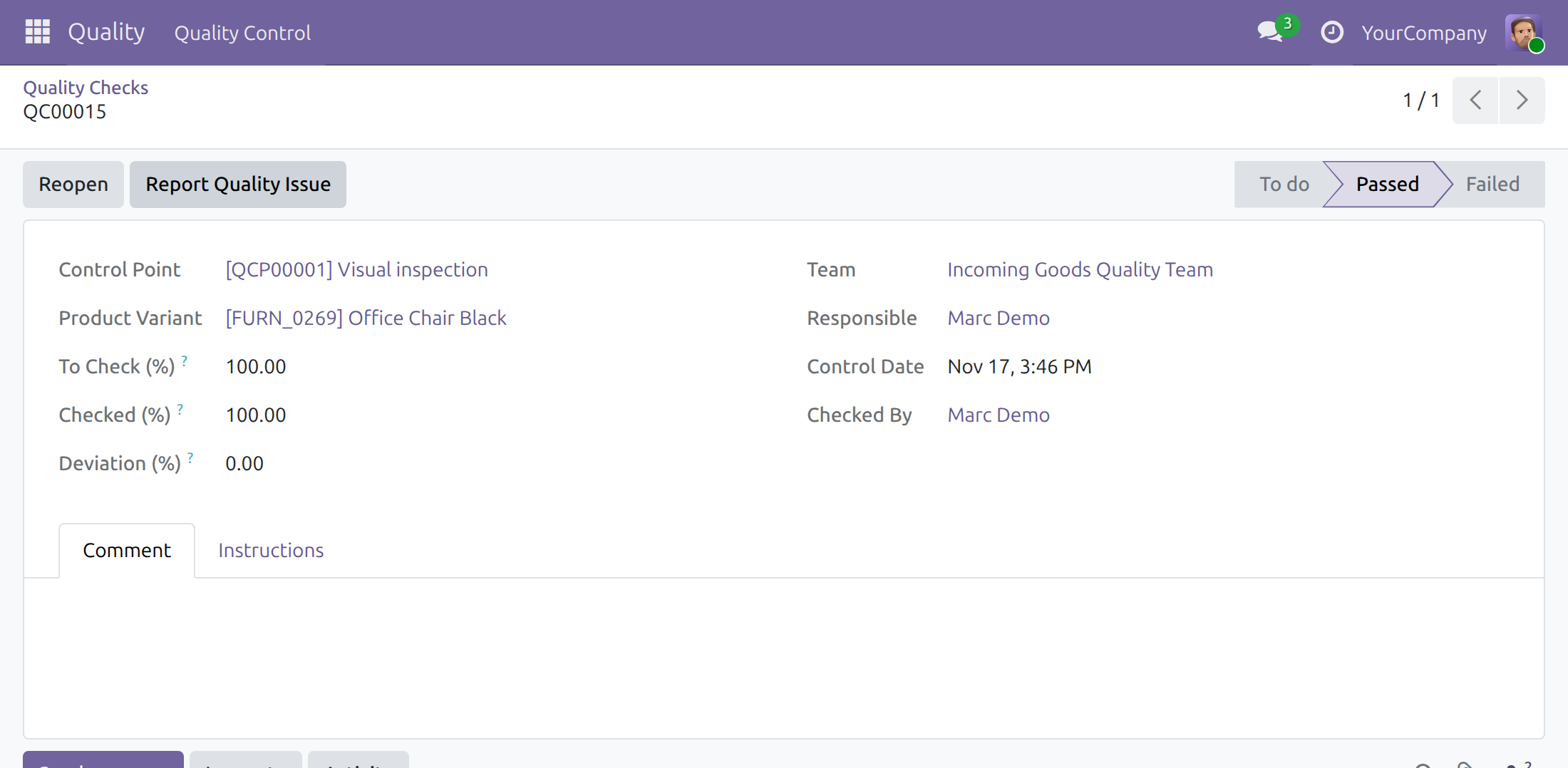
If you passed a check by mistake, click Reopen. The check goes back to To do; Checked By, Control Date, the measure and the units are cleared, and the comment and the photos are kept. You can reopen a passed check as long as the document it belongs to is not completed.
Fail a check with photos and a note
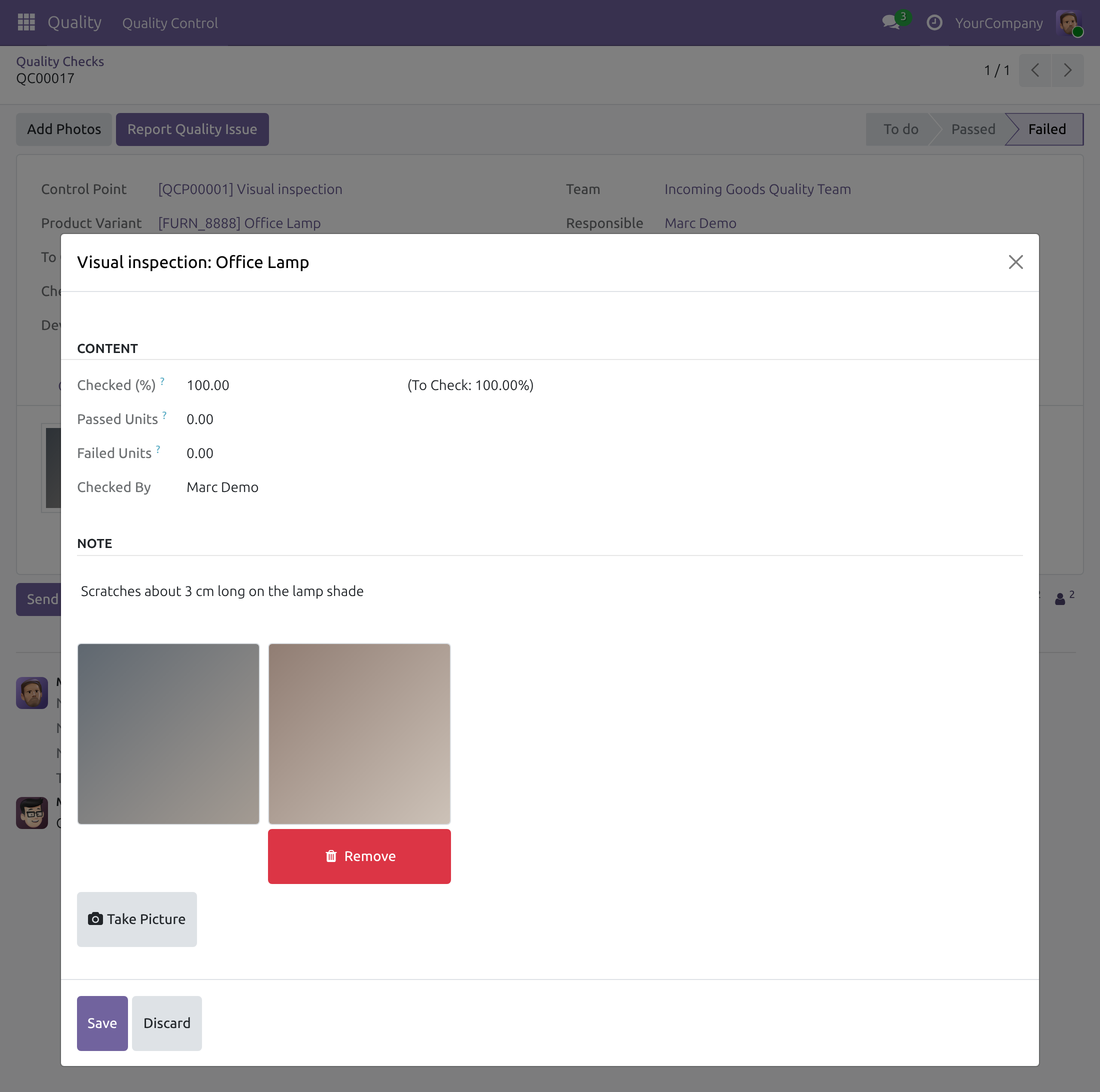
- Open the check and click Take Photo.
- Click Take Picture and take or choose a photo. A thumbnail appears; repeat for more photos. Remove under a thumbnail removes a photo you have not saved yet.
- In Note, explain what the photos show, for example Scratches about 3 cm long on the lamp shade.
- Click Fail.
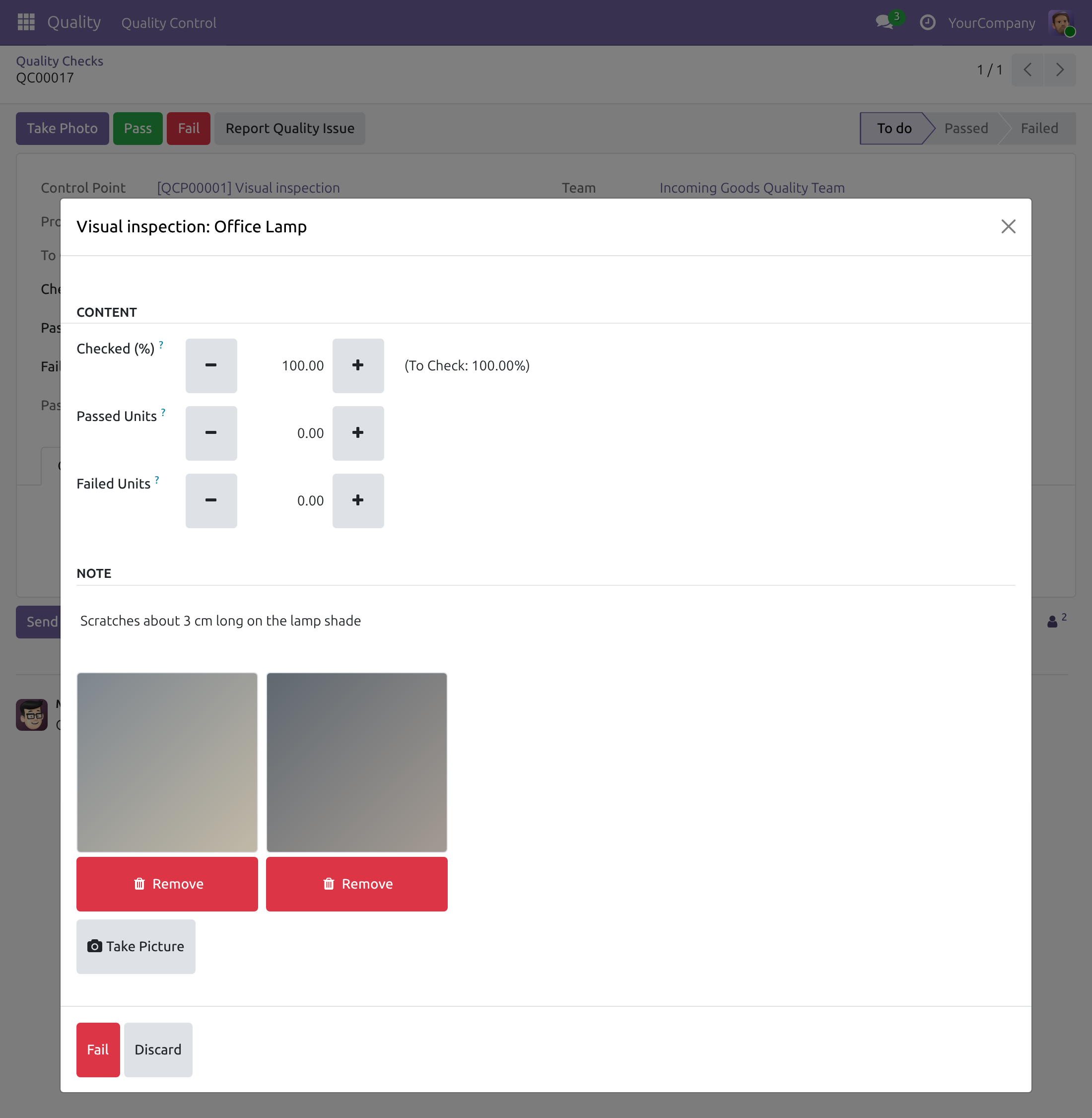
The check is Failed. The Checked Image tab shows the photos and the Report Quality Issue button is highlighted.
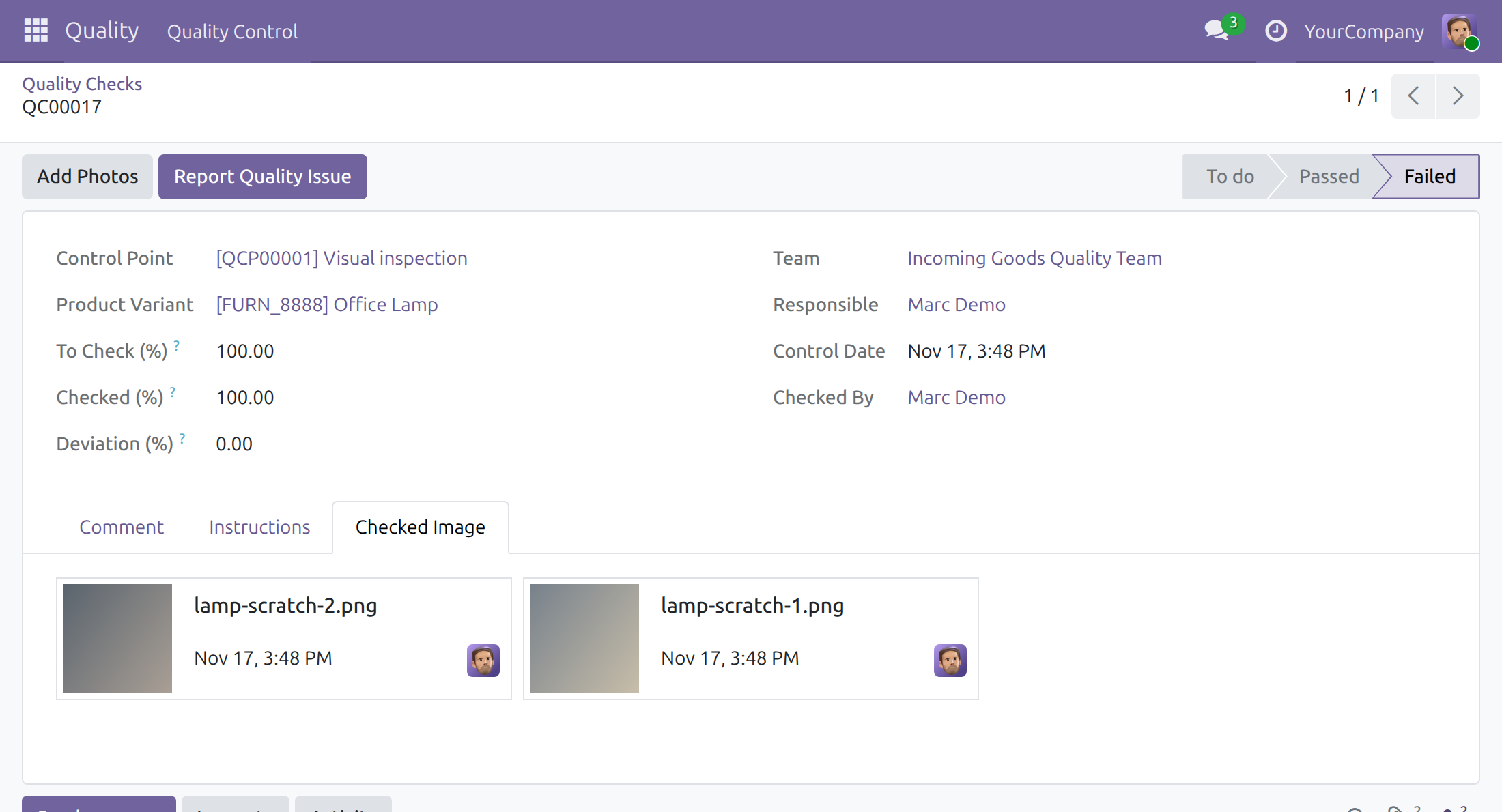
To add a photo afterwards, click Add Photos on the failed check, take the picture and click Save. The check stays Failed. The photos already attached to a failed check cannot be removed or replaced by an inspector: the evidence of a failure only grows. The photos of a passed check are locked. Only a quality user can change them.
A check of the Take a Picture type needs at least one photo before it can be passed.
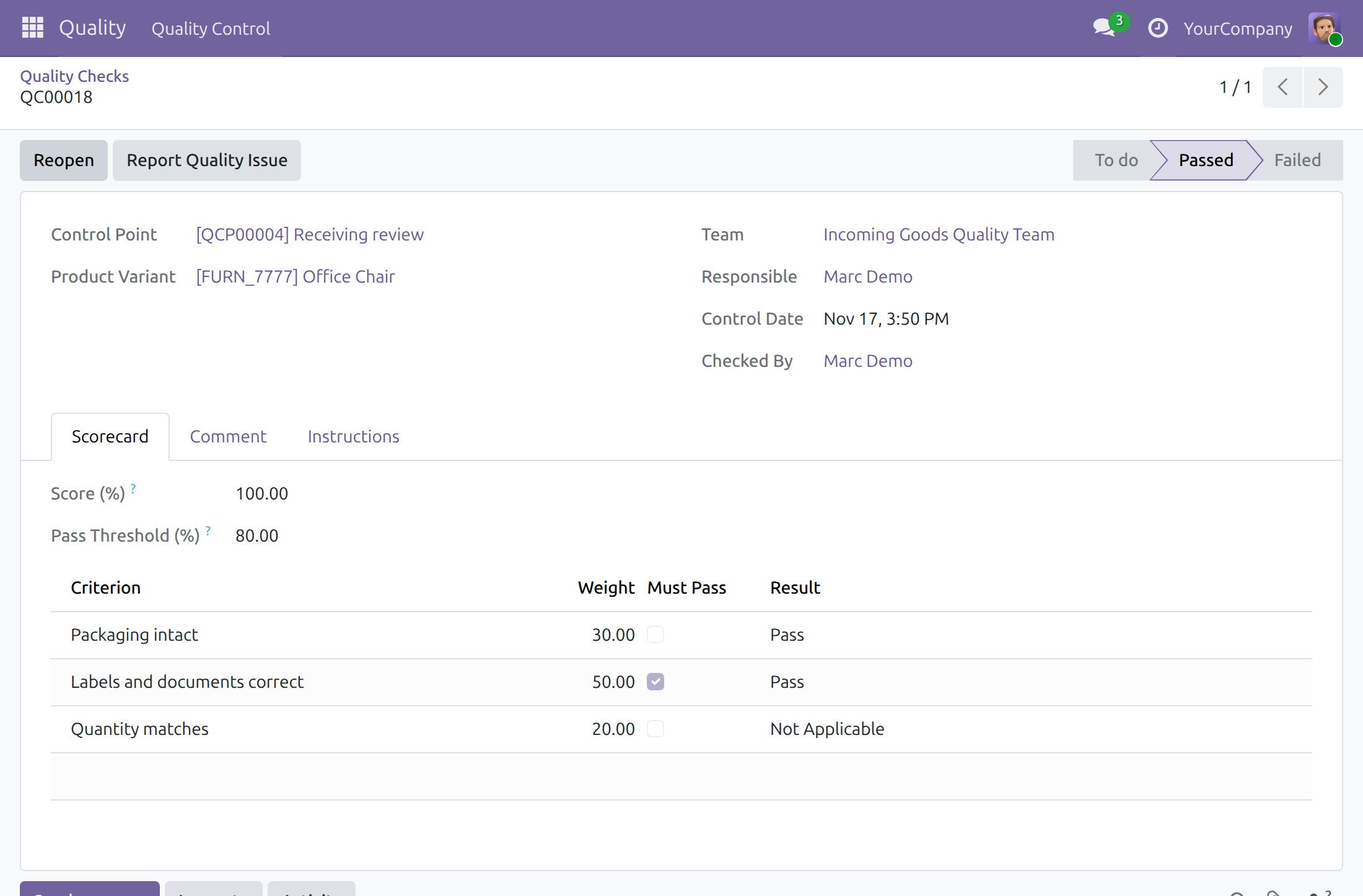
Grade a scorecard check
- Open a check of a Scorecard control point. The Scorecard tab lists the criteria with their Weight and Must Pass.
- For each criterion, tap Pass, Fail or Not Applicable.
- Click Confirm.
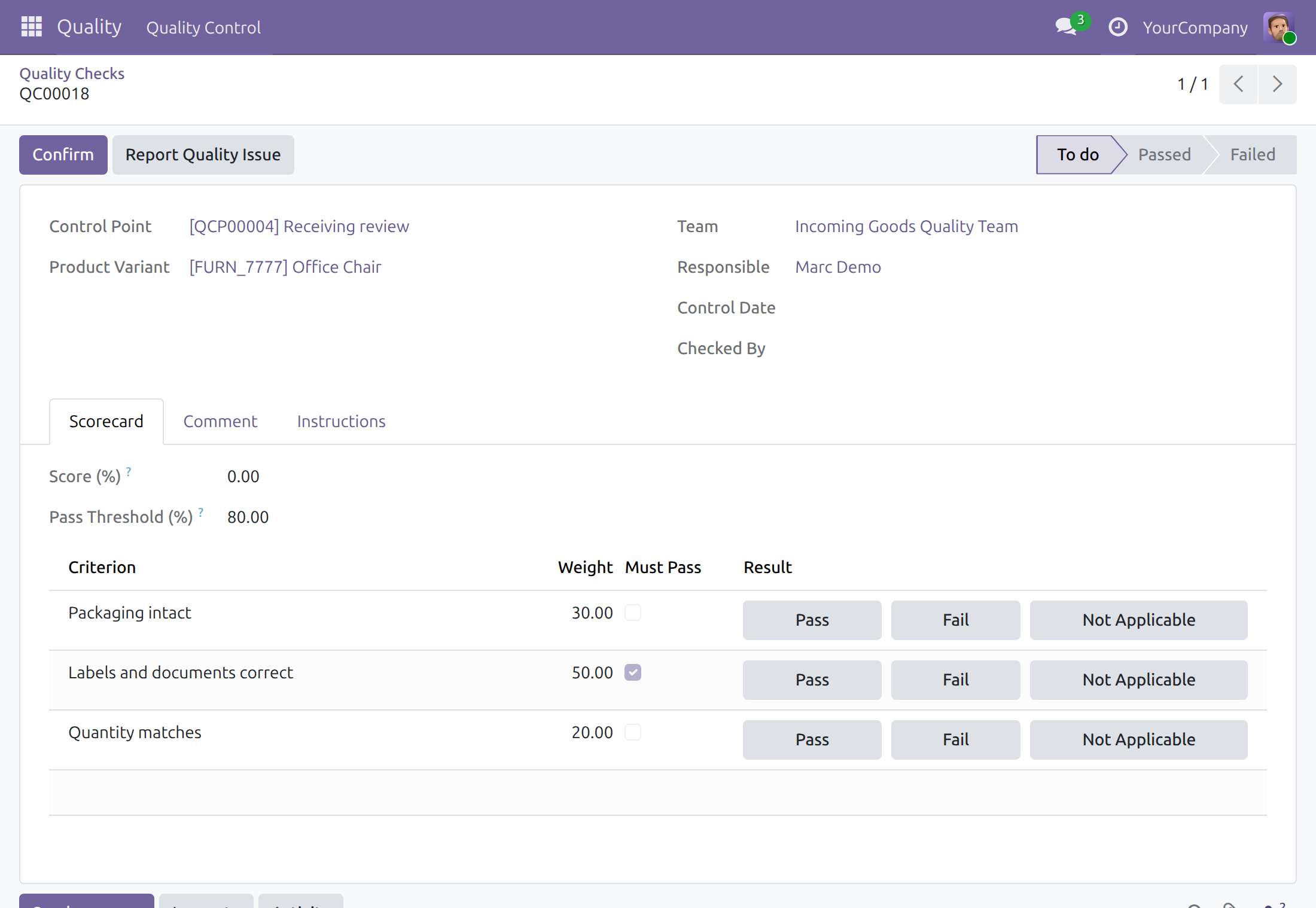
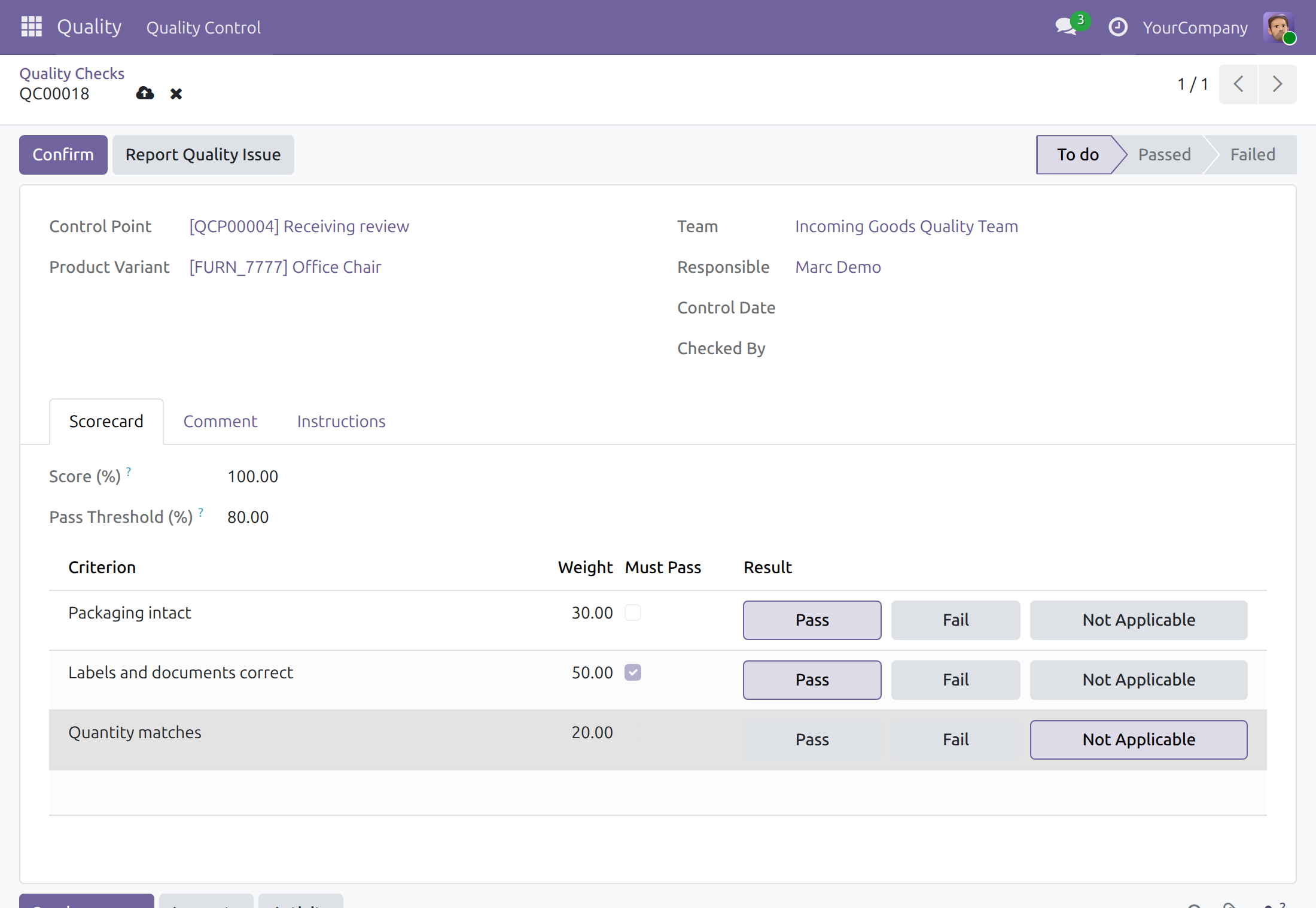
The Score (%) is the weight of the passed criteria over the weight of the criteria that apply. The check is Passed when the score reaches the Pass Threshold (%) and every Must Pass criterion passed; otherwise it is Failed. Every criterion must be graded and at least one must apply before you can confirm.
Any employee: report a quality issue
Anyone who can open a check can raise a quality alert from it, usually from a failed one.
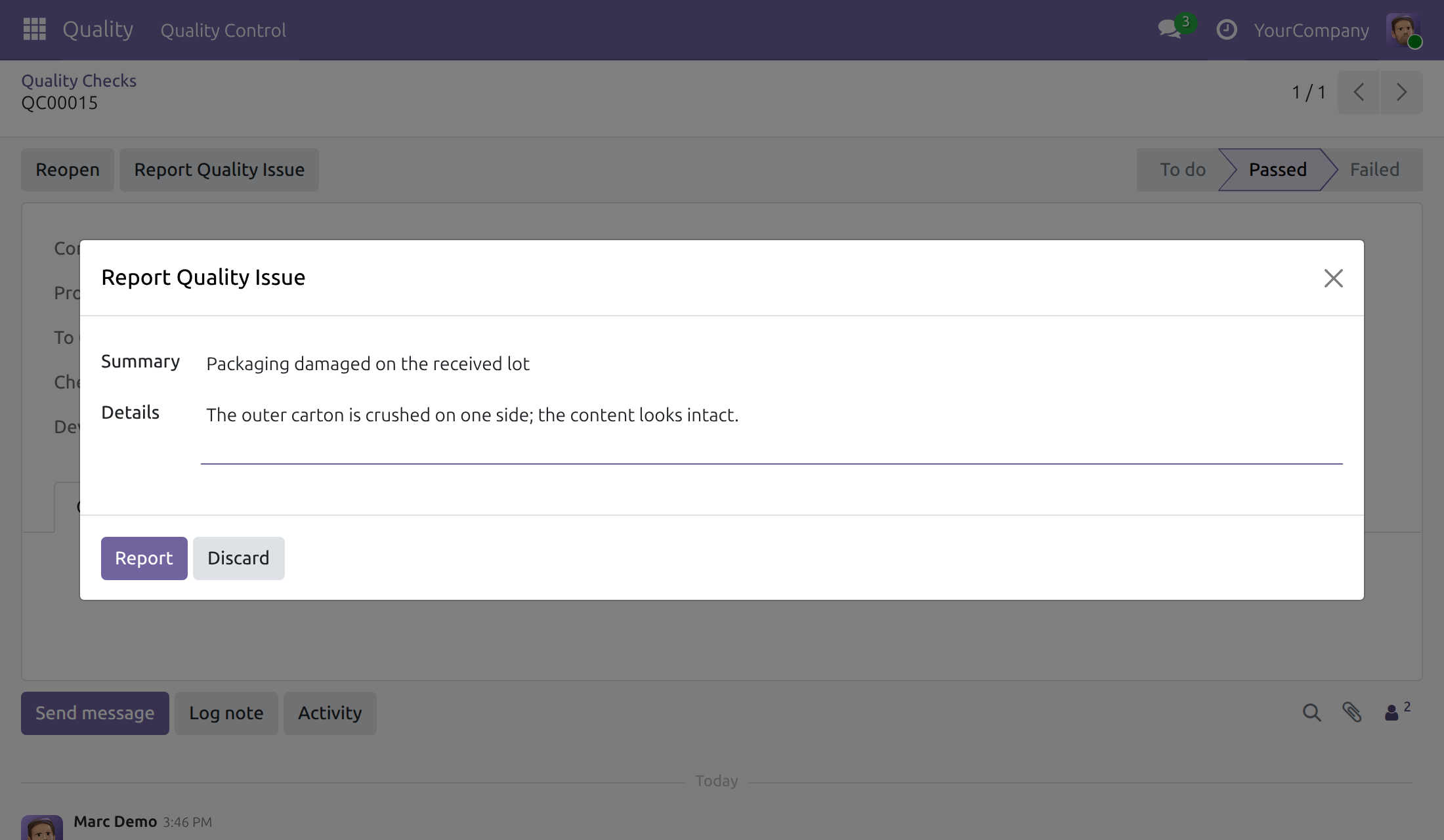
- Open the check and click Report Quality Issue.
- In Summary, write what is wrong in a few words. Add Details if they help.
- Click Report. When the document of the check has several products and does not say which one the issue is about, you also choose the Product.
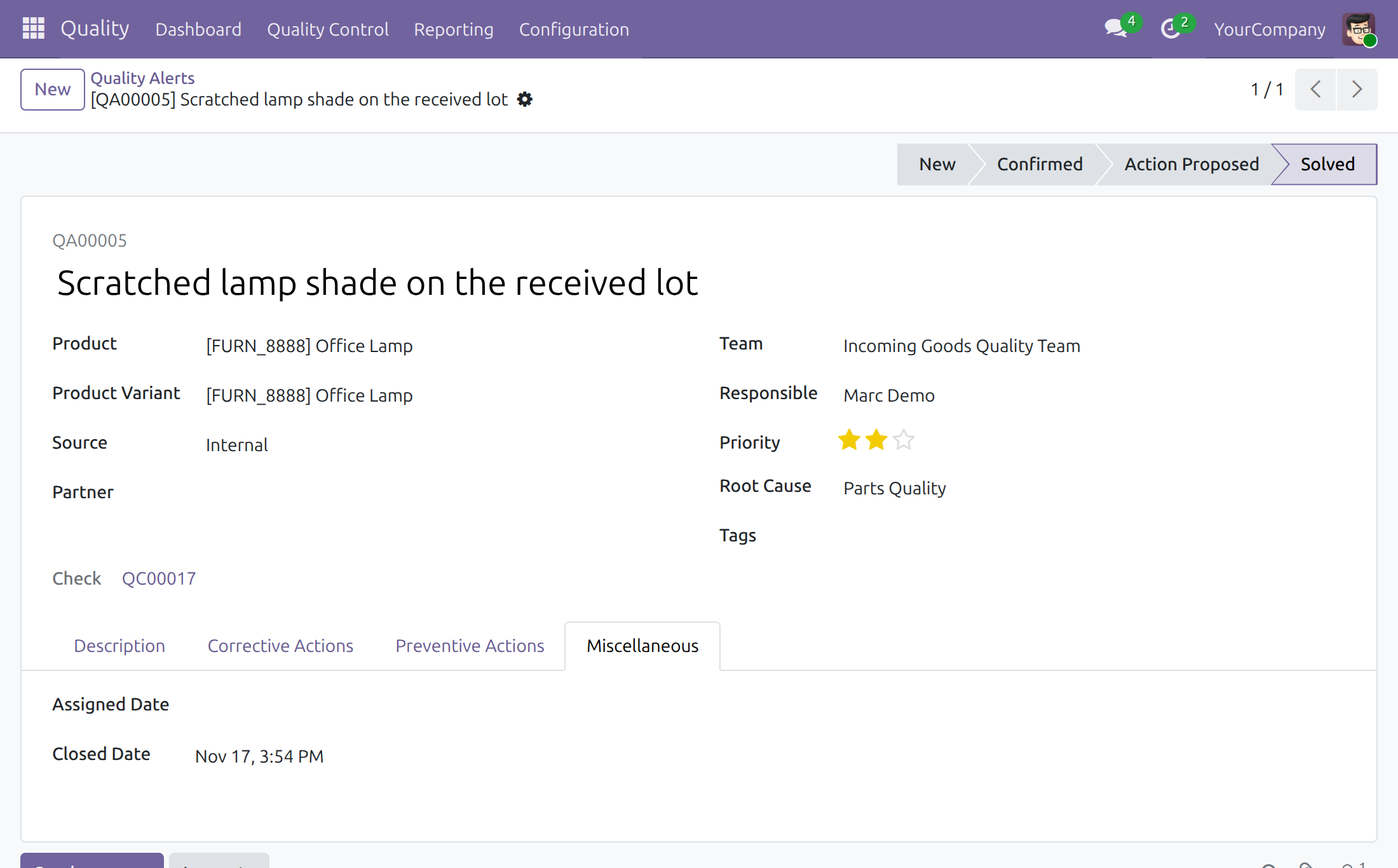
The saved quality alert opens in the stage New. Its summary is the title of the form and the reference such as QA00005 stays above it. The alert is linked to the check and takes its Team and Product; its Responsible is the Responsible of the check, and you follow the alert. Back on the check, the Quality Alerts button shows the number of alerts and opens them.
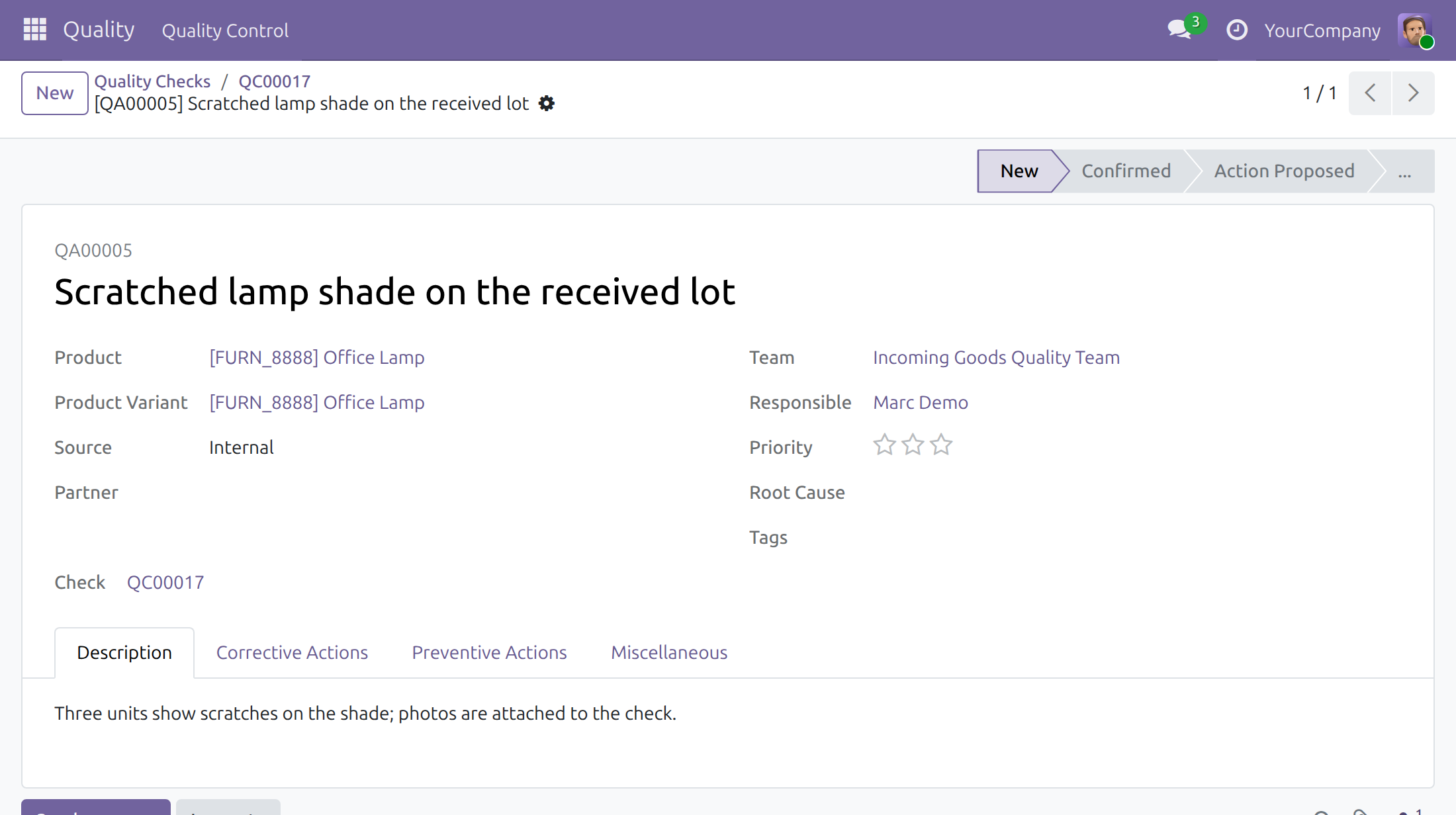
Without the Quality User access right you cannot change the alert: you follow it in the discussion below the form, where you can write and attach files, and the quality team takes over.
Quality User: decide and follow up
A quality user sees every check and every alert. Besides the Quality Checks menu, you have the Dashboard, the Alerts menu and Reporting.
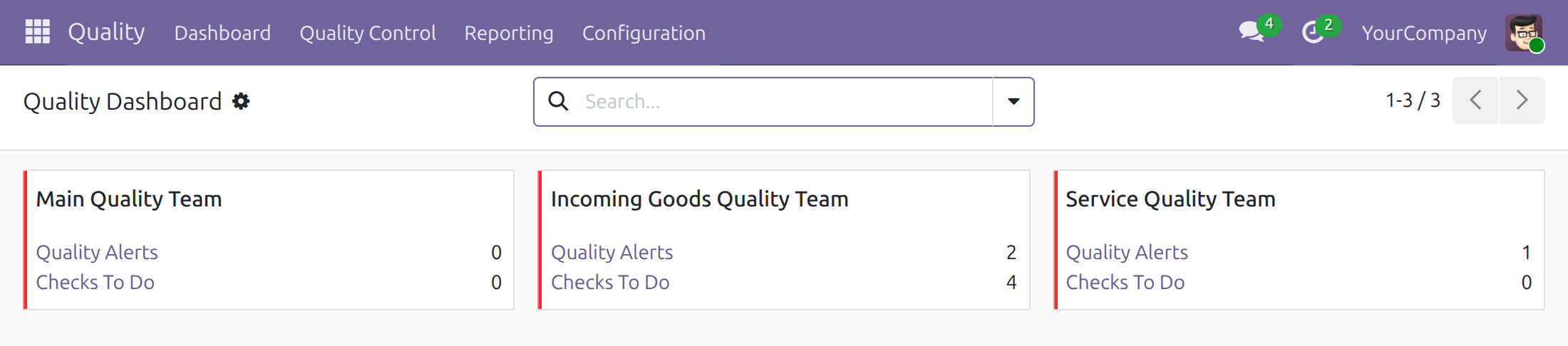
Dashboard
Open Quality ‣ Dashboard. Each quality team has a card with the number of Quality Alerts that are not processed yet and the number of Checks To Do. Click a number to open the matching list. A waived check is not counted among the checks to do.
Decide about a failed check
Only a quality user takes a check out of Failed. Open Quality ‣ Quality Control ‣ Quality Checks, use the Failed filter in the search options and open the check. The header offers:
- Accept with Conditions: the goods or the service are accepted although the check failed.
- Reject: the failure is confirmed and not accepted.
- Reopen: the check goes back to To do for a new inspection. The first result stays recorded: group the checks by First Result to see it.
- Correct Result: opens the dialog again to change the recorded values.
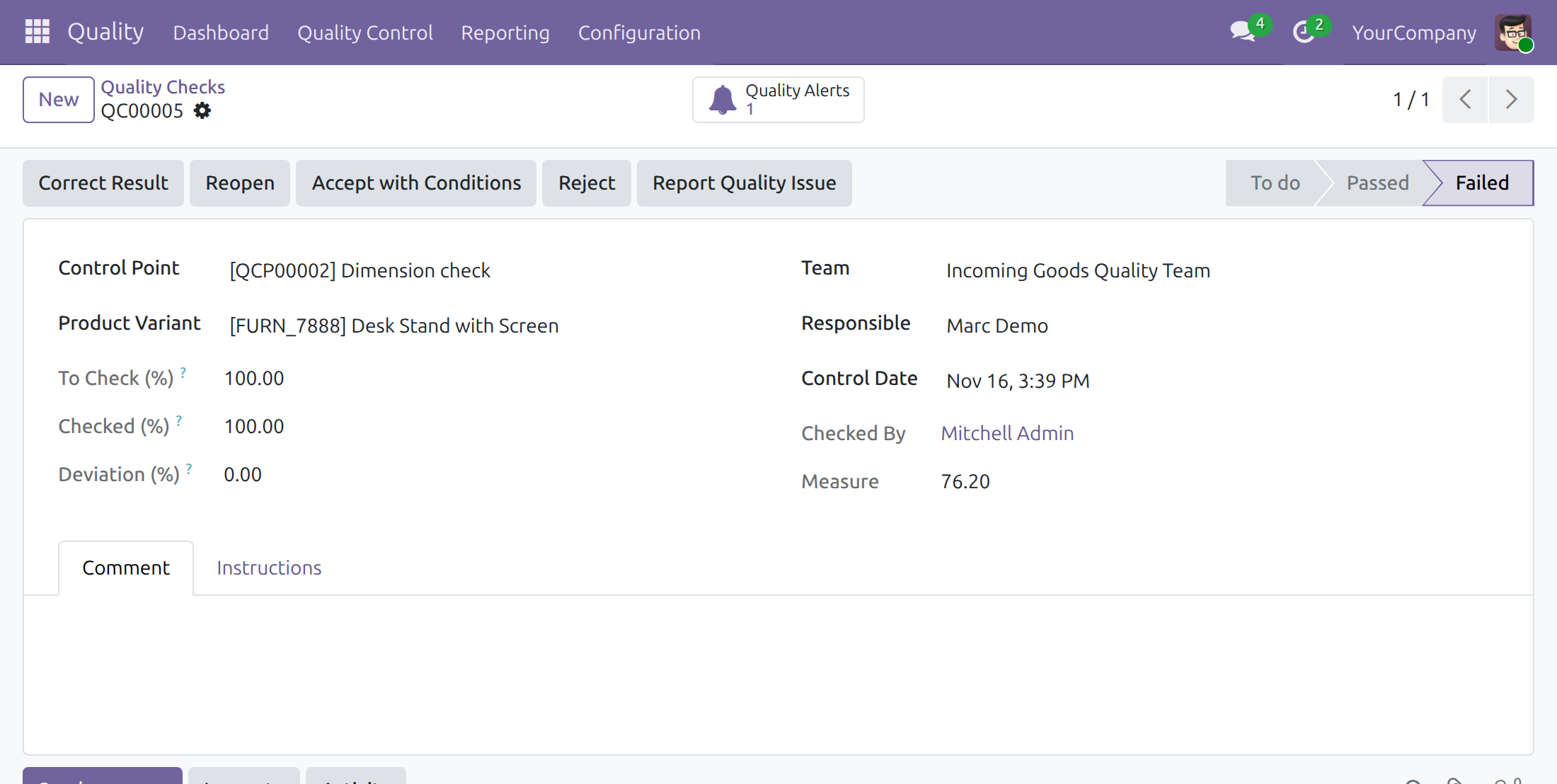
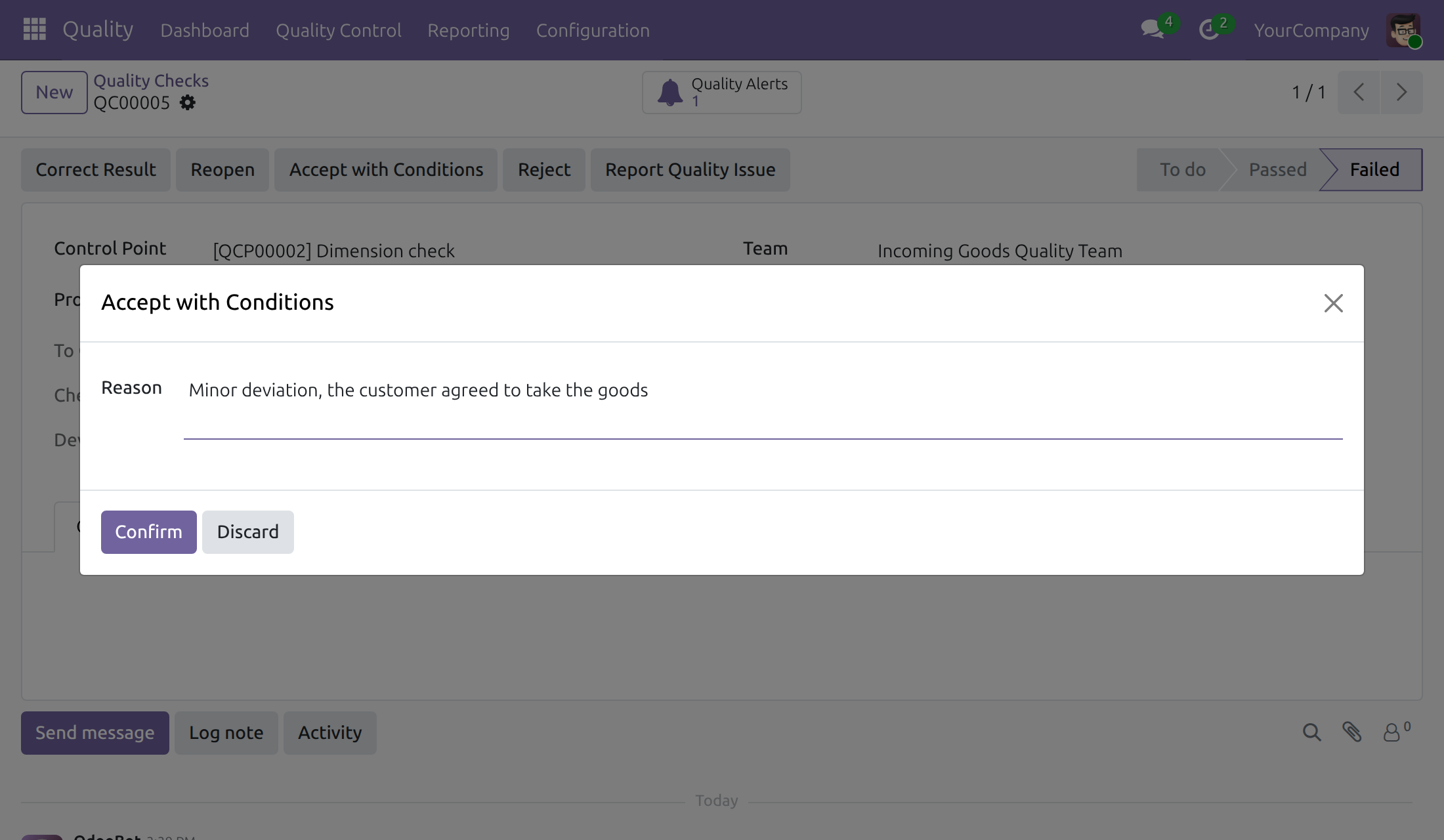
Accept with Conditions and Reject ask for a Reason: it is mandatory. Click Confirm. The check stays Failed and a Decision section records the decision, the reason, Decided By and Decision Date. The With Decision filter lists the decided checks.
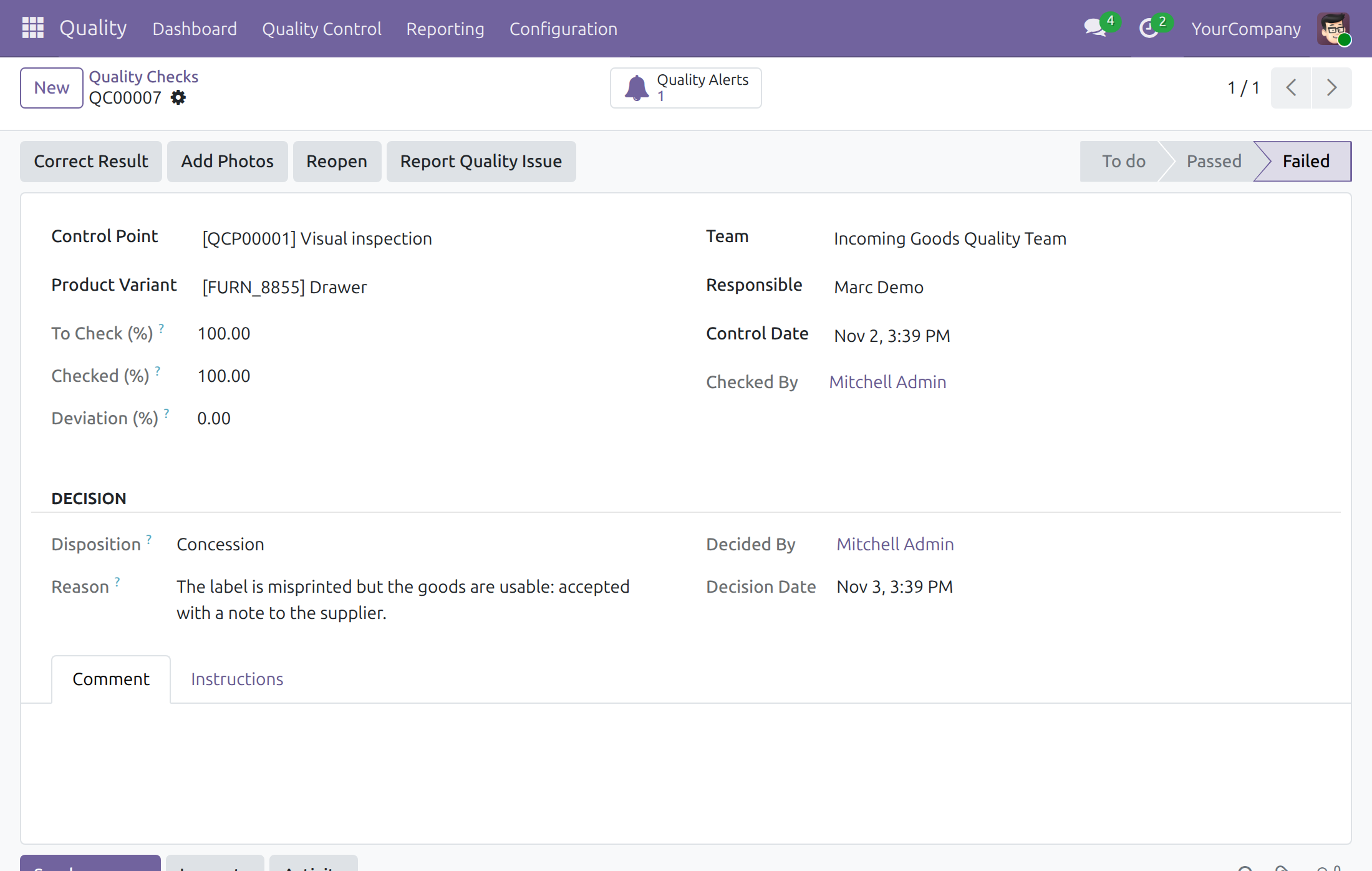
When you reopen a decided check, the decision is withdrawn from the check and a note in the discussion keeps the decision, the reason, who decided and when.
Waive a check
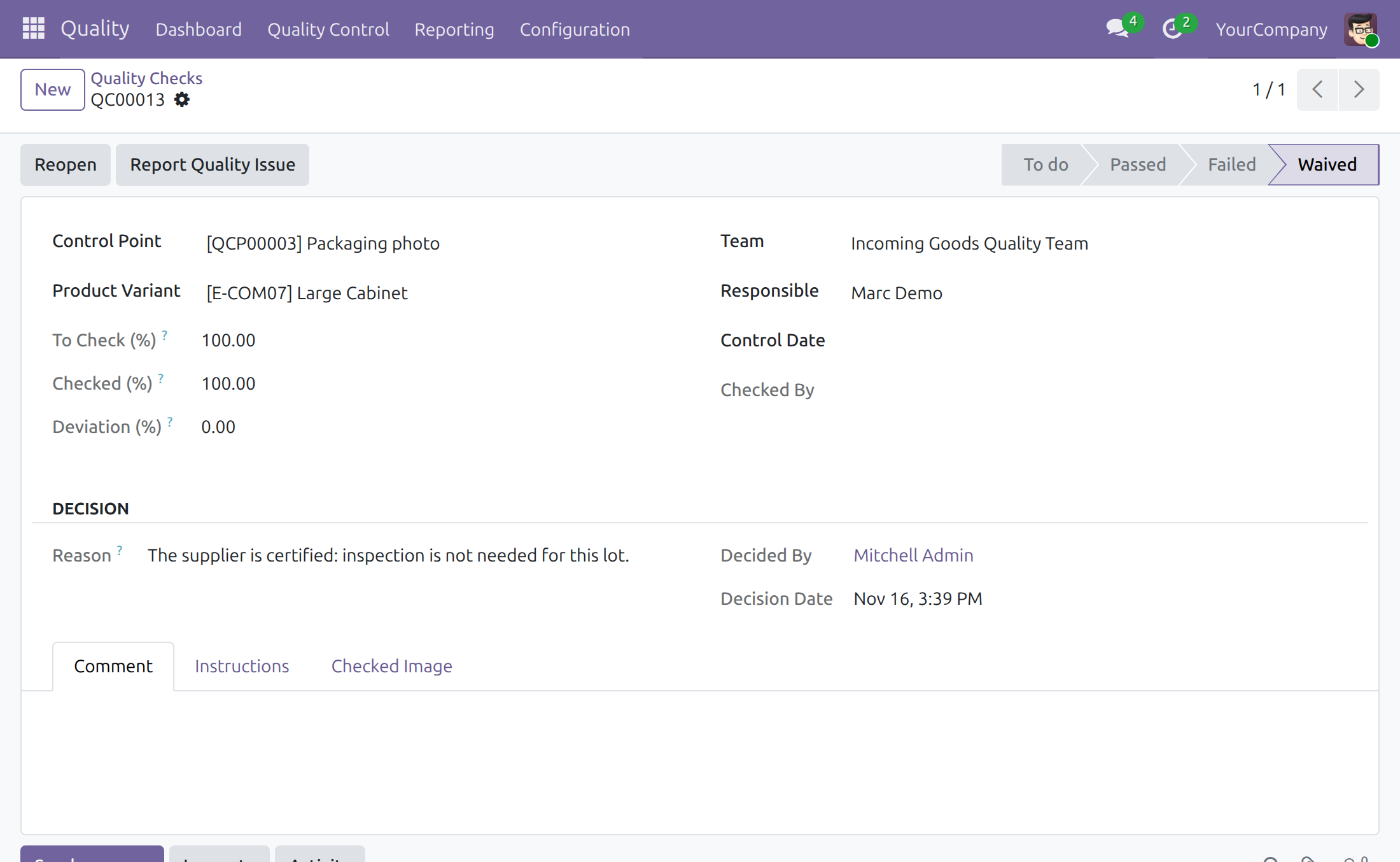
A check that is still to do and does not need inspection can be waived. Open it and click Waive, give the Reason and click Confirm. The status becomes Waived, the reason, the user and the date are recorded, and the check is not counted as to do. Only a quality user can reopen a waived check.
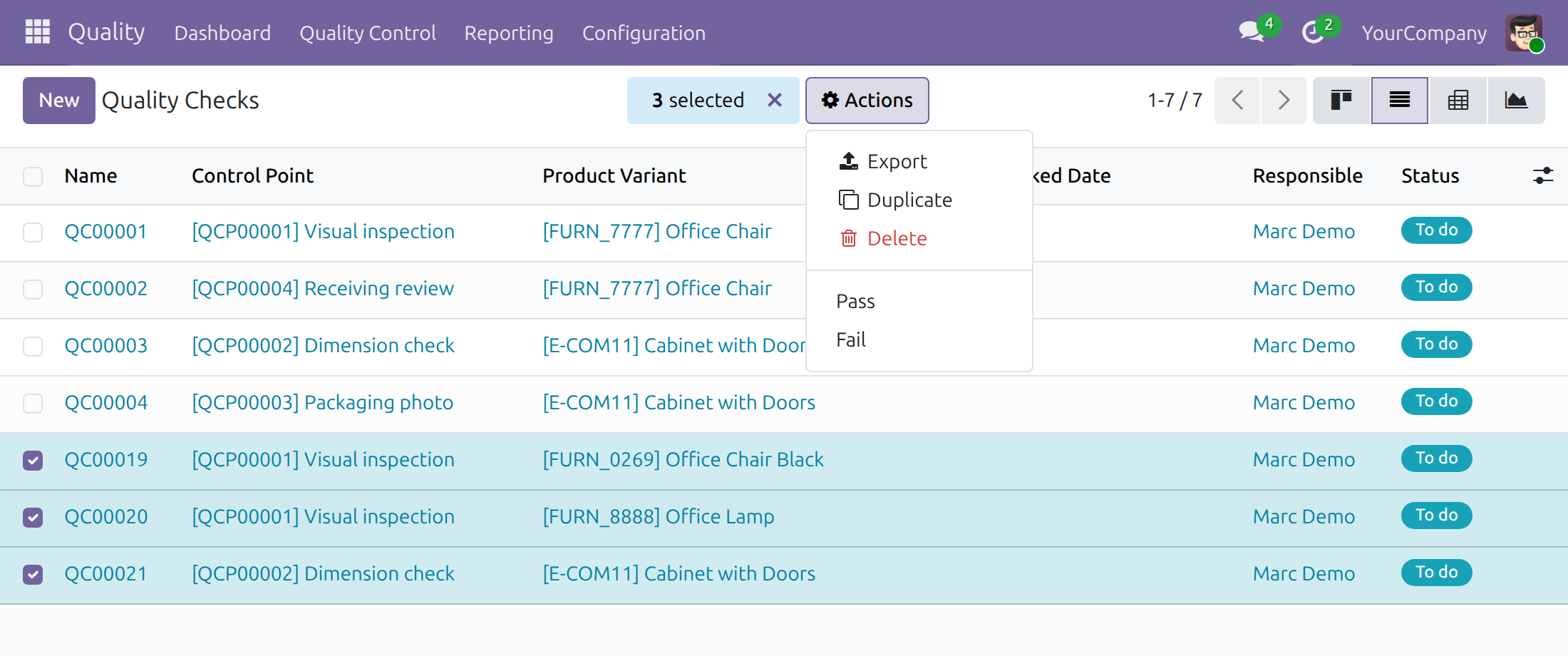
Pass or fail many checks at once
In the check list, tick several checks of the Pass - Fail type, click Actions and choose Pass or Fail. The checks the action applies to are processed. The others, for example a Measure check, are skipped, and a message gives the number processed and the number skipped.
Work through a quality alert
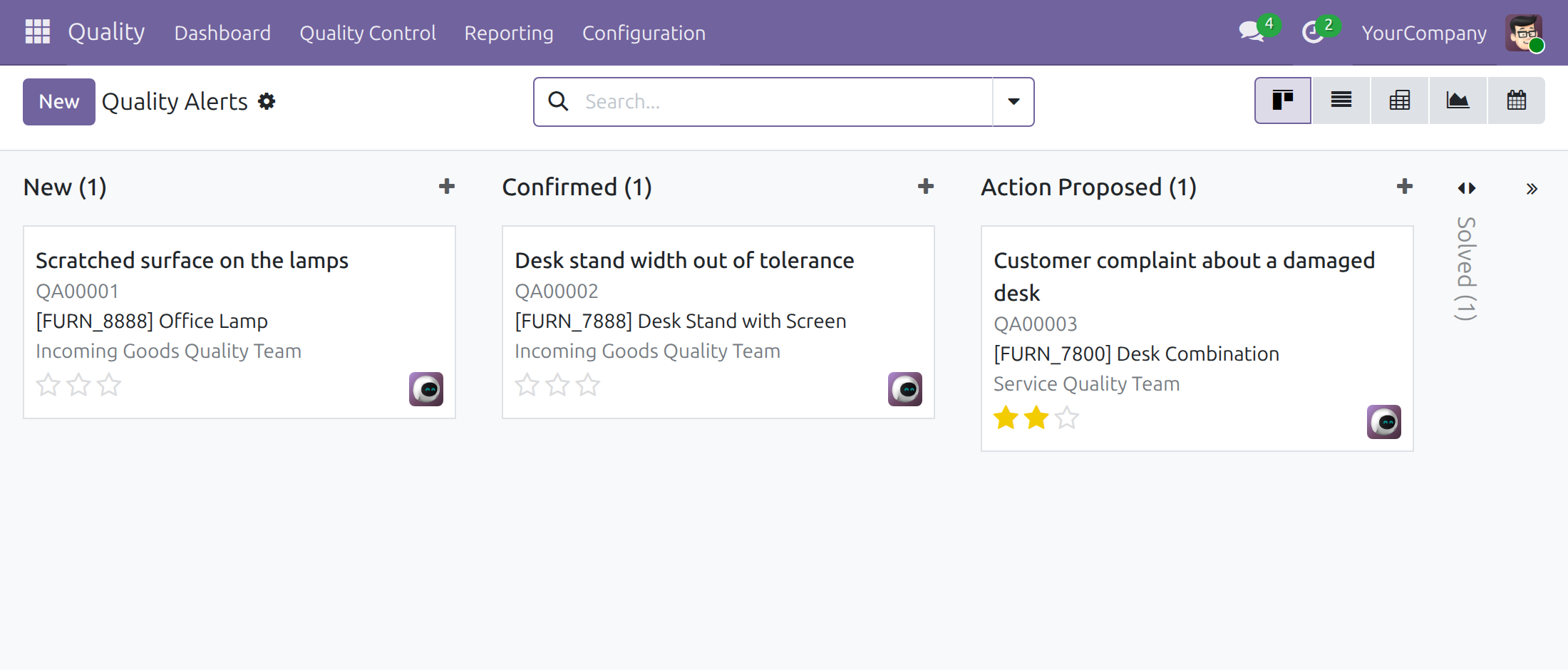
Open Quality ‣ Quality Control ‣ Alerts ‣ Quality Alerts. The board has one column per stage; the Solved column is folded.
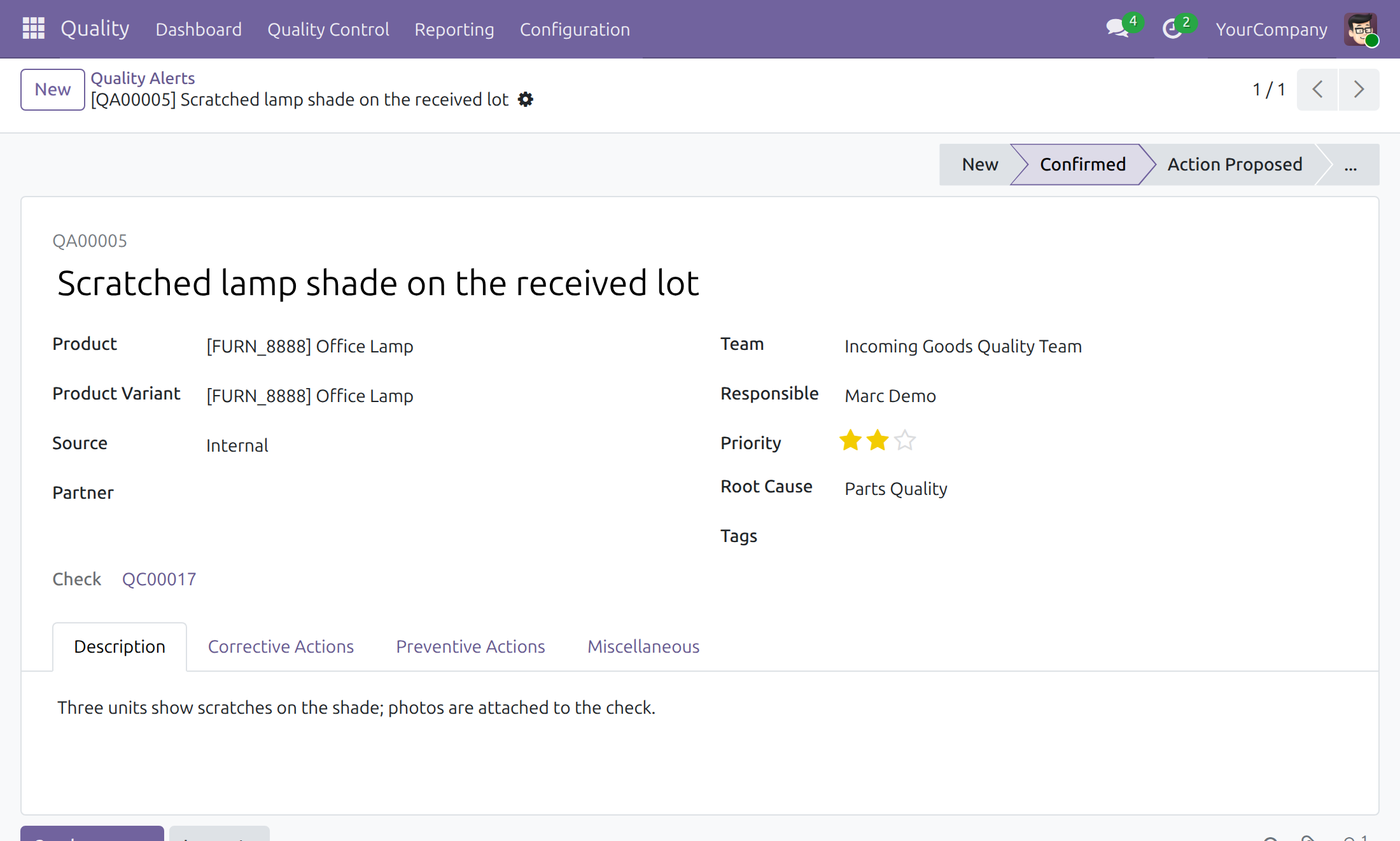
- Open the alert.
- On the Description tab, describe the issue.
- In Root Cause, choose why it happened, for example Parts Quality. Use Tags to label the alert and Source and Partner to say where it comes from.
- In Priority, click the stars to set the urgency.
- Click Confirmed in the status bar once the problem is acknowledged.
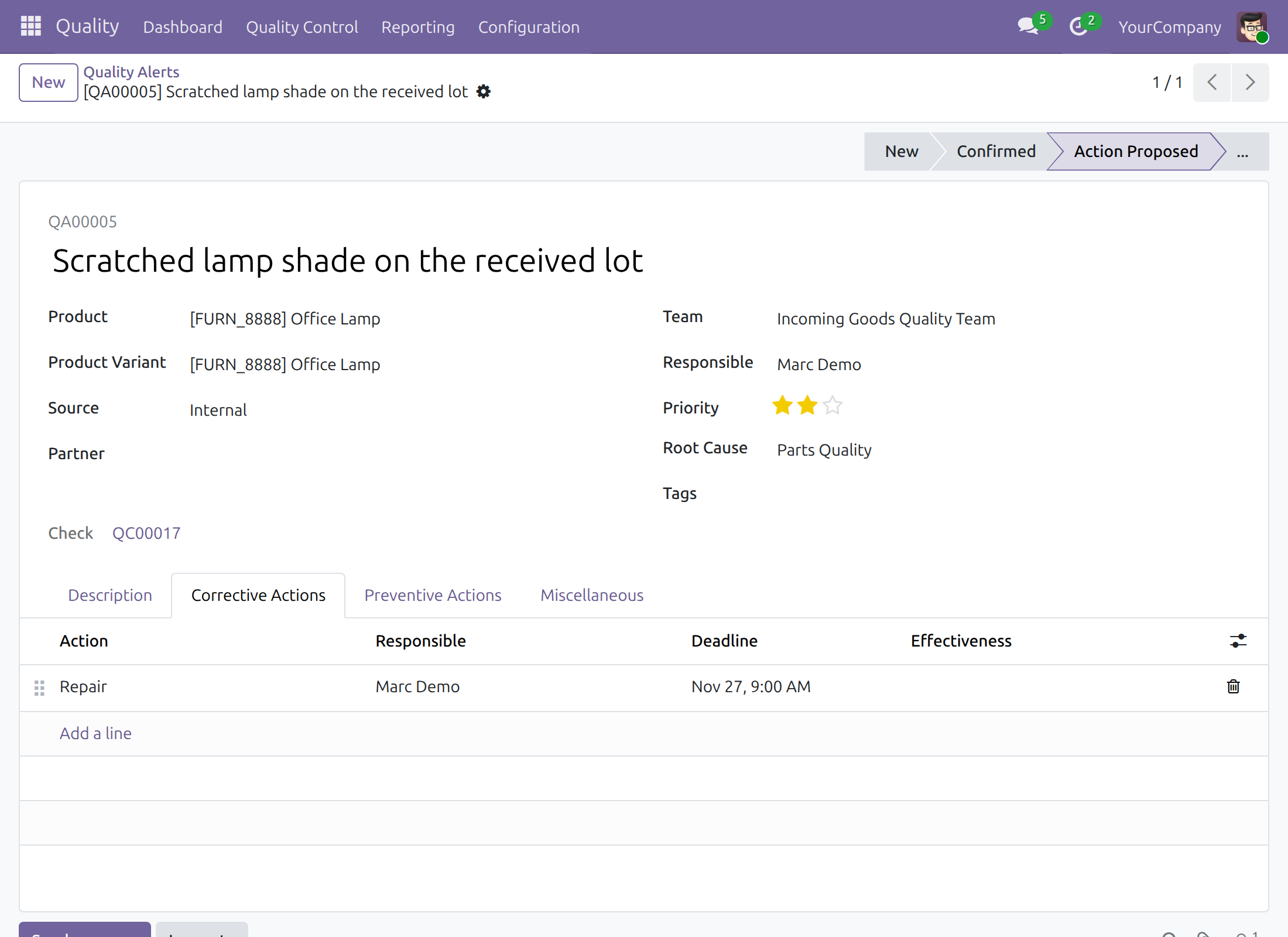
- Open the Corrective Actions tab and click Add a line.
- In Action, pick a reusable action (for example Repair). Check the Responsible and set the Deadline. Use the Preventive Actions tab in the same way for the measures that stop the problem from coming back.
- Click Action Proposed in the status bar when the fix is planned.
- When the fix is done and verified, click ... in the status bar and choose Solved.
The Miscellaneous tab shows the Closed Date.
Review whether the actions worked
The follow-up lists are in Quality ‣ Quality Control ‣ Alerts ‣ Corrective Actions and Preventive Actions. They show the actions of all alerts with their Responsible and deadline; an action that is not done and whose deadline has passed is shown in red.
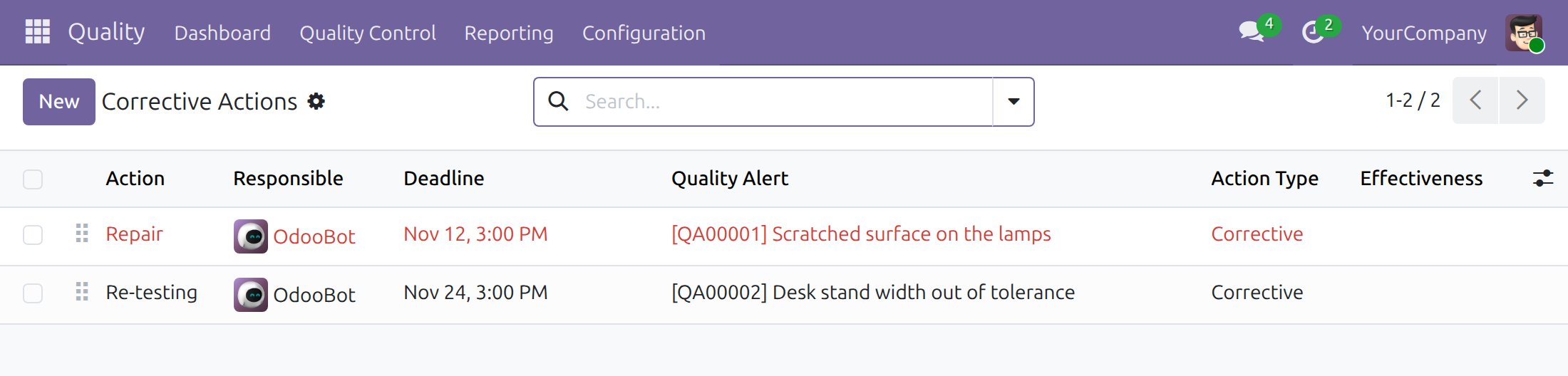
Open an action to review it:
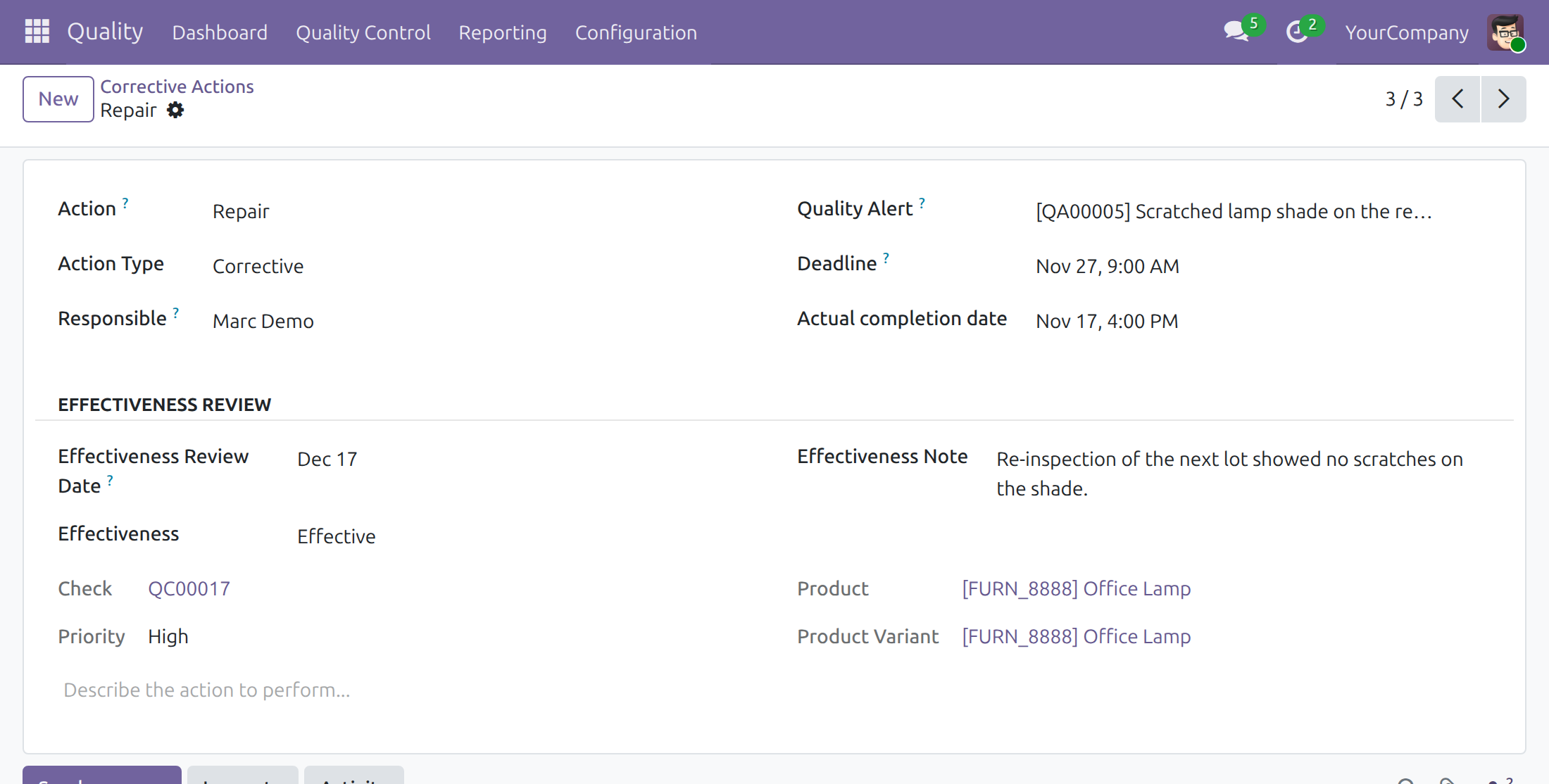
- Fill Actual completion date when the action is done.
- In Effectiveness Review Date, choose the date when the Responsible has to check whether the action solved the problem. On that date the Responsible receives a to-do.
- On or after that date, choose Effective or Ineffective in Effectiveness and write the Effectiveness Note.
- Click Save.
An Ineffective action stays visible with the Ineffective filter, and the alert can still move to its next stage.
Reports and control charts
Under Quality ‣ Reporting a quality user finds:
- Quality Checks: the results over time and the passed against failed units per product, as a graph, a pivot table, a board or a list.
- Control Charts: the control points that are measured, with their number of checks, average and standard deviation.
A quality administrator also finds Quality Alerts (alerts by stage, root cause, team and product) and Alert Actions Analysis (the corrective and preventive actions that are open, late, done or ineffective).
Open Quality ‣ Reporting ‣ Control Charts and click a control point: its control chart opens.
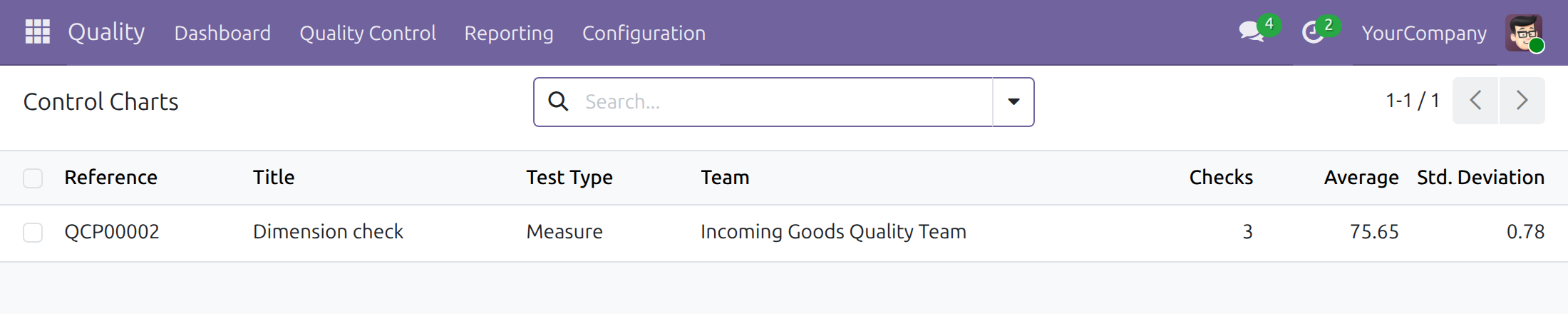
The chart plots one point per measured check and draws the norm and the lowest and highest tolerance as dashed lines, so you see at a glance whether the process drifts toward a limit.
Troubleshooting
- I do not see the Control Points, Quality Point Template or Configuration menus.
- These menus are for the Quality Administrator. Ask an administrator to set your Quality access right to Administrator.
- I do not see the Dashboard, the Alerts menu or Reporting.
- They are for the Quality User. Without a Quality access right you only see the checks assigned to you or followed by you, under Quality ‣ Quality Control.
- I open a check and there is no Pass or Measure button.
- The header only offers the controls the test type of the control point allows: a Measure check offers Measure, a scorecard check offers Confirm. You also see no result button on a check that already has a result.
- The Validate button is grey.
- Enter a measure first, by typing it or by tapping + or -.
- I cannot remove a photo.
- The photos attached to a failed check cannot be removed by an inspector, and the photos of a passed check are locked. Only a quality user can change them.
- I cannot pass a Take a Picture check.
- This type of check needs at least one photo before it can be passed.
- The Reopen button is missing on a failed or waived check.
- Only a quality user takes a check out of Failed or Waived. Ask one to reopen it.
- I cannot confirm a scorecard check.
- Grade every criterion first, and make sure at least one criterion applies.
- I cannot edit the quality alert I just reported.
- Without the Quality User access right the alert is read-only for you. Write in the discussion below the form; the quality team handles it.
- I cannot delete a control point.
- A control point that has checks cannot be deleted. Archive it instead.
FAQ
- Who decides that a check is passed?
- Whoever works on the check records the result. Checked By shows who did it and Control Date when. The Recorded by Another User filter lists the checks recorded by someone other than the Responsible.
- Is the result of a measurement calculated for me?
- Yes. The check is passed when the measure lies inside the tolerance of the control point and failed when it lies outside.
- Does reopening a check delete anything?
- It withdraws the result and brings the check back to To do. The comment and the photos are kept, and a decision on the check is withdrawn with a note that keeps its reason.
- What does Accept with Conditions change?
- The check stays Failed, because the inspection result is a fact. The decision, its reason, the person and the date are recorded on the check.
- Where do the checks come from?
- You can create a check with New in Quality Checks if you are a quality user. When the quality apps for transfers and production orders are installed, they create the checks of your control points for you.
- Can a quality alert be raised without a check?
- Yes. A quality user creates one with New in Quality Alerts, and mail sent to the email alias of a quality team creates one as well.
This software and associated files (the "Software") may only be used (executed, modified, executed after modifications) if you have purchased a valid license from the authors, typically via Odoo Apps, or if you have received a written agreement from the authors of the Software (see the COPYRIGHT file).
You may develop Odoo modules that use the Software as a library (typically by depending on it, importing it and using its resources), but without copying any source code or material from the Software. You may distribute those modules under the license of your choice, provided that this license is compatible with the terms of the Odoo Proprietary License (For example: LGPL, MIT, or proprietary licenses similar to this one).
It is forbidden to publish, distribute, sublicense, or sell copies of the Software or modified copies of the Software.
The above copyright notice and this permission notice must be included in all copies or substantial portions of the Software.
THE SOFTWARE IS PROVIDED "AS IS", WITHOUT WARRANTY OF ANY KIND, EXPRESS OR IMPLIED, INCLUDING BUT NOT LIMITED TO THE WARRANTIES OF MERCHANTABILITY, FITNESS FOR A PARTICULAR PURPOSE AND NONINFRINGEMENT. IN NO EVENT SHALL THE AUTHORS OR COPYRIGHT HOLDERS BE LIABLE FOR ANY CLAIM, DAMAGES OR OTHER LIABILITY, WHETHER IN AN ACTION OF CONTRACT, TORT OR OTHERWISE, ARISING FROM, OUT OF OR IN CONNECTION WITH THE SOFTWARE OR THE USE OR OTHER DEALINGS IN THE SOFTWARE.