
Viindoo AI - Editor
| Lines of Code | 1099 |
| Technical name | viin_ai_editor |
| License | OPL-1 |
| Website | https://viindoo.com |
| Read description for | |
| Required Apps | Discuss (mail) |
| Included Dependencies | Viindoo AI Viindoo Web Editor Viindoo Base API Request Logger |
| Extensions | Viindoo AI - Brain Bridge Viindoo AI Suite |

An AI block and AI assist commands in any HTML field
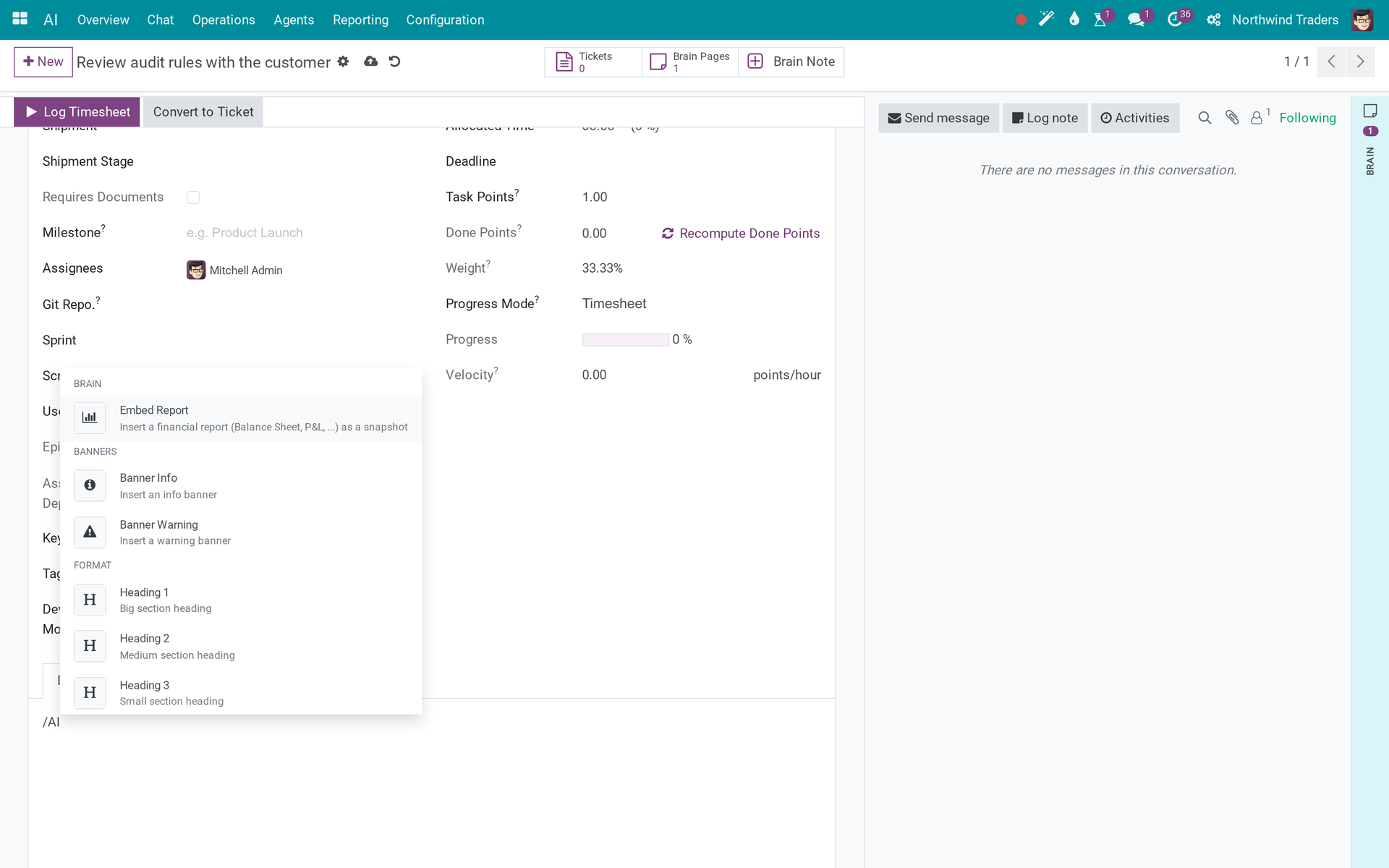
Type / in any rich-text field and choose "AI block": a generated block appears with its status (generating, pending review, approved, human modified, error) and can be accepted or rewritten; the commands are generic and need no knowledge base.
Viindoo AI - Editor (technical name viin_ai_editor) is an Odoo 17.0 app for Odoo Community and Viindoo Cloud, built for project manager.

At a Glance
The facts of Viindoo AI - Editor, version 1.0.1, in one place. Published by Viindoo.
How It Works
Type / then AI.
Powerbox
The AI block command.
The task
Where the block goes.

What You Get
/AI in any HTML field
Block with a review status
Generic - no Brain needed
What This App Does Not Do
Read this before you buy. Everything below is something the app deliberately leaves to another app or to you.
The lab provider keys are placeholders; every trace, brief and chat reply shown was recorded by hand to show the shape of the data.
This module inserts blocks.
Works Well With
Apps from the same stack, built to fit this one:
Who Should Use Viindoo AI - Editor?
Project manager
Draft the task description, then edit it.
Frequently Asked Questions
What does Viindoo AI - Editor do?
Type / in any rich-text field and choose "AI block": a generated block appears with its status (generating, pending review, approved, human modified, error) and can be accepted or rewritten; the commands are generic and need no knowledge base.
What does Viindoo AI - Editor not do?
Nothing answers without a vendor key. The lab provider keys are placeholders; every trace, brief and chat reply shown was recorded by hand to show the shape of the data. The writing dialog with alternatives belongs to the Brain bridge. This module inserts blocks.
Who is Viindoo AI - Editor for?
Project manager: Draft the task description, then edit it.
Which Odoo version and editions does it support?
Odoo 17.0 - Odoo Community, Viindoo Cloud. Upgrades to a newer Odoo series are a separate purchase for that series.
What does it depend on?
It installs on top of: viin_web_editor, viin_ai, web. Odoo installs them with it.
How do I set it up?
Type / then AI.
What works well with it?
Viindoo AI (viin_ai): Required - vendors, providers, agents, cost caps and the audit trail. AI - Brain Bridge (viin_ai_brain): AI: Write dialog and fact history in Brain.
Can I try it before buying?
Yes - the Live Preview button at the top of this page opens the module's own screen on a working database.
How do I get support?
Write to apps.support@viindoo.com with your Odoo version and the technical name viin_ai_editor; pre-sales questions go to sales@viindoo.com.
See Viindoo AI - Editor in Action
An AI block and AI assist commands in any HTML field
Need help with Viindoo AI - Editor?
For questions, implementation support, or consulting services, contact Viindoo.
Pre-Sales & Partnership
sales@viindoo.comWhen contacting us, please include:
- Odoo/Viindoo version (Odoo CE / Viindoo Editions).
- Number of users and business scope.
- Other modules currently in use.
Technical Support
apps.support@viindoo.comFor faster troubleshooting, please provide:
- Order number or app reference.
- Odoo/Viindoo version & edition.
- Steps to reproduce the issue.
- Screenshots/logs if available.
Upgrades to a newer Odoo series are a separate purchase for that series.
Technical Requirement
Changes log
1.0.1 - Latest on the 17.0 line
- Approve and Reject on an AI block wait for the server to record the decision; the block stays awaiting review, with a clear message, if the decision is refused.
- Rejecting removes the block only after the rejection is recorded.
- The browser reports only the run and the decision; attribution and confidence are recorded on the server.
- Model-authored HTML is sanitized before it is rendered.
1.0.0 - Aligned with 17.0
- Aligned with the 17.0 models and views.
This software and associated files (the "Software") may only be used (executed, modified, executed after modifications) if you have purchased a valid license from the authors, typically via Odoo Apps, or if you have received a written agreement from the authors of the Software (see the COPYRIGHT file).
You may develop Odoo modules that use the Software as a library (typically by depending on it, importing it and using its resources), but without copying any source code or material from the Software. You may distribute those modules under the license of your choice, provided that this license is compatible with the terms of the Odoo Proprietary License (For example: LGPL, MIT, or proprietary licenses similar to this one).
It is forbidden to publish, distribute, sublicense, or sell copies of the Software or modified copies of the Software.
The above copyright notice and this permission notice must be included in all copies or substantial portions of the Software.
THE SOFTWARE IS PROVIDED "AS IS", WITHOUT WARRANTY OF ANY KIND, EXPRESS OR IMPLIED, INCLUDING BUT NOT LIMITED TO THE WARRANTIES OF MERCHANTABILITY, FITNESS FOR A PARTICULAR PURPOSE AND NONINFRINGEMENT. IN NO EVENT SHALL THE AUTHORS OR COPYRIGHT HOLDERS BE LIABLE FOR ANY CLAIM, DAMAGES OR OTHER LIABILITY, WHETHER IN AN ACTION OF CONTRACT, TORT OR OTHERWISE, ARISING FROM, OUT OF OR IN CONNECTION WITH THE SOFTWARE OR THE USE OR OTHER DEALINGS IN THE SOFTWARE.