
Accounting Reports - Vietnam Accounting
| Lines of Code | 15406 |
| Technical name | l10n_vn_viin_account_reports |
| License | OPL-1 |
| Website | https://viindoo.com/apps/modules/19.0/l10n_vn_viin_account_reports |
| Read description for | v 10.0 v 11.0 v 12.0 v 13.0 v 14.0 v 15.0 v 16.0 v 17.0 v 18.0 |
| Required Apps | Invoicing (account) Discuss (mail) |
| Included Dependencies | Accounting & Financial Reports Account Counterparts Viindoo Base Vietnam Chart of Accounts - Circular 99 and 133 Accounting Foundation Legal Invoice Number |
| Extensions | Accounting Reports - Vietnam Accounting - Foreign Trade Accounting Reports - Vietnam Accounting - Fixed Asset Disposals |
VAS templates for Vietnam
Vietnam Accounting Reports (VAS)
Prebuilt Statement of Financial Position (B01-DN), Profit & Loss (B02-DN) and Cash Flow Statement (B03-DN) under Circular 99, the Circular 133 forms (B01a-DNN, B01b-DNN, B02-DNN, B03-DNN), imported goods on the VAT return, sales and purchase invoice lists, and required ledgers/books that comply with Circular 99/2025/TT-BTC and Circular 133/2016/TT-BTC.
What this module does
Extends to_account_reports and l10n_vn_viin to provide Vietnam Accounting Standards reports required by the Ministry of Finance.
- VAS Chart of Accounts aligned with Circular 99/2025/TT-BTC and Circular 133/2016/TT-BTC.
- Financial statements: Statement of Financial Position (B01-DN), Profit & Loss (B02-DN), Cash Flow Statement (B03-DN) for Circular 99; B01a-DNN, B01b-DNN, B02-DNN, B03-DNN for Circular 133.
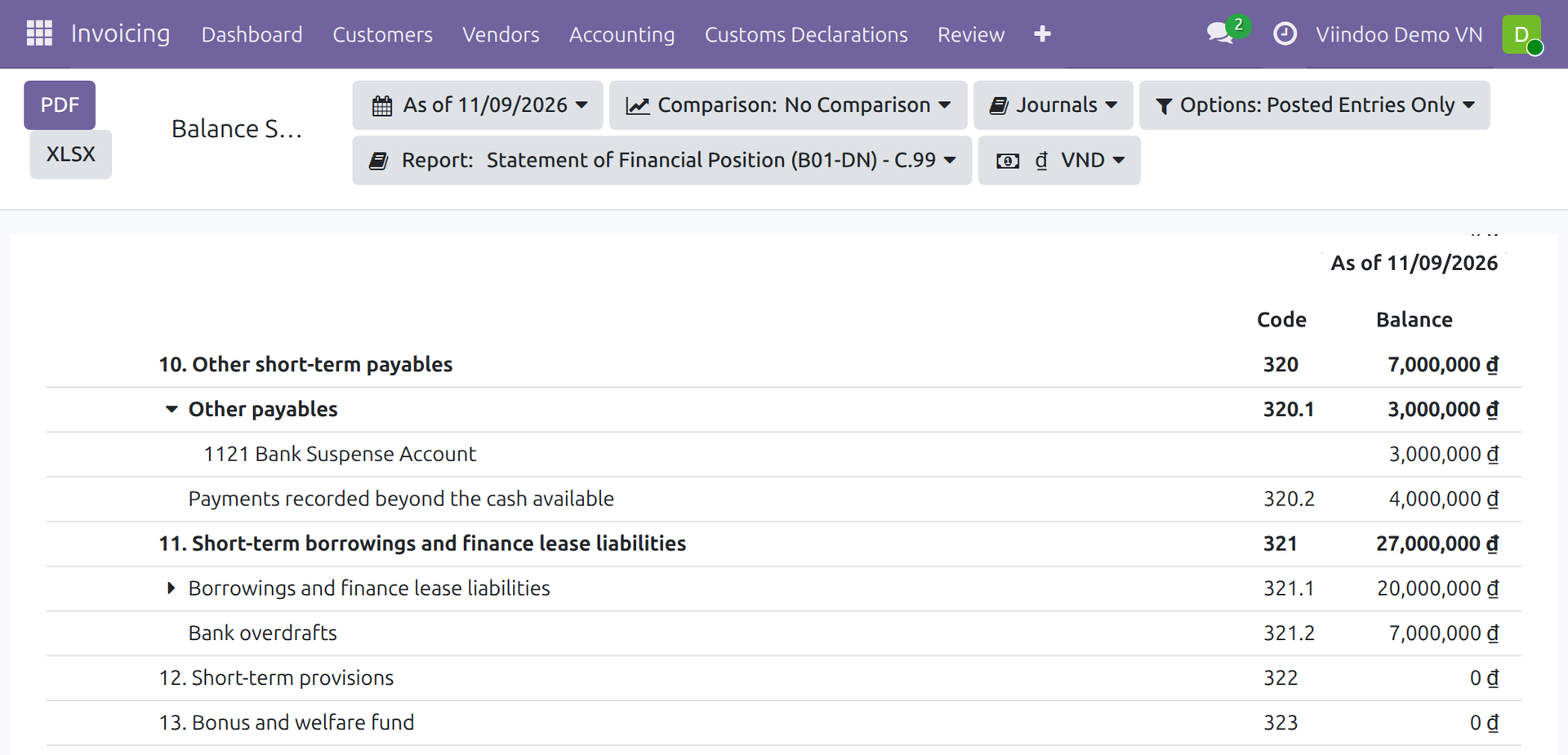
- Statement of Financial Position: cash per account, bank overdrafts as short-term borrowings, unmatched bank statement lines as other payables or other receivables, and a preparer's note on the short-term classification.
- Cash Flow Statement: line 70 equals line 110 of the Statement of Financial Position for any period, with other receipts and payments broken down by counterpart account.
- Trial Balance: debit and credit per partner and per legal entity for accounts flagged "Has balance at both debit and credit?".
- Invoice lists: Reporting > Invoice Lists offers a Sales Invoice List and a Purchase Invoice List in Excel format.
- Audit-ready ledgers and books (S38, S03a, S03b, S07, S08) with PDF/XLSX export.
- Imported goods on the VAT return: import VAT and customs duty are declared on the customs declaration (Foreign Trade); the imported-goods value lines of the Tax Report (source of 01/GTGT [23]/[23a]) are computed from its vouchers, the customs duty is inside the import VAT base, and every figure opens the journal items behind it.
- Purchase Invoice List lists every vendor bill in full, even when only part of its lines is spread over a VAT-section analytic account.
Vietnam Accounting Standards reports Statement of Financial Position, Profit & Loss, Cash Flow Statement, sales and purchase invoice lists, and statutory ledgers/books with PDF/XLSX export.
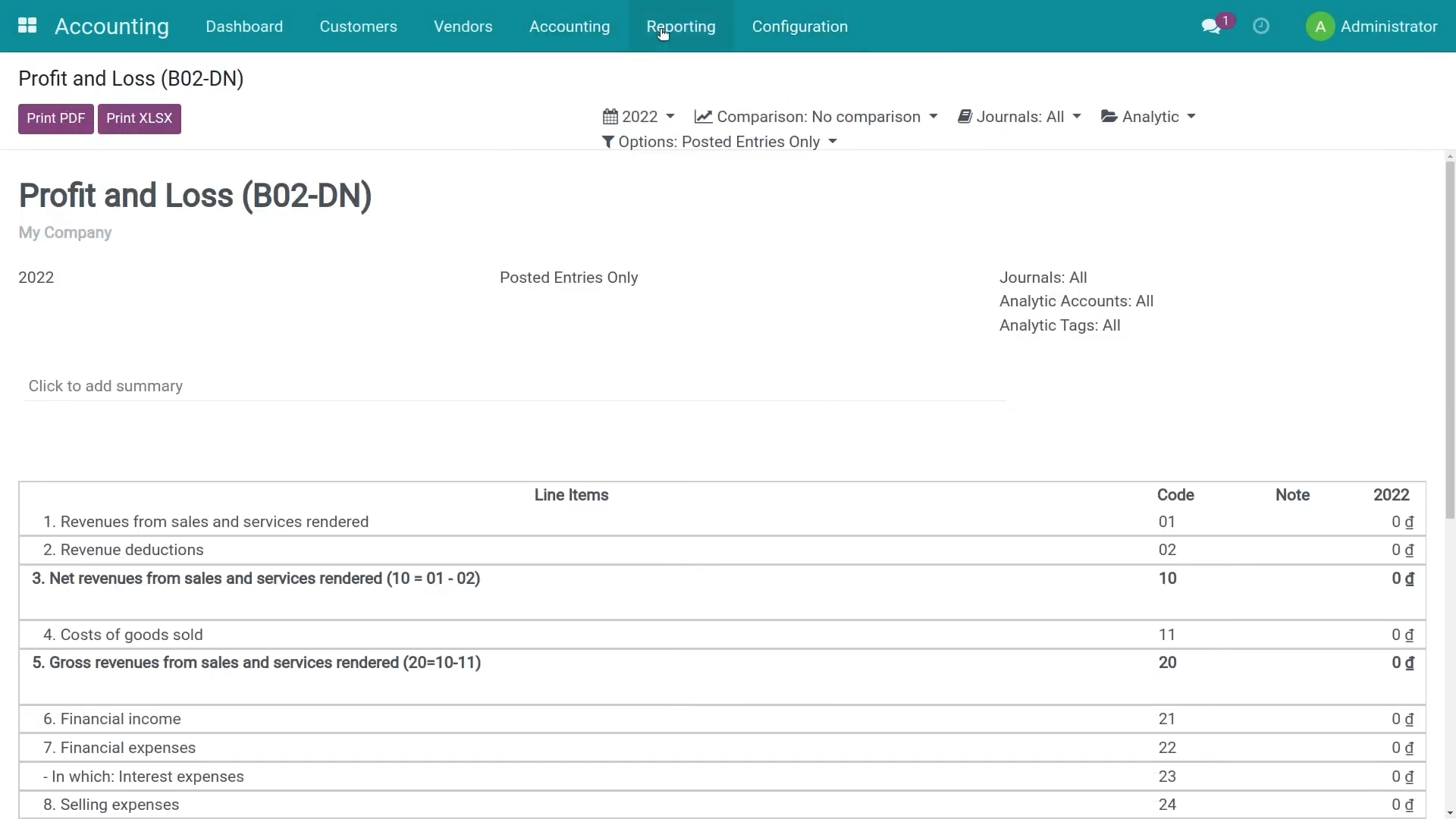
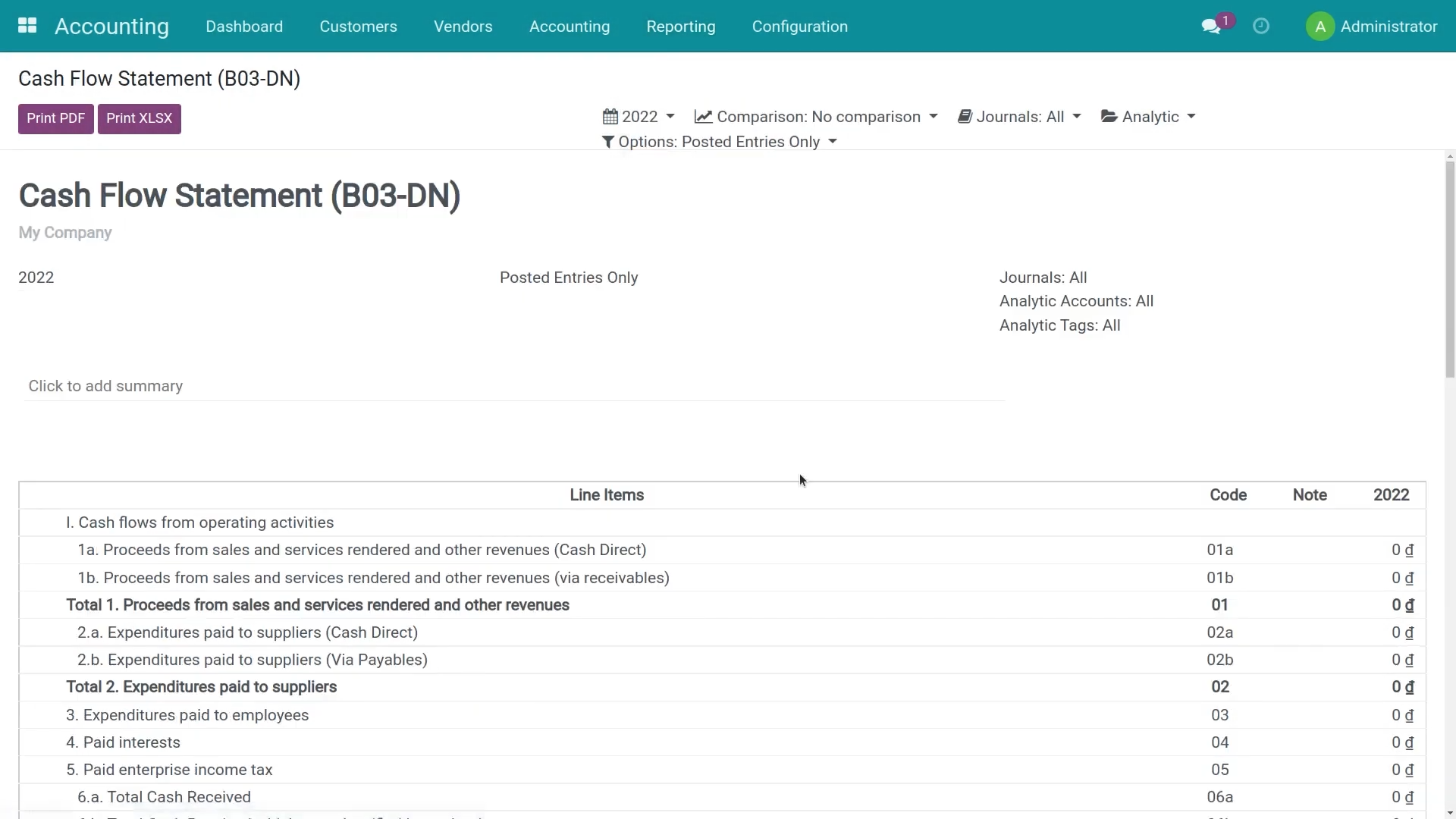
Imported goods on the VAT return Import VAT bases that include the customs duty, read from the customs declarations and traceable to the journal items.
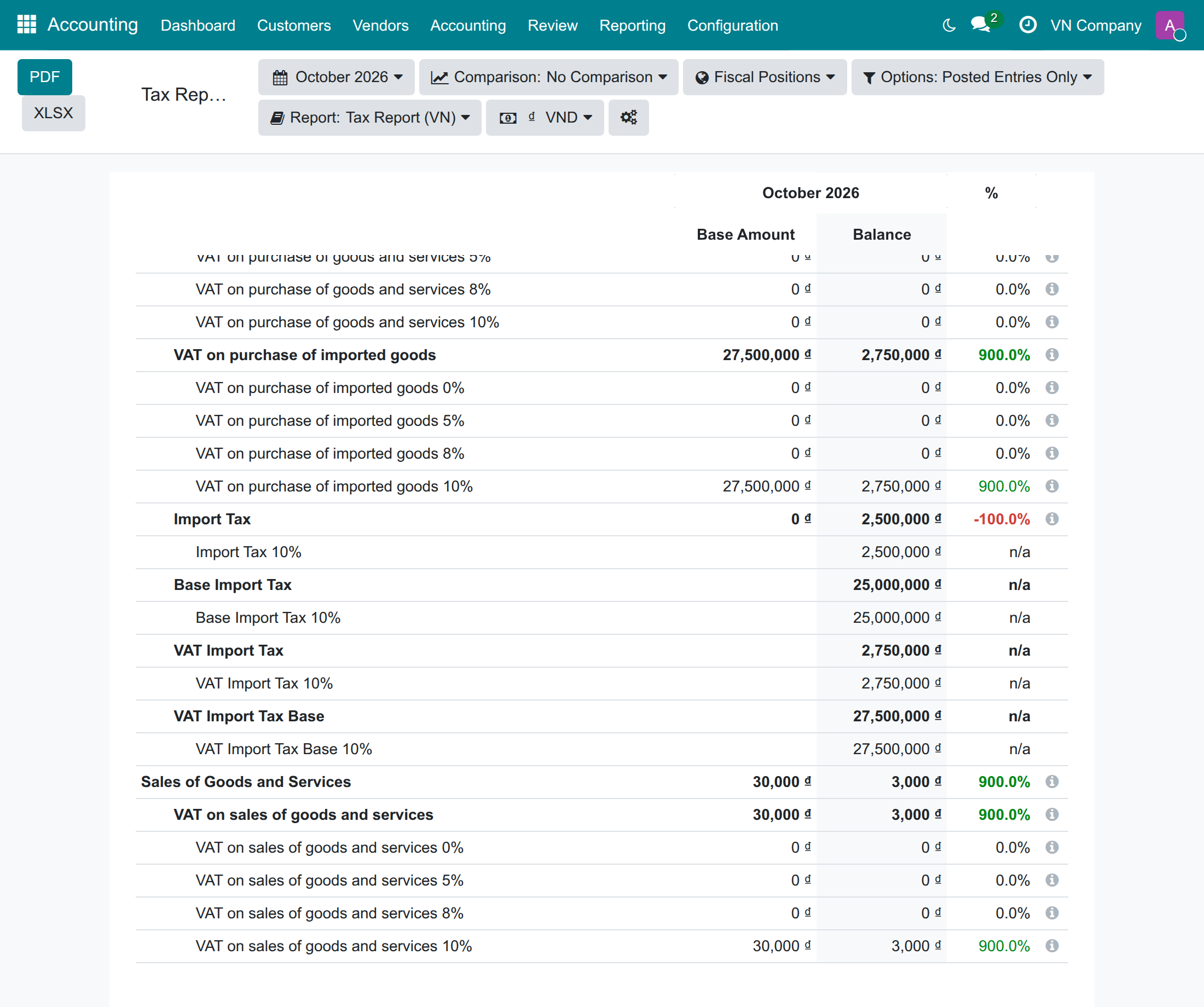
Imported-goods lines of the Tax Report: goods of 25,000,000 with 10% import duty give an import VAT base of 27,500,000.
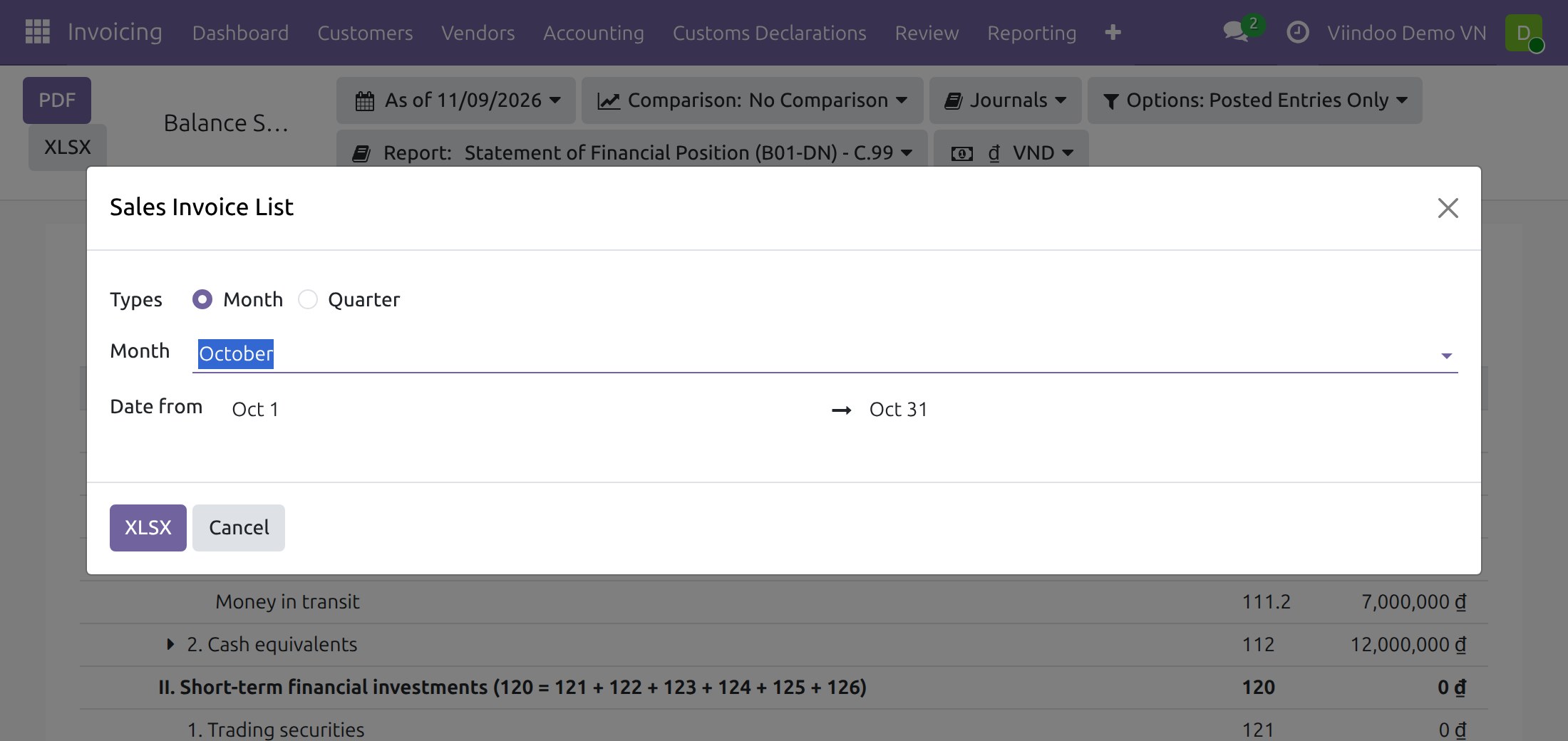
Print the Sales or Purchase Invoice List by month or quarter.
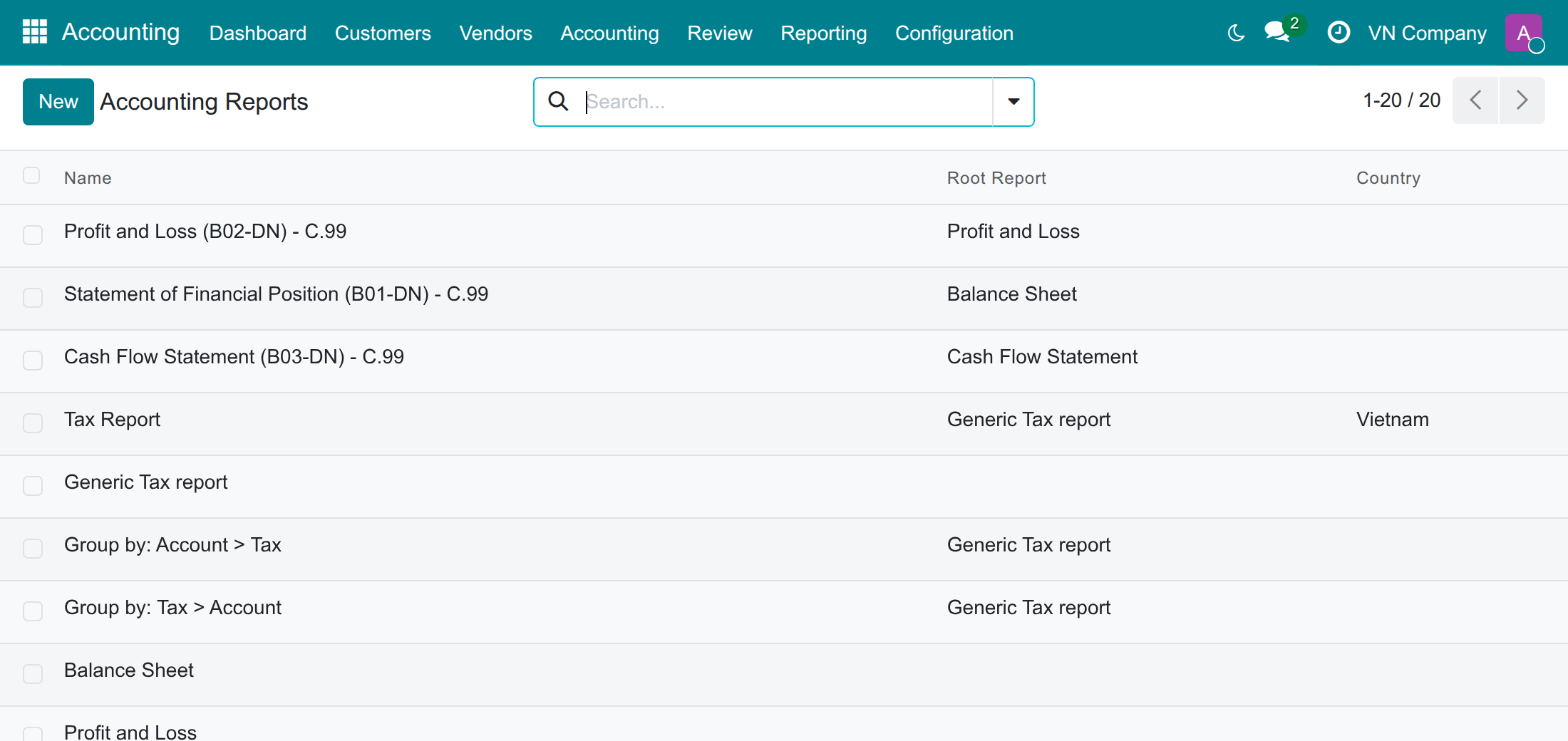
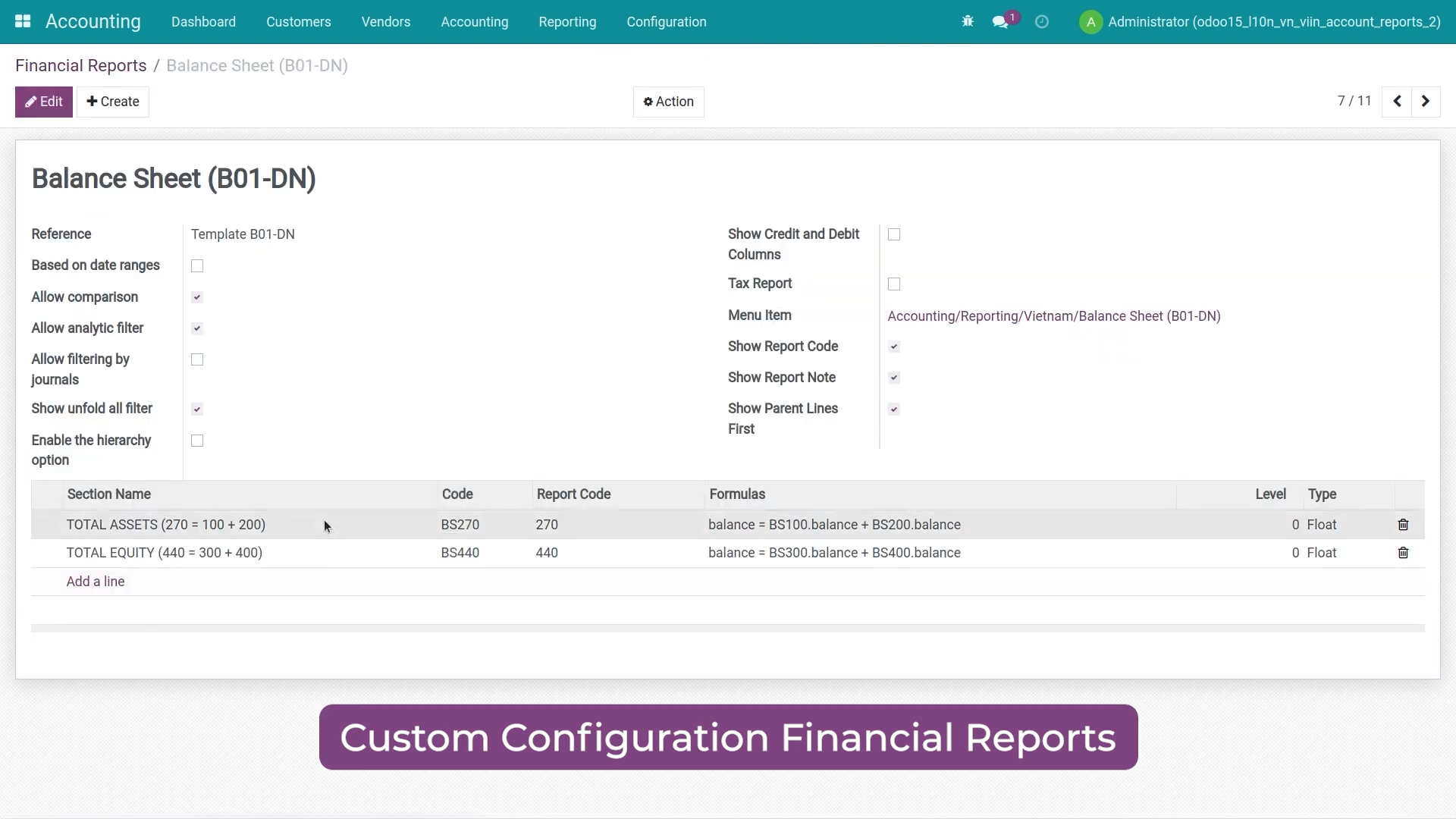
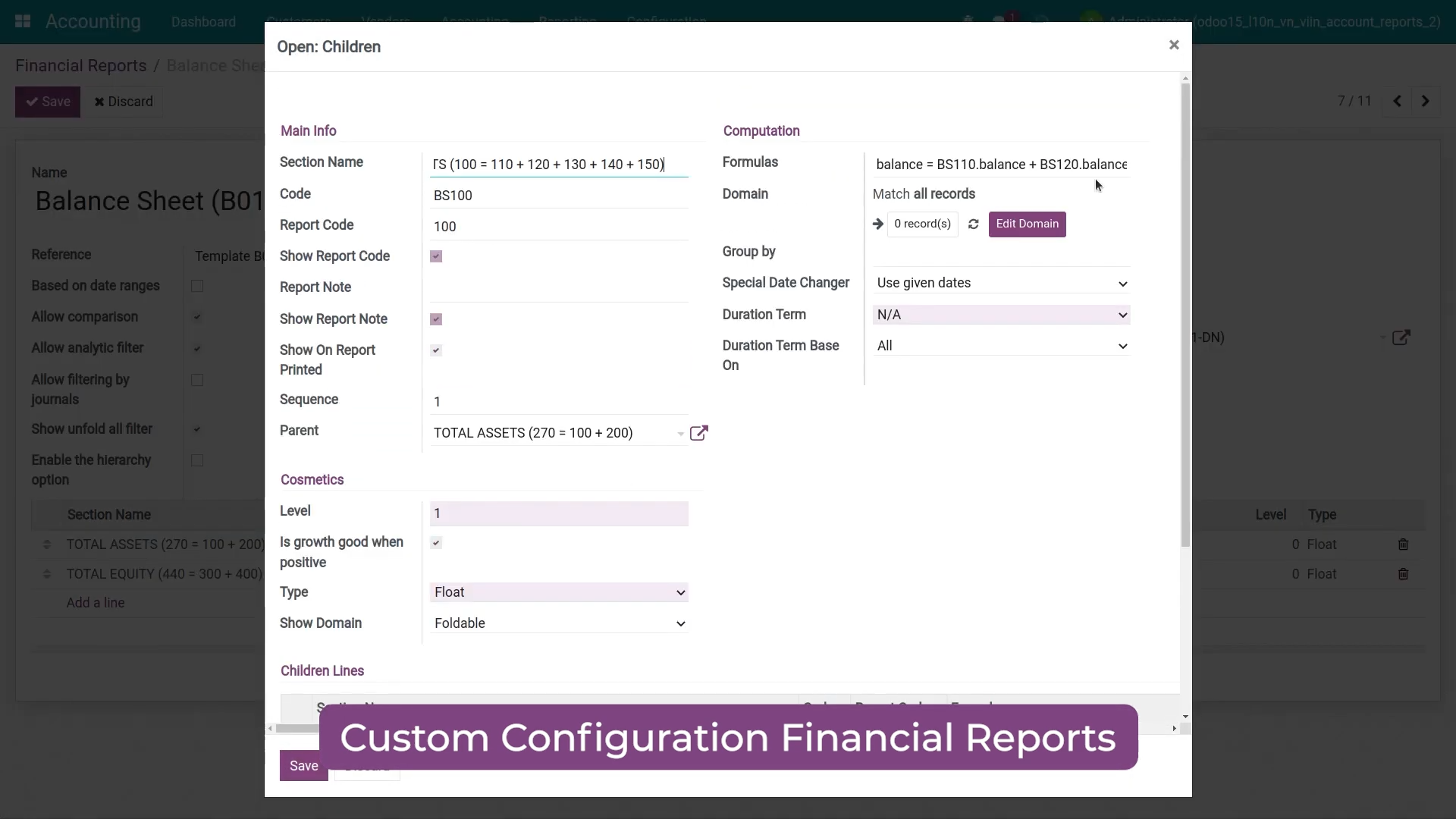
Financial Reports Customization Customize financial reports to your needs
Pre-Sales Question
Need help before purchasing? Share module name & version, edition (Odoo CE / Viindoo Editions), and the issue (trial, payment, installation). Attach screenshots if possible.
sales@viindoo.comSupport
For assistance, include your order number, issue description, expected resolution, and images/videos that replicate the issue.
apps.support@viindoo.comTechnical requirement
- Odoo 19 Community Edition.
- Prerequisites: to_account_reports, l10n_vn_viin, and to_legal_invoice_number.
- Uninstall Odoo default Accounting Reports to avoid conflicts.
- Users who print the Vietnamese statutory reports need the Accounting access right Bookkeeper or Administrator (on a database without the Accounting app, the extra right Show Full Accounting Features).
- Legal context: the module covers report templates and accounting books related to Circular 99/2025/TT-BTC and Circular 133/2016/TT-BTC.
Changes log
- v0.1.24 - Purchase list 01-2/GTGT prints one row per vendor bill and per vendor credit note (bills of two vendors that carry the same number each get their own row), shows the Bill Reference of every document as its number, lists the rows of a section by date then number, and rounds an amount split between sections to the currency so that the sections add up to the bill. The General Journal (S03a-DN) menu names only the Bookkeeper right its report needs. The guide explains that import VAT and customs duty are declared on the customs declaration, and how to correct a vendor bill that carries them.
- v0.1.23 - The imported-goods value lines of the Tax Report (source of 01/GTGT [23]/[23a]) are computed from the tax lines of vendor bills and customs declaration vouchers, the import VAT base includes the customs duty, import taxes due on payment are not reported there, and the lines open their journal items with a Reported Base column. Purchase list 01-2/GTGT lists in full a bill line spread only partly over a VAT section, and prints when the default section analytic account was deleted or no VAT-section analytic account exists. The Vietnamese statutory reports need the Bookkeeper or Administrator access right of Accounting.
- v0.1.10 - Updated the description to match the manifest, and added Circular 99/2025/TT-BTC coverage effective from 01 January 2026.
Who should use this module?
Need VAS-compliant financial packs for board meetings and banking submissions.
Require statutory ledgers, VAT invoice lists, and downloadable evidence for audits.
Compare periods across B01/B02/B03 statements and export XLSX for analysis.
This guide is for accountants and accounting administrators of companies that keep their books under Circular 99/2025/TT-BTC or Circular 133/2016/TT-BTC, including the accountants who declare imported goods on the VAT return (01/GTGT).
Installation
- Navigate to Apps.
- Search with keyword l10n_vn_viin_account_reports.
- Press Install.
Note: To have a full feature-related observation of this module, you need to install the Accounting app.
Instructions
Instruction video: Accounting Reports - Vietnam Accounting
The statements, books and invoice lists of a Vietnamese company are under Accounting ‣ Reporting. The screenshots in this guide show the top-level menu named Invoicing, which is the name it carries when only the Invoicing features are installed.
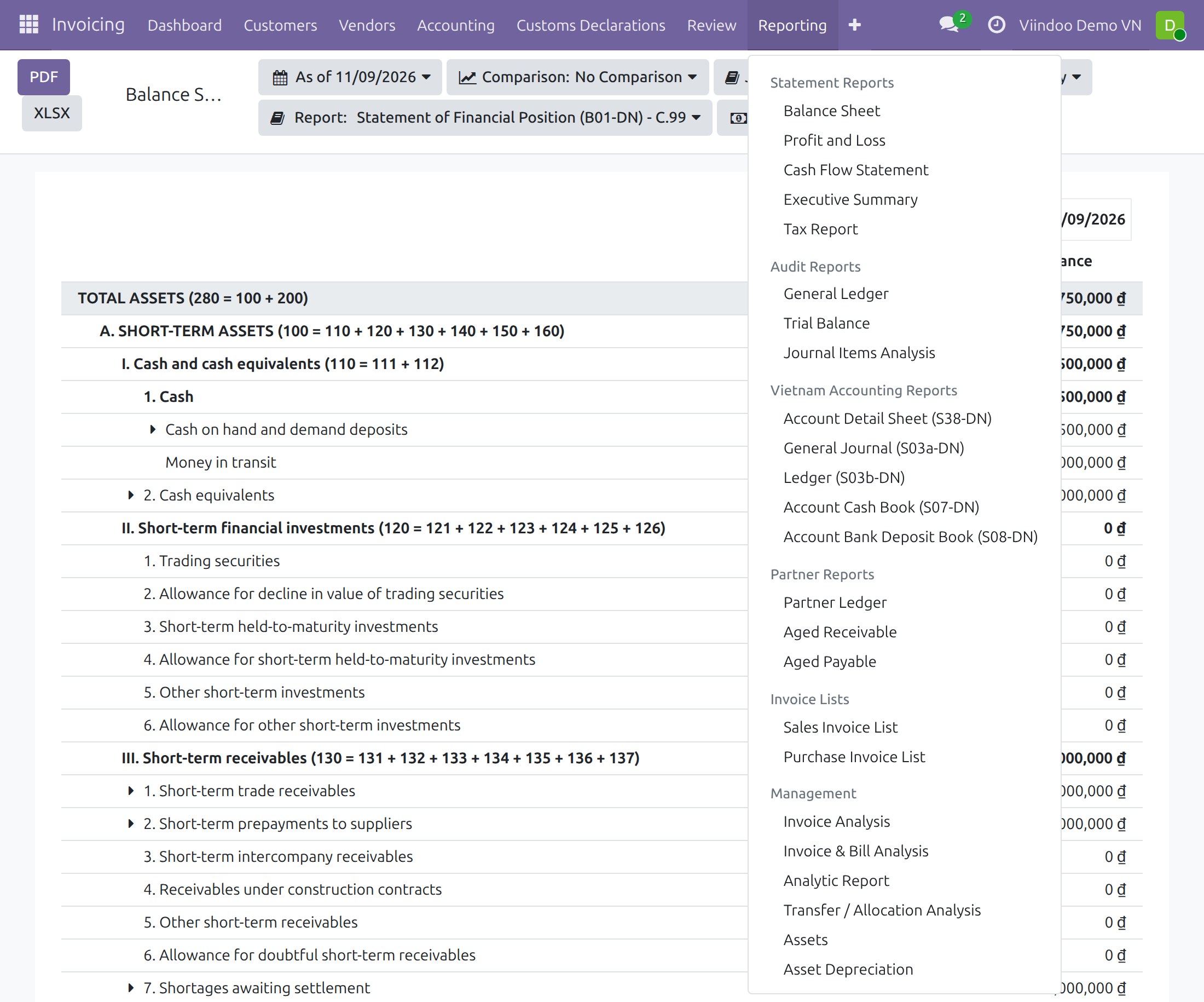
The menu groups the reports as follows:
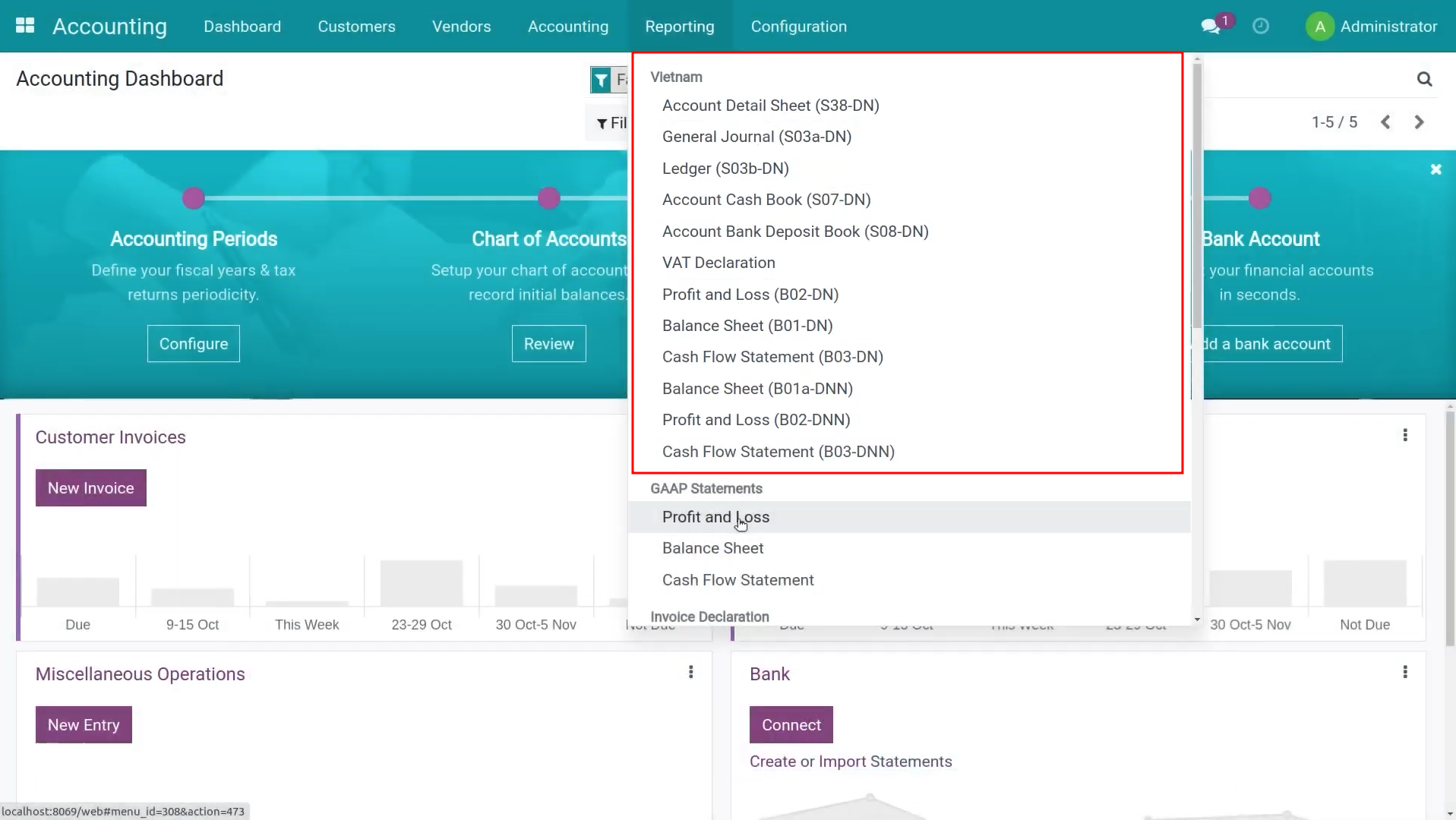
- Statement Reports: Balance Sheet, Profit and Loss, Cash Flow Statement, Executive Summary and Tax Report. Each statement opens on the form of the company's chart of accounts: on a company using the Circular 99/2025/TT-BTC chart, Statement of Financial Position (B01-DN) - C.99, Profit and Loss (B02-DN) - C.99 and Cash Flow Statement (B03-DN) - C.99; on a company using the Circular 133/2016/TT-BTC chart, Profit and Loss (B02-DNN), Cash Flow Statement (B03-DNN) and, through the Report selector of the Balance Sheet, Balance Sheet (B01a-DNN) or Balance Sheet (B01b-DNN). The generic reports these forms replace are offered only when the selected companies use different charts.
- Audit Reports: General Ledger, Trial Balance and Journal Items Analysis.
- Vietnam Accounting Reports: Account Detail Sheet (S38-DN), General Journal (S03a-DN), Ledger (S03b-DN), Account Cash Book (S07-DN) and Account Bank Deposit Book (S08-DN).
- Invoice Lists: Sales Invoice List and Purchase Invoice List.
The menu also holds the groups Partner Reports and Management, which belong to the guide of Accounting Reports. The statements of this guide show negative amounts in parentheses, on screen, in the PDF and in the XLSX file.
Configuration of financial reports
To verify how a statement is built, go to Accounting ‣ Configuration ‣ Accounting Reports (available to accounting managers) and open the statement.
- If you know the building method related to financial reports, you can study and configure them properly.
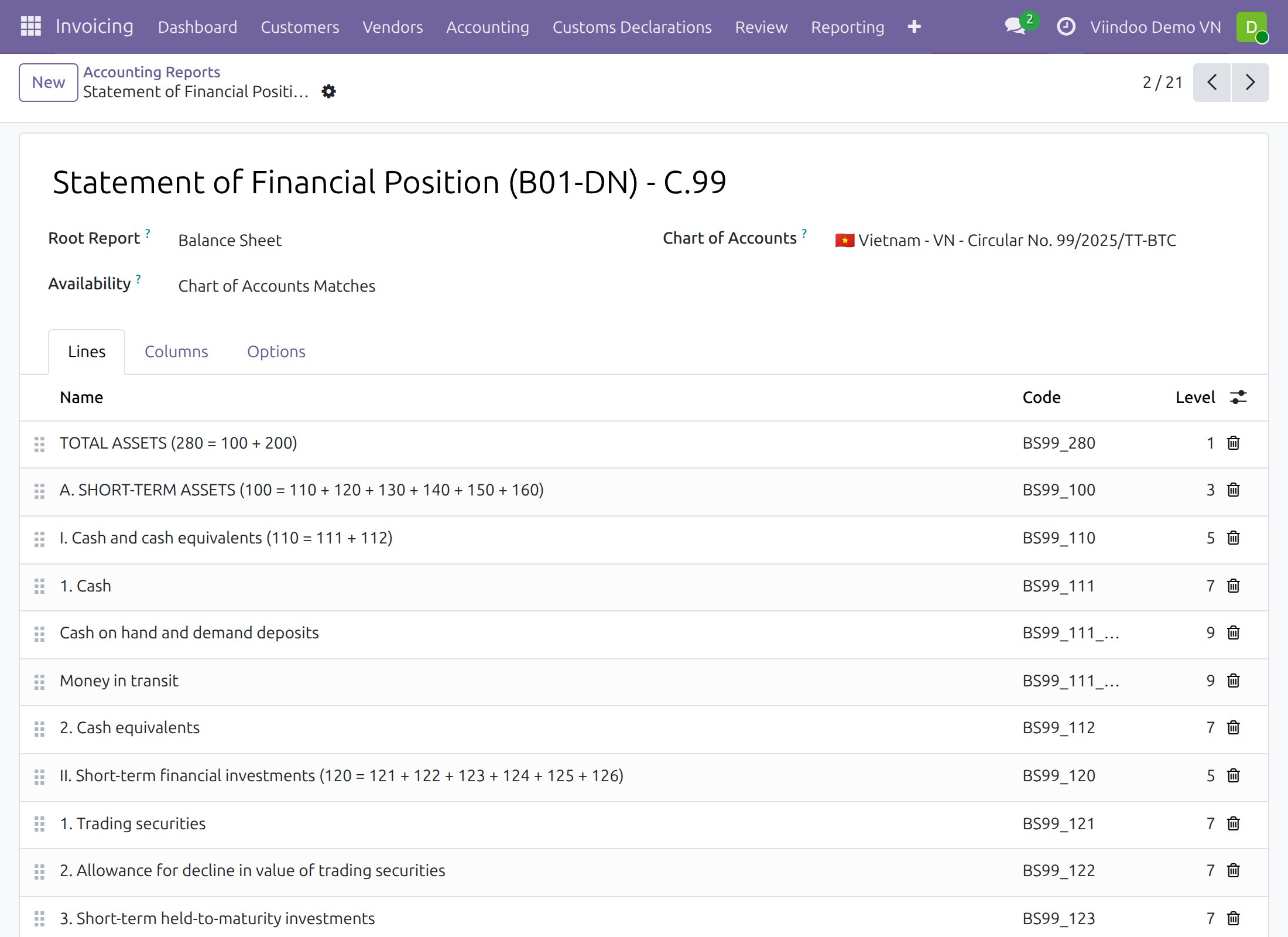
Open a line to see its code, its grouping and its formula.
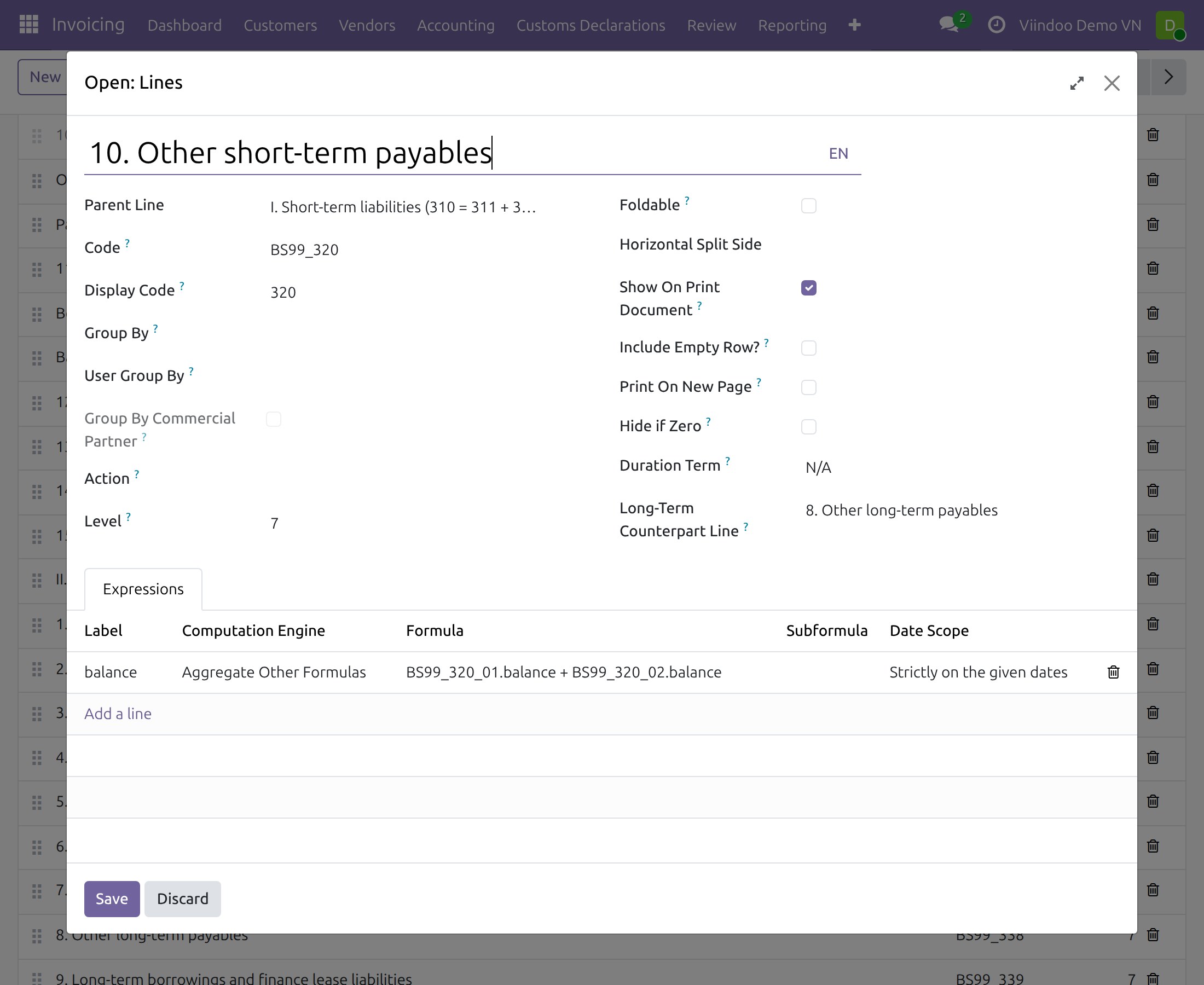
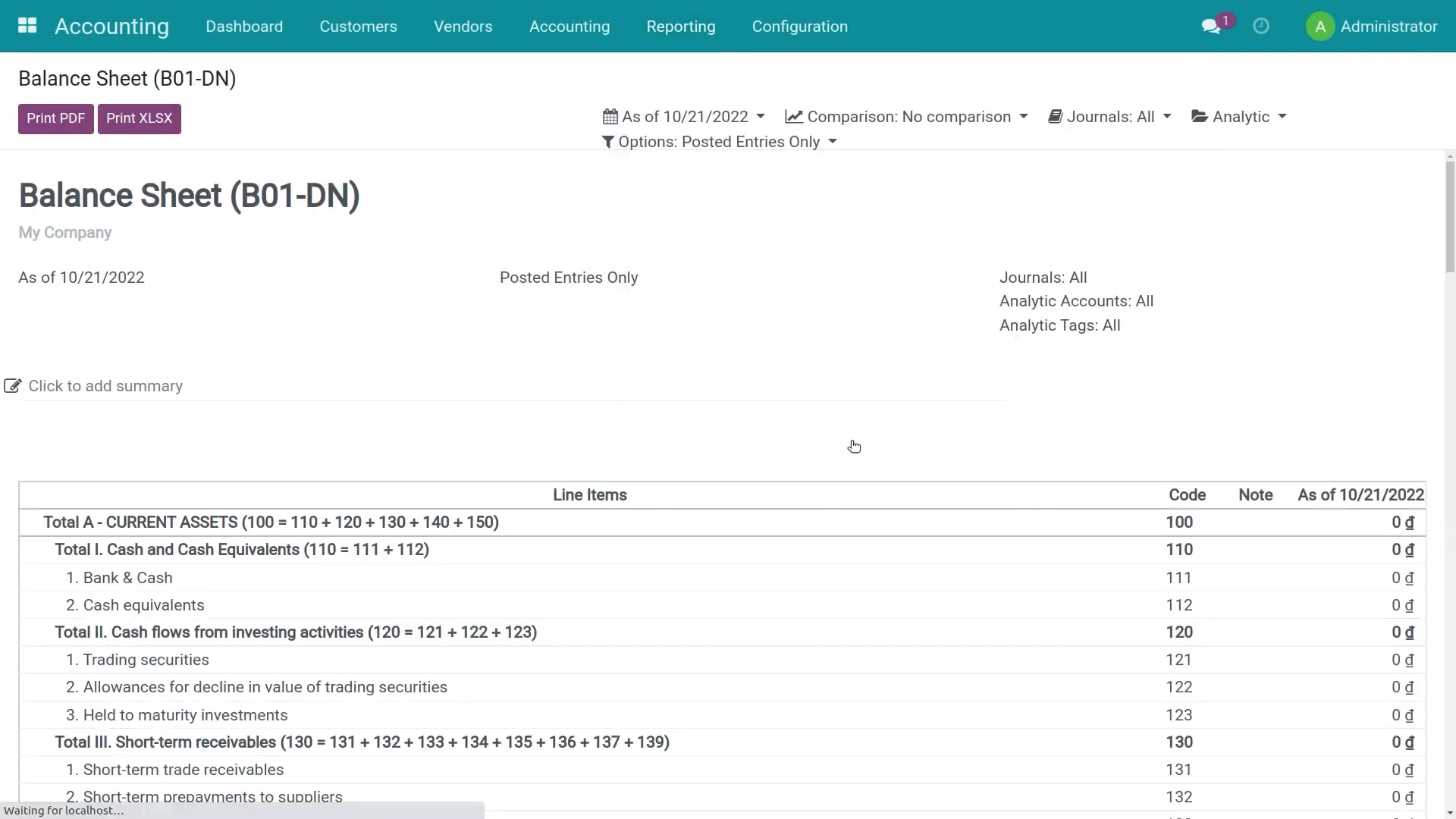
On a short-term line of the Statement of Financial Position (B01-DN), the field Long-Term Counterpart Line names the long-term line it is paired with (above, line 320 is paired with 8. Other long-term payables). The Preparer's note of the statement reads these pairs.
Detail accounts the statements read
Some statement lines need to know what a balance or a movement is, not only on which account it sits: a deposit of up to three months is a cash equivalent, the income of an asset sale is a disposal receipt, an exchange gain is not interest received. The statements read these facts from detail accounts of the chart of accounts. Book on the detail account from the start; the statements then classify the entry by itself.
| Chart | Account | Book on it | What the statements do with it |
|---|---|---|---|
| Circular 133/2016/TT-BTC | 12811, 12881 | a time deposit with an original term of 3 months or less; another held-to-maturity investment that qualifies as a cash equivalent | cash equivalents (line 110.3 of B01a-DNN and B01b-DNN, part of line 110); placing or collecting it is no cash flow |
| Circular 133/2016/TT-BTC | 12882 | a loan given | other receivables (line 134 of B01a-DNN; lines 133 and 214 of B01b-DNN), outside the held-to-maturity investments; lines 23 and 24 of B03-DNN read its payment and its collection |
| Circular 133/2016/TT-BTC | 7111, 8111 | the income and the expenses of selling or scrapping a fixed asset | line 22 of B03-DNN (proceeds from disposals) |
| Circular 133/2016/TT-BTC | 5151 | realised exchange gains (it is the company's Gain Exchange Rate Account) | an other operating receipt, never interest received (line 25) |
| Circular 133/2016/TT-BTC | 6351 | interest on loans | line 23 of B02-DNN (interest expense) and line 04 of B03-DNN (interest paid) |
| Circular 99/2025/TT-BTC | 5153 | interest on demand deposits | an other operating receipt (line 06 of B03-DN), not line 27 |
| Circular 99/2025/TT-BTC | 12811, 12881 | a time deposit with an original term of 3 months or less; another held-to-maturity investment that qualifies as a cash equivalent | cash equivalents (line 112 of B01-DN) |
Legal basis: under Circular 133/2016/TT-BTC (Article 10.1.b), a company may open level-2 and level-3 accounts where the circular prescribes none, without the approval of the Ministry of Finance. Under Circular 99/2025/TT-BTC (Article 11.2), a company that adds detail accounts states why in its own accounting rules ("Quy chế hạch toán kế toán").
Entries booked before these detail accounts
An update never changes a posted entry; the statements read history as it was booked.
- A deposit of up to 3 months booked on 1281 or 1288 stays an investment. For a deposit still open, change the account of the placement entry to 12811 in an open period, or book one reclassification Dr 12811 / Cr 1281 on the update date.
- An asset disposal booked on 711 or 811 reaches line 22 only through the asset Sell flow or with its derecognition in the same entry; otherwise it stays an other receipt or payment. In an open period, change the invoice line to 7111 or 8111 and match the payment again.
- Interest booked on the parent 635 is not read by line 23 of B02-DNN or line 04 of B03-DNN. One reclassification Dr 6351 / Cr 635 for the year to date corrects B02-DNN; line 04 needs the original entries changed.
- Demand-deposit interest booked on 5158 (Circular 99/2025/TT-BTC) stays on line 27; change the interest lines of the current year to 5153.
- A foreign exchange gain booked by hand on account 515 instead of 5151 is read as interest received (line 25 of the Cash Flow Statement), also when the same entry moves money between two cash or bank accounts. Book exchange gains on 5151, the gain account the update sets in Accounting Settings.
- Interest accrued on account 1388 and collected later, alone or together with the principal of a deposit or a loan, is read as interest received (line 27 of form B03-DN, line 25 of form B03-DNN) for the part of the collection matched with an accrual on account 515. Match the collection with its accruals; an unmatched collection stays on line 06.
- Loans given under Circular 133 are booked on 12882 and shown as other receivables (B01a line 134; B01b lines 133 and 214). A loan already booked on 1288 is shown with the held-to-maturity investments until you reclassify it with one entry Dr 12882 / Cr 1288; the entry changes no cash-flow figure.
- When an account of your own already holds one of these codes with another meaning, the managers receive a notice: give that account another code, then create the account with the statutory code.
Statement of Financial Position (B01-DN, B01a-DNN, B01b-DNN)
Open Accounting ‣ Reporting ‣ Statement Reports ‣ Balance Sheet. The figures below apply to the three forms of the statement; the line codes differ per form and are given for each.
Cash per account
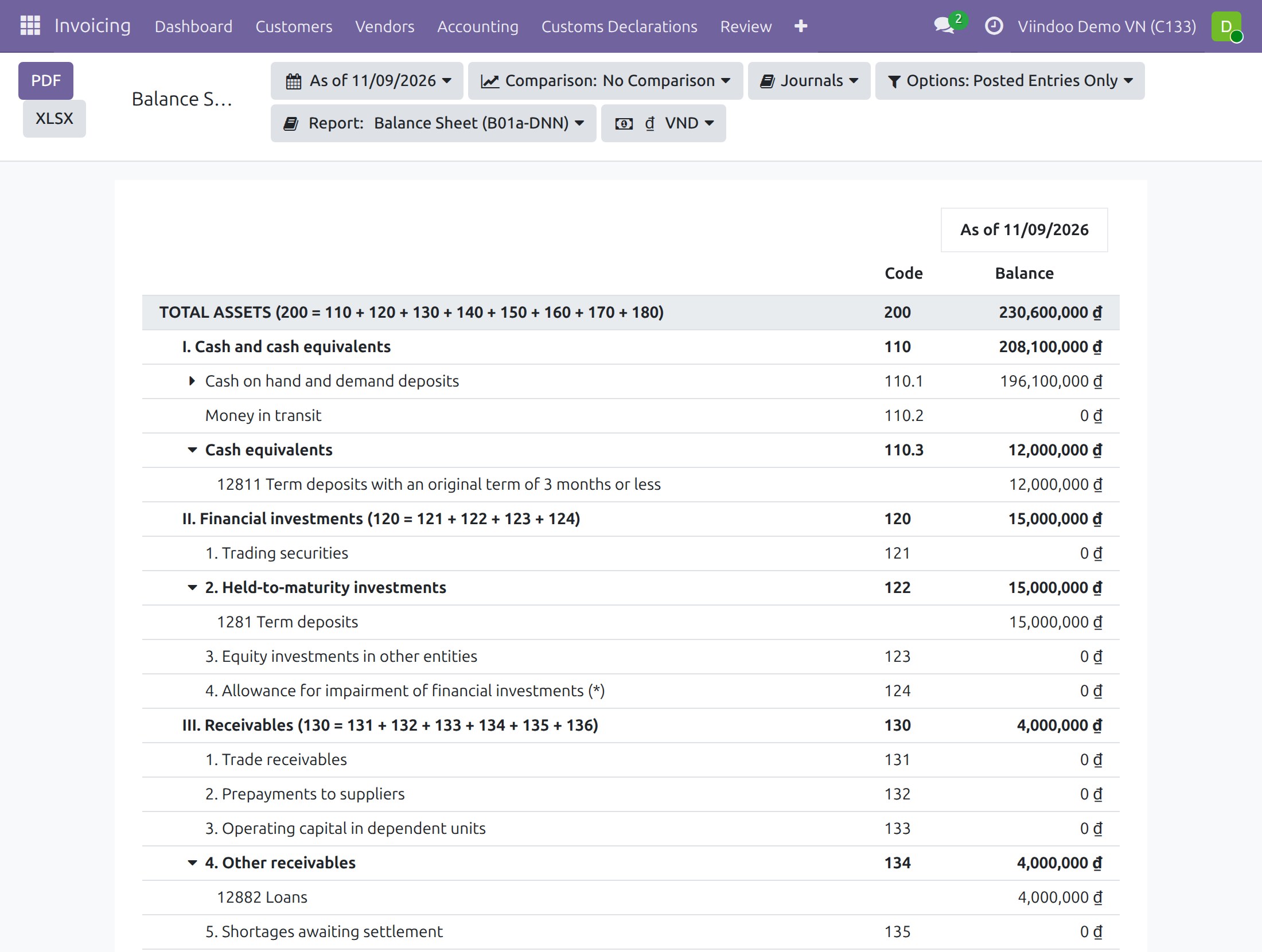
Line 111 (Cash; 110 on B01a-DNN and B01b-DNN) is measured account by account and is never negative. Each cash and bank account counts its own balance and the payments and receipts registered from its journal that the bank has not matched yet; one account is never netted against another.
Line 111.1 (Cash on hand and demand deposits; 110.1 on B01a-DNN and B01b-DNN): unfold it to see each cash and bank account with a debit balance on its own row.
Line 111.2 (Money in transit; 110.2 on B01a-DNN and B01b-DNN) is the rest of line 111: the payments and receipts registered and not matched yet, the internal transfer account, and the money on any other account of 111, 112 or 113 that no journal uses, such as foreign currency in transit on 1132 under Circular 133/2016/TT-BTC.
Cash equivalents are part of line 110: line 112 on B01-DN, line 110.3 on B01a-DNN and B01b-DNN, read from accounts 12811 and 12881. The other balances of 1281 and 1288 are investments, except loans given on 12882 under Circular 133/2016/TT-BTC, which are other receivables (line 134 on B01a-DNN; on B01b-DNN line 133 when they fall due within 12 months or have no due date, line 214 otherwise). The investments are on line 122 on B01a-DNN; on B01b-DNN line 123 when they fall due within 12 months or have no due date, line 253 otherwise.
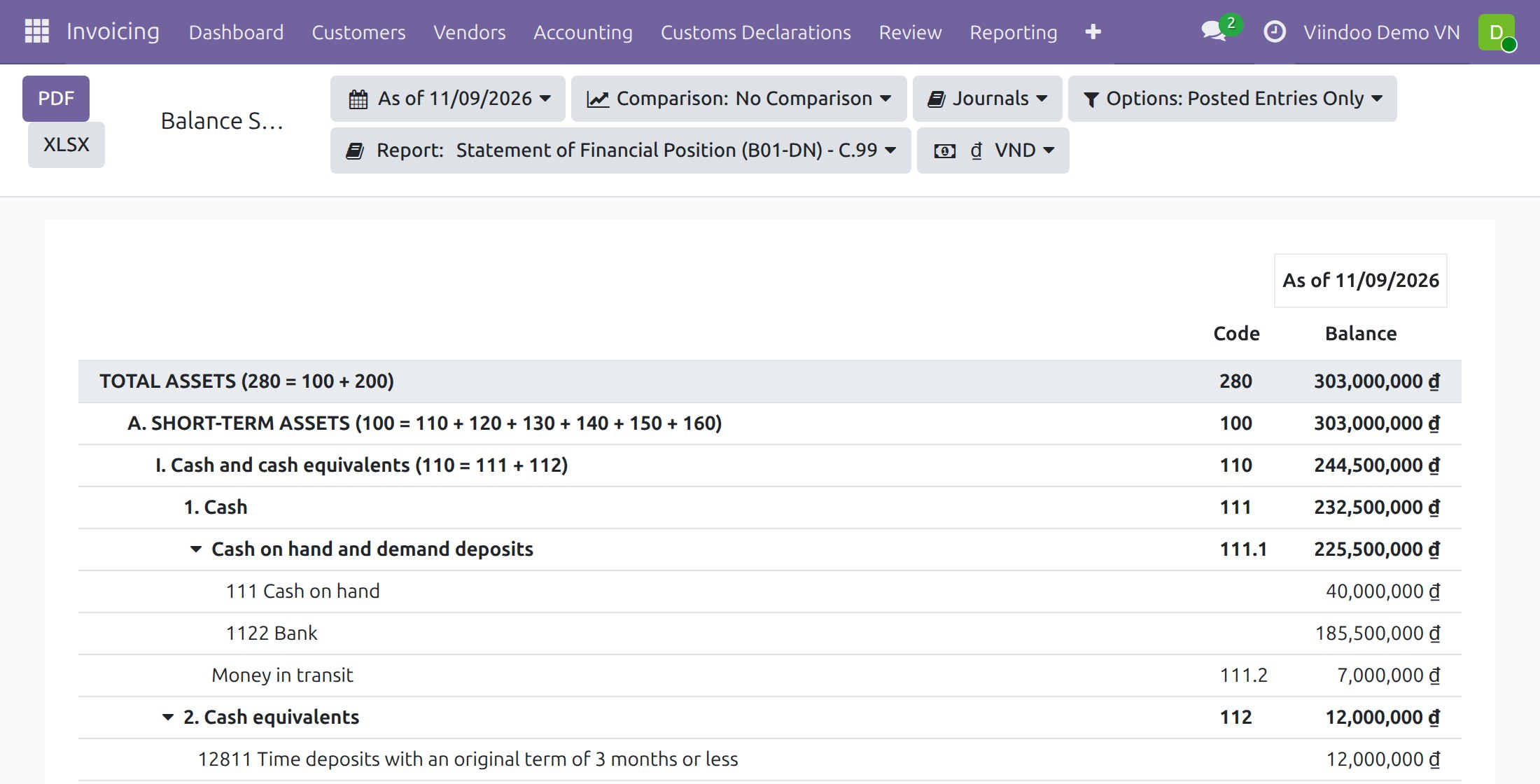
On the Balance Sheet (B01a-DNN) of a company under Circular 133/2016/TT-BTC, the cash equivalents are line 110.3, the term deposits that are not cash equivalents are held-to-maturity investments on line 122, and the loans given are other receivables on line 134.
Bank overdrafts
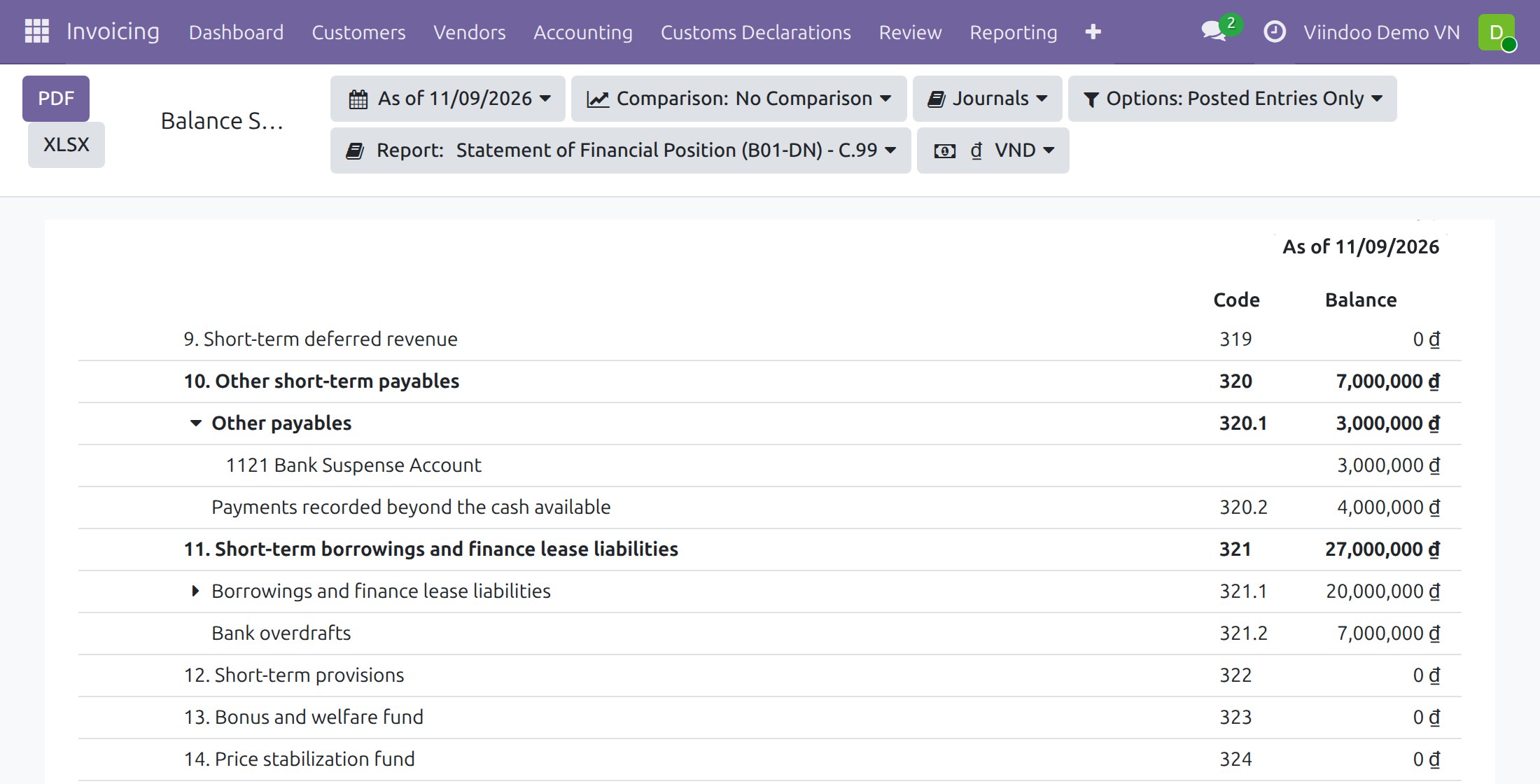
A bank account in credit is shown as a loan, under Bank overdrafts: line 321.2 on B01-DN, 316.2 on B01a-DNN and 416.2 on B01b-DNN. It is part of the short-term borrowings line (321, 316 and 416 respectively). A bank account is an account a bank journal uses.
Payments recorded beyond the cash available
Two cases are not overdrafts: payments registered from a bank account beyond its money and not executed yet, and a cash on hand account in credit. Their amount is shown as another short-term payable, under Payments recorded beyond the cash available: line 320.2 on B01-DN, 315.2 on B01a-DNN and 415.2 on B01b-DNN. The other payables are on line 320.1 (315.1, 415.1).
Unmatched bank statement lines
Bank statement lines that are not matched yet sit on the bank suspense account. They are shown on the statement instead of being left out:
- a line of money received goes to other payables: line 320.1 on B01-DN, 315.1 on B01a-DNN and 415.1 on B01b-DNN;
- a line of money paid out goes to line 137 (Shortages awaiting settlement) on B01-DN, 135 on B01a-DNN and 134 on B01b-DNN.
Preparer's note
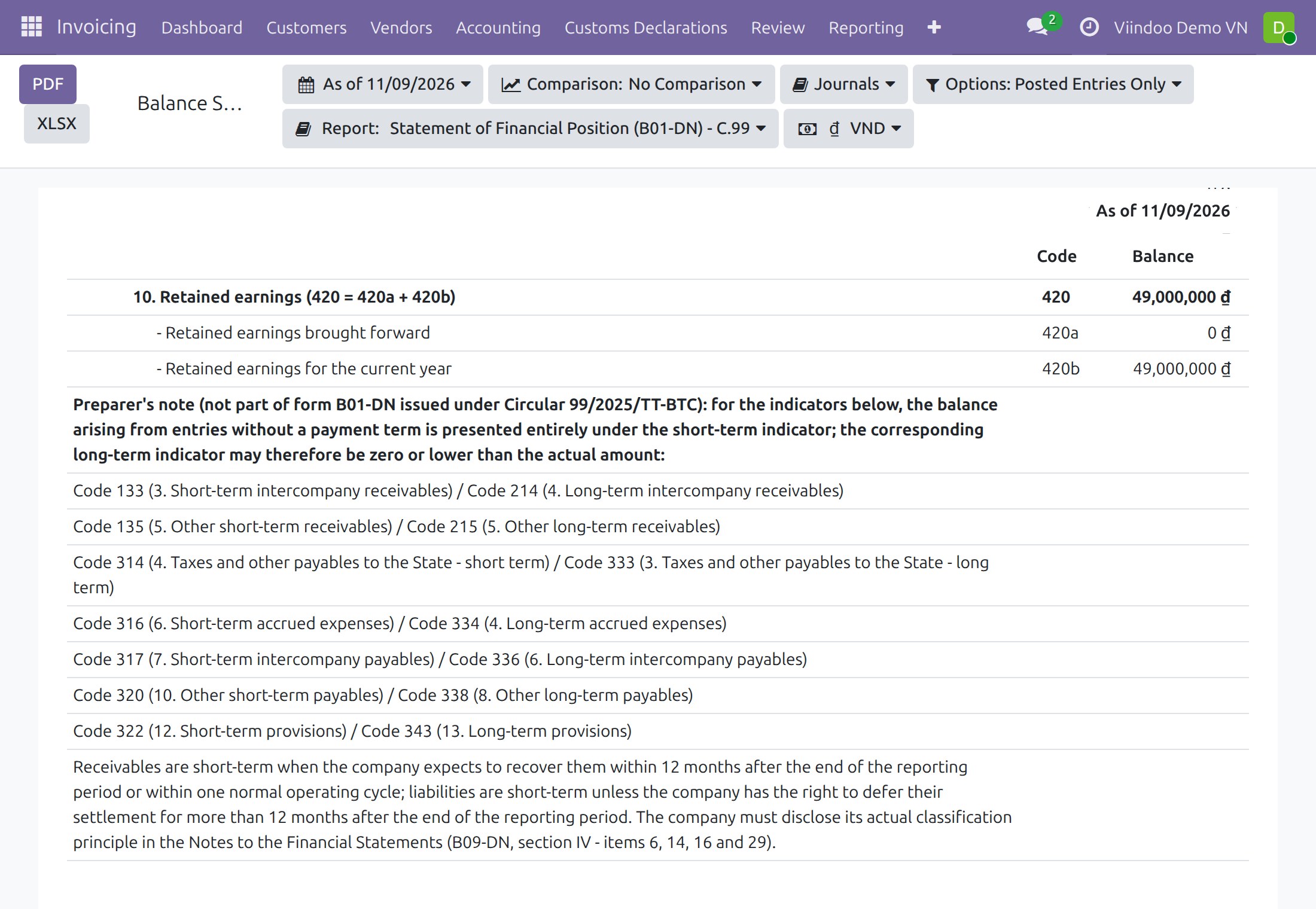
At the bottom of Statement of Financial Position (B01-DN) - C.99 (the Circular 99/2025/TT-BTC variant of the Balance Sheet), under line 420b, the report prints a note that begins with Preparer's note. It is not part of the official B01-DN form. It tells the reader that, for each short-term line and its long-term counterpart listed below it, the balance arising from entries without a payment term is shown entirely under the short-term line, so the long-term line may be zero or lower than the actual amount. It then recalls the criterion: receivables are short-term when the company expects to recover them within 12 months after the end of the reporting period or within one normal operating cycle, and liabilities are short-term unless the company has the right to defer their settlement for more than 12 months after the end of the reporting period. The company must disclose its actual classification principle in the Notes to the Financial Statements (B09-DN).
The pairs come from the report lines. As shipped, seven short-term lines name their long-term counterpart: 133/214, 135/215, 314/333, 316/334, 317/336, 320/338 and 322/343. An accounting manager adds or removes a pair in Accounting ‣ Configuration ‣ Accounting Reports: open the statement, open the short-term line and set or clear its Long-Term Counterpart Line. A module update writes the shipped lines back; to keep your own pairs, work on a duplicate of the statement (duplicating a statutory statement needs the Settings access rights).
The note wraps in full on screen, in the printed PDF and in the XLSX export. It only appears on this report; the Profit and Loss (B02-DN) and Cash Flow Statement (B03-DN) reports and the Circular 133/2016/TT-BTC forms do not carry it.
To see it, open the Balance Sheet for a company using the Vietnam chart of accounts under Circular 99/2025/TT-BTC and scroll to the end of the report.
Cash Flow Statement (B03-DN, B03-DNN)
Open Accounting ‣ Reporting ‣ Statement Reports ‣ Cash Flow Statement.
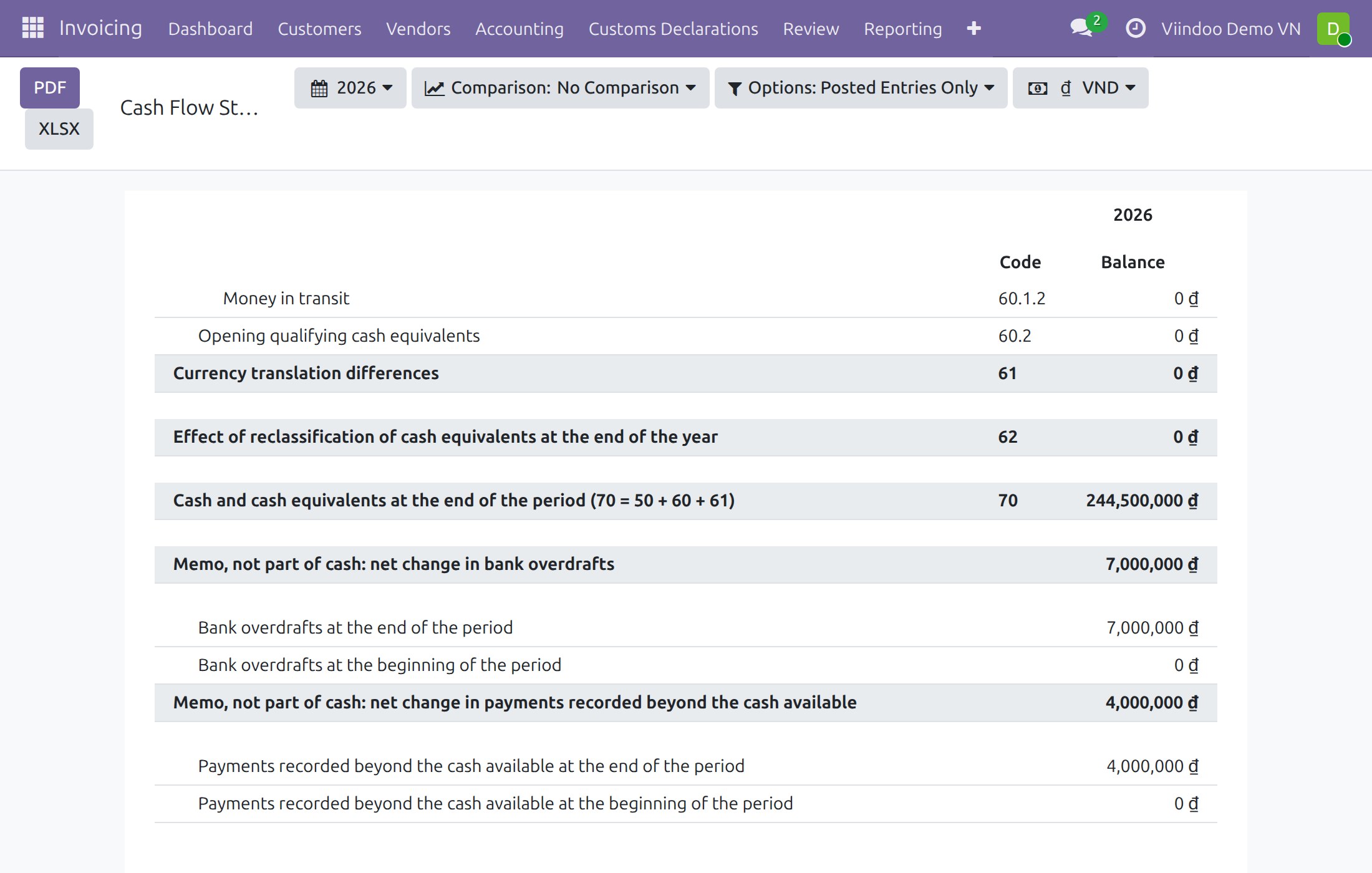
- Closing cash. Line 70 (Cash and cash equivalents at the end of the period) equals line 110 of the Balance Sheet at the end of the same period, for any period you choose: a month, a quarter or a year.
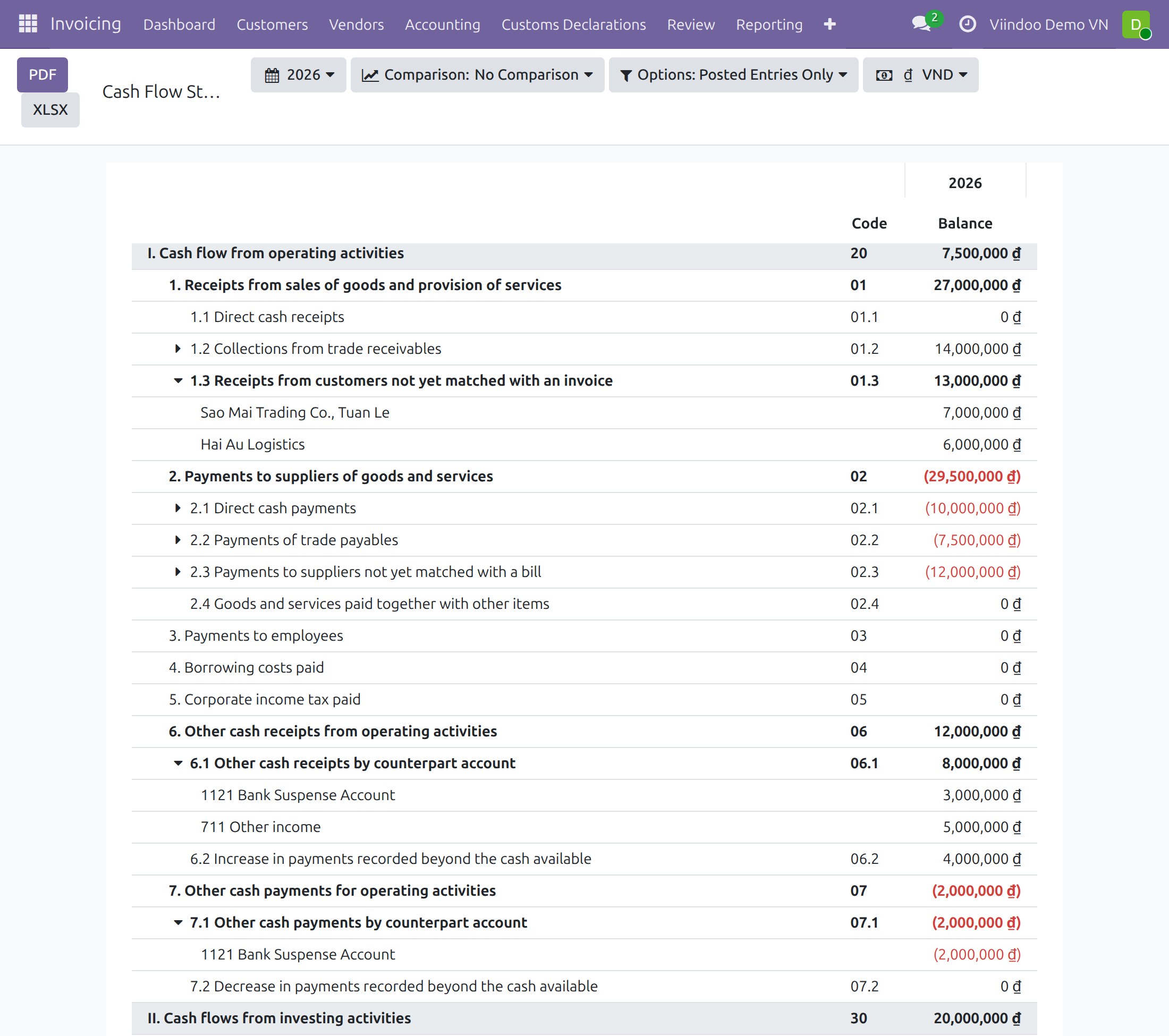
- Customer receipts not yet matched with an invoice. Line 01.3 shows the payments received from customers that no invoice is matched with yet, such as advances. Unfold it to see the customers.
- Other receipts and payments. Line 06 (other cash receipts from operating activities) and line 07 (other cash payments for operating activities) can be unfolded: lines 06.1 and 07.1 list the amounts by counterpart account, so you can see which account each receipt or payment came from.
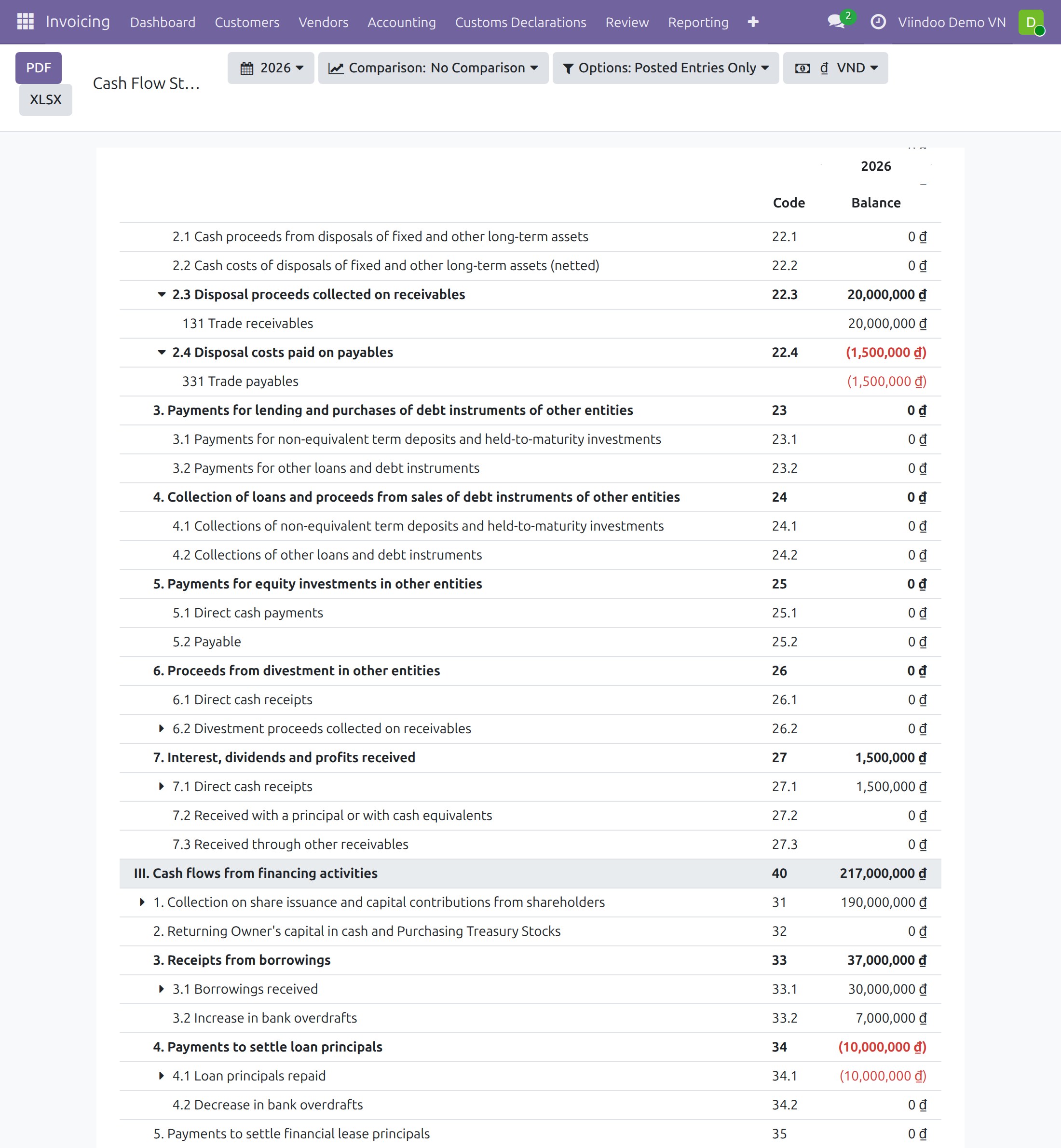
- Bank overdrafts. Movements on a bank overdraft appear in the financing section: line 33.2 (Increase in bank overdrafts) under line 33 (Receipts from borrowings), and line 34.2 (Decrease in bank overdrafts) under line 34 (Payments to settle loan principals).
- Payments recorded beyond the cash available. Their change is an operating flow: line 06.2 (increase) under line 06 and line 07.2 (decrease) under line 07.
- One collection or payment for documents of several natures. A customer payment that settles an asset sale and a sale of goods, or a supplier payment that settles a disposal cost and goods, is split by the documents it is matched with: each share goes to the line of its document. The asset sale goes to line 22.3 (collected on receivables) and the disposal cost to line 22.4 (paid on payables); a divestment goes to line 26.2 on B03-DN and to line 24.3 on B03-DNN; the goods go to line 01.2 or 02.2. The part matched with no document is an advance: it is shown on line 01.3 or 02.3.
- Cash equivalents. Placing cash on a cash equivalent (12811, 12881) and collecting it is no cash flow: closing cash (line 70) includes it.
- Interest (B03-DN). Line 27 splits into 27.1 (received directly), 27.2 (received with a principal or with cash equivalents) and 27.3 (received through other receivables). Interest on demand deposits booked on 5153 is an other operating receipt (line 06), not interest received (line 27). A deposit, a loan or a cash equivalent collected with its interest in one entry counts the principal on line 24 (nothing for a cash equivalent) and the interest on line 27. Interest accrued on 1388 counts on line 27 when the receivable is collected, for the part of the collection matched with the accrual; interest booked straight to 515 in the same collection counts on line 27 too, once.
- Interest, investments and exchange gains (B03-DNN). Line 25 splits into 25.1 (received directly in cash), 25.2 (received through other receivables) and 25.3 (received with a principal or with cash equivalents). Line 04 (interest paid) reads interest booked on 6351, also when a payment settles a lender's bill together with other bills. Lines 23 and 24 read time deposits and other held-to-maturity investments on 128 that are not cash equivalents. Line 25 (interest received) leaves out exchange gains on 5151, and a deposit collected with its interest in one entry counts the principal on line 24 and the interest on line 25. Interest accrued on 1388 counts on line 25 when the receivable is collected, for the part of the collection matched with the accrual; interest booked straight to 515 in the same collection counts on line 25 too, once.
- Disposals (B03-DNN). Line 22 reads the disposal income and expenses booked on 7111 and 8111, besides assets sold with the Sell flow.
- Investment property (B03-DN). On form B03-DN, an investment property sold on account 5117 is a disposal receipt (line 22), whether or not it is sold from the asset form. Rent from an investment property is booked on 511 and is a sales receipt (line 01). Cash costs of selling an investment property booked on 6327 are not told apart from its other costs and stay on line 02 or 07.
- Memoranda below line 70. Two memoranda, not part of cash, show the net change in bank overdrafts and in payments recorded beyond the cash available, each with its balance at the end and at the beginning of the period. They explain the difference between the cash accounts and line 70, and are printed in the PDF and the XLSX file.
- Sale of a fixed asset. When you sell an asset with the Sell button of its form (Accounting ‣ Reporting ‣ Management ‣ Assets) and the customer pays the resulting invoice, the amount collected goes to line 22 (Proceeds from disposals of fixed assets and other long-term assets), not to the receipts from sales of goods. This needs the module Accounting Reports - Vietnam Accounting - Fixed Asset Disposals.
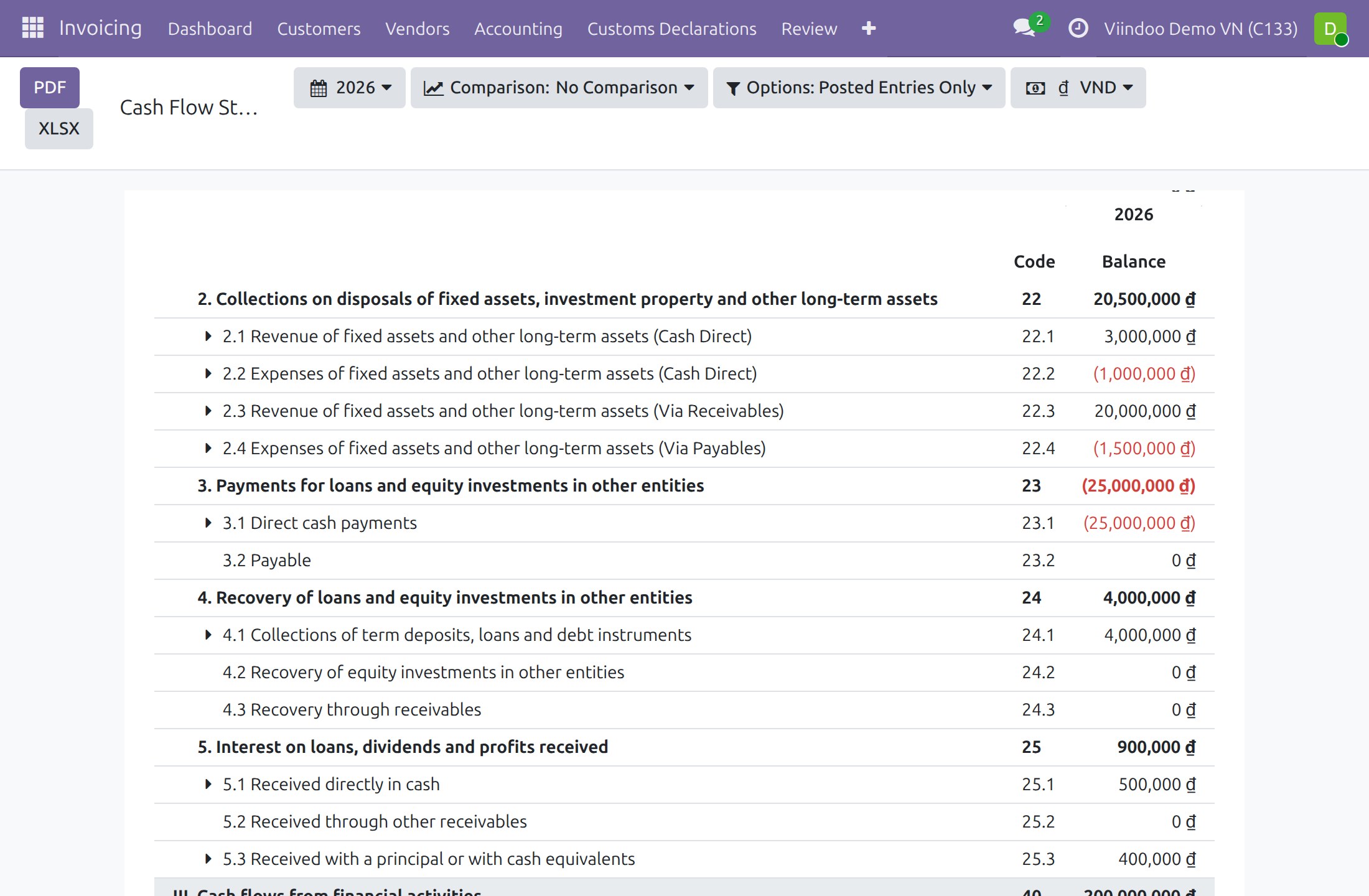
On Cash Flow Statement (B03-DNN) (Circular 133/2016/TT-BTC), lines 23, 24 and 25 carry the wording of that Circular: Payments for loans and equity investments in other entities, Recovery of loans and equity investments in other entities and Interest on loans, dividends and profits received.
Trial Balance
Open Accounting ‣ Reporting ‣ Audit Reports ‣ Trial Balance.
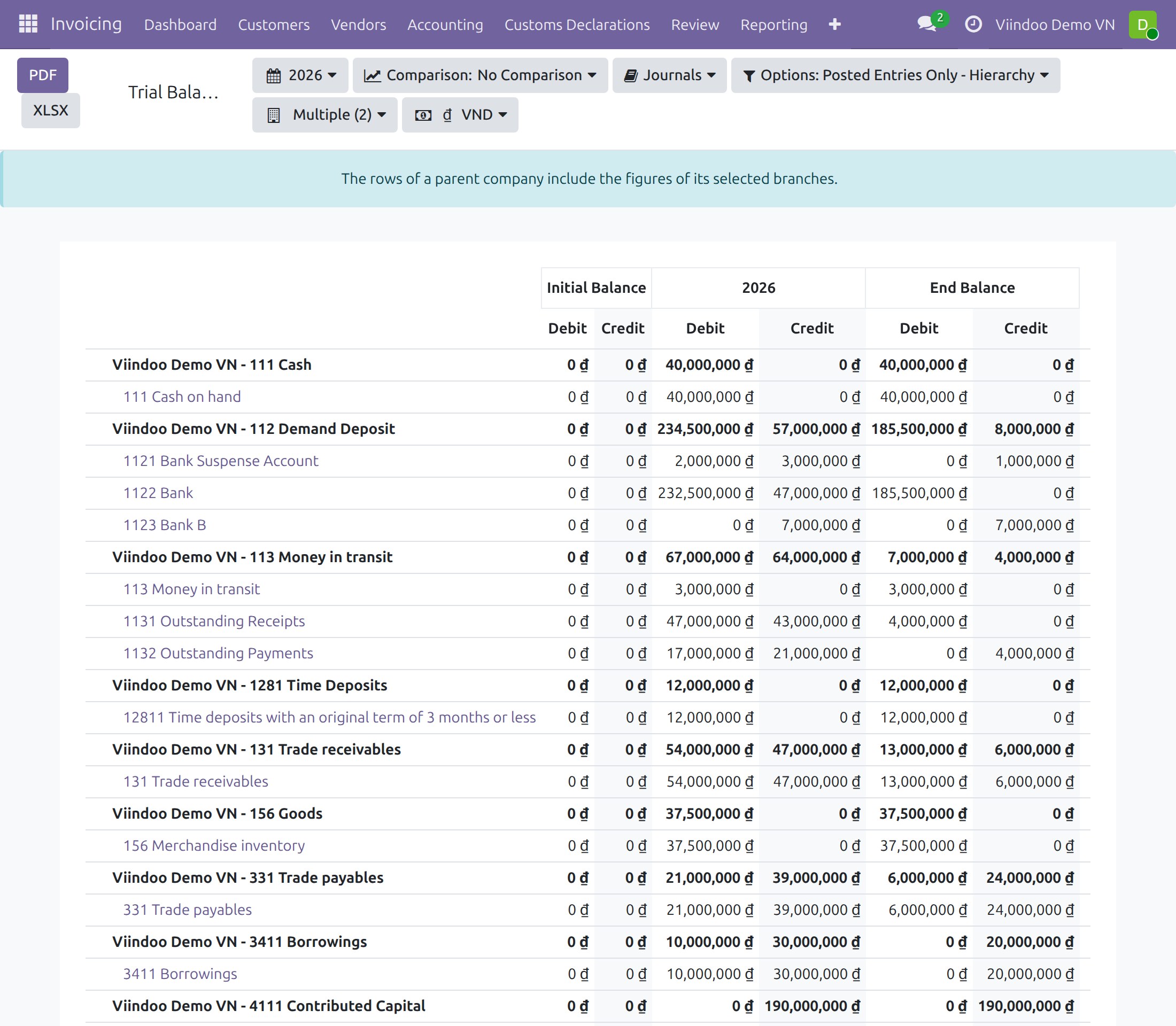
Receivable and payable accounts can carry a debit balance and a credit balance at the same time (customers who owe you and customers who paid in advance, for example). Accounts with the option Has balance at both debit and credit? switched on, such as 131 Trade receivables and 331 Trade payables, are balanced partner by partner before the totals are taken. The contacts of one company count as one partner (its commercial partner), and the balance is taken within each legal entity. The account therefore shows its debit balances in the Debit columns and its credit balances in the Credit columns, instead of one netted figure. An archived account keeps its partner balances. All other accounts are balanced per company.
When you select a parent company together with its branches, the message The rows of a parent company include the figures of its selected branches. appears above the report. A branch posts on the accounts of its parent company, so it has no row of its own: its figures are in the rows of the parent.
Invoice Lists
Open Accounting ‣ Reporting ‣ Invoice Lists ‣ Sales Invoice List or Purchase Invoice List.
- Choose Month or Quarter under Types, then pick the month or the quarter. The dialog opens on the previous month; when you choose Quarter, it proposes the previous quarter. You can also edit Date from to set any period.
- Press XLSX to download the list.
Both lists include the posted invoices and credit notes of the period that carry a VAT tax, and on each of them the lines that carry a VAT tax. An invoice or credit note with no VAT tax on any line is not listed, and the lines without a VAT tax of a listed document are left out of its amounts.
- The sales list has one section per VAT rate. Taxes whose tax group has the VAT Exempt option switched on are listed in their own section, VAT Exemption Goods & Services, instead of at 0%.
- The purchase list has one section per VAT deduction category, as described below.
Purchase Invoice List
The sections of the purchase list are the analytic accounts of the analytic plan Tax and of its sub-plans that your company uses, in the order of their codes, each titled with the name of the account; an archived account keeps its section. The section of a bill line follows the account of that plan it is spread on. For each row, the file shows the bill, its date, the vendor, the tax id, the Untaxed Amount and the Taxes.
- A bill line spread only partly over these accounts is listed in full: the share that no section receives goes to the section of the account VAT Taxable and Exemption Goods & Services for Production and Business be eligible for VAT deduction or, if your company has no such account, to the first section it has. A company without any account in the plan Tax gets a single section, Purchased goods and services, that lists every bill.
- The total of the section of the account VAT Exemption Goods & Services for Production and Business carries the comment is a summary of non-deductible tax, even after the account is given another code.
- Each bill has its own row in each section it is spread on, even when bills of two vendors carry the same number.
- Within a section, the rows follow their date, then their number. An amount split between sections is rounded to the currency, and the last section takes what the rounding leaves, so that the sections add up to the bill.
- The number of each row is the Bill Reference of the bill or credit note: enter there the number printed by the vendor. A credit note made with the Credit Note button of a bill gets Reversal of: <bill number> in this field; replace it with the number of the vendor's credit note. A document whose Bill Reference is empty shows its own number.
- This list reads vendor bills and vendor credit notes only. Customs declarations are listed by the customs-declaration reporting extension of the Foreign Trade modules, when it is installed.
Imported goods on the VAT return and the Purchase Invoice List
This section is for the accountant who declares imported goods. It explains how the imported-goods lines of the Tax Report (the source of the 01/GTGT indicators [23] and [23a]) and the Purchase Invoice List are worked out.
What you get
- Import VAT and customs duty are declared on the customs declaration of the Foreign Trade modules, and the vendor bill of imported goods is recorded without them. The imported-goods value lines of the Tax Report are computed from the tax lines of the customs declaration vouchers, and the declaration is listed on the Purchase Invoice List.
- The base of the import VAT includes the customs duty. For goods of 25,000,000 with 10% import duty, the import VAT is calculated on 27,500,000 and the line shows 27,500,000, not 25,000,000.
- Every one of these figures can be opened to see the journal items behind it, with a Reported Base column that adds up to the figure you clicked.
- The Purchase Invoice List lists a bill in full even when only part of its lines is spread over a VAT section.
Declaring an import
- Record the vendor bill of the foreign vendor for the goods (25,000,000 in our example), without any customs tax.
- Record the import on a customs declaration of the Foreign Trade modules, with its import duty and import VAT (here 10% Import Tax and 10% Import VAT), and confirm it with its clearance date. Its tax vouchers feed the Tax Report lines below.
How a declaration reaches the Purchase Invoice List is explained in the guide of Accounting Reports - Vietnam Accounting - Foreign Trade.
Reading the lines on the Tax Report
- Go to Accounting ‣ Reporting ‣ Statement Reports ‣ Tax Report.
- Set the period, for example the clearance month of the declaration. For a company on the Vietnam chart, the Report selector shows Tax Report (VN).
- Look at the lines VAT on purchase of imported goods 0%, 5%, 8% and 10%: the Base Amount column is the base of the import VAT and the Balance column is the import VAT.
For the declaration of the example, the report shows:
| Line | Base Amount | Balance |
|---|---|---|
| VAT on purchase of imported goods 10% | 27,500,000 | 2,750,000 |
| Import Tax 10% | 2,500,000 | |
| Base Import Tax 10% | 25,000,000 | |
| VAT Import Tax 10% | 2,750,000 | |
| VAT Import Tax Base 10% | 27,500,000 |
The totals VAT on purchase of imported goods and Purchase of Goods and Services include the 27,500,000.
- Imports taxed at 0% have no tax line, so the 0% lines (VAT on purchase of imported goods 0%, Base Import Tax 0% and VAT Import Tax Base 0%) are read from the base lines of the documents, without the reverse-charge lines of the customs duty.
- A document is counted once per tax, even when it carries several tax lines.
Opening the journal items behind a figure
- On the Tax Report, click the figure of an imported-goods line, for example the Base Amount of VAT on purchase of imported goods 10%.
- The Journal Items list opens, with the date, the journal entry, the partner, the account, the originator tax, the Balance and the Reported Base.
- The total of Reported Base at the bottom of the list is the figure you clicked. To also see the raw Tax Base Amount of each item, tick it in the optional columns menu at the right of the list header.
On the 0% lines, Reported Base is the balance of the base lines. A reversed customs voucher keeps its Tax Base Amount without a sign, and Reported Base gives the base with its sign, which is the amount the report subtracts.
Credit notes, reversals and past periods
- A reversed customs voucher lowers the base in the month of its reversal date.
- Editing a tax after the document is posted does not change the figures of past periods.
Rules to follow
- Declare the import taxes on the customs declaration. Record the vendor bill of imported goods without them: an import VAT or a duty entered on the bill as well is reported twice, amounts and bases. A bill that already carries them is corrected as shown in Troubleshooting.
- Do not set the import VAT or the customs duty to be due on payment (cash basis). Vietnamese import taxes are due on the customs declaration, so a tax due on payment is not reported on these lines.
- Do not clear the Auditable box of the ten import lines in Accounting ‣ Configuration ‣ Accounting Reports: the next update of the module puts it back.
Who can run these reports
The Sales and Purchase Invoice Lists and the account books (S38-DN, S03a-DN, S03b-DN, S07-DN and S08-DN) need the Accounting access right Bookkeeper, or Administrator, which includes it. A user without it does not see their menus, and the download of a list is refused to them.
On a database where the Accounting app is not installed, this right is the extra right Show Full Accounting Features, and the role Administrator of the Accounting line of the user form does not give it by itself.
The Tax Report, with its imported-goods lines, also opens for an Administrator without this right and for a user with one of the read accounting roles (Invoicing & Banks or Auditor - Readonly of the Accounting app); such a user cannot print the Purchase Invoice List. A customs declarant of the Foreign Trade modules, who has no accounting right, opens neither. A user with the Invoicing role only cannot open the Tax Report.
To give the right to an accountant, the administrator:
- Goes to Settings ‣ Users & Companies ‣ Users and opens the user.
- In the tab Access Rights, sets the Accounting line to Bookkeeper (or Administrator), then saves.
- Without the Accounting app: activates the developer mode, then in the same tab, section Extra Rights, ticks Show Full Accounting Features.
Troubleshooting
- The import figures are twice the expected ones, or a vendor bill carries the import duty or the import VAT. The import taxes belong on the customs declaration. Correct the bill with its usual actions: Reset to Draft, remove the import duty and the import VAT from its lines and Confirm it again, or, once it is in draft, Cancel it and record the bill again; then declare those taxes on the customs declaration. If the period is already filed, correct the return through the usual adjustment procedure.
- An import tax due on payment is missing from the lines. Import taxes due on payment are not reported there. Change the tax so that it is due on the invoice, as the taxes of the chart are.
- The report refuses to open with a message saying that report lines read the same import base grid but differ in date scope (or in duration term). Two lines of the Tax Report that read the same import base were given different settings. Open the report in Accounting ‣ Configuration ‣ Accounting Reports and give them the same date scope, or the same duration term.
- An access error opens when you print the Purchase Invoice List. See Who can run these reports.
This software and associated files (the "Software") may only be used (executed, modified, executed after modifications) if you have purchased a valid license from the authors, typically via Odoo Apps, or if you have received a written agreement from the authors of the Software (see the COPYRIGHT file).
You may develop Odoo modules that use the Software as a library (typically by depending on it, importing it and using its resources), but without copying any source code or material from the Software. You may distribute those modules under the license of your choice, provided that this license is compatible with the terms of the Odoo Proprietary License (For example: LGPL, MIT, or proprietary licenses similar to this one).
It is forbidden to publish, distribute, sublicense, or sell copies of the Software or modified copies of the Software.
The above copyright notice and this permission notice must be included in all copies or substantial portions of the Software.
THE SOFTWARE IS PROVIDED "AS IS", WITHOUT WARRANTY OF ANY KIND, EXPRESS OR IMPLIED, INCLUDING BUT NOT LIMITED TO THE WARRANTIES OF MERCHANTABILITY, FITNESS FOR A PARTICULAR PURPOSE AND NONINFRINGEMENT. IN NO EVENT SHALL THE AUTHORS OR COPYRIGHT HOLDERS BE LIABLE FOR ANY CLAIM, DAMAGES OR OTHER LIABILITY, WHETHER IN AN ACTION OF CONTRACT, TORT OR OTHERWISE, ARISING FROM, OUT OF OR IN CONNECTION WITH THE SOFTWARE OR THE USE OR OTHER DEALINGS IN THE SOFTWARE.